 Xiamen lenz Communications Co., Ltd.
Industry Technical Pain Points: Traditional Bus Information Lags, Passenger Experience Urgently Needs Upgrade
In the public transportation context, the passenger information display screen is a core medium connecting operators with passengers. However, traditional displays commonly suffer from three major pain points:Information update delay——Dependent on manual operation or local storage, unable to synchronize real-time dynamic data such as vehicle location and arrival time.Content display is monotonous— Only supports fixed text or simple icons, difficult to present diversified information such as route adjustments, weather alerts, etc.Lack of interactivity——Passengers are unable to obtain personalized services (such as transfer suggestions and lost and found) through the display screens, resulting in low information access efficiency. Taking the public transportation system of a second-tier city as an example, due to the lagging information on the screens, 42% of passenger complaints are about "unclear waiting time," directly affecting the attractiveness of public transportation.
Introduction to Corporate Technical Strength: Xiamen Lans Communication's Hardware and Software Coordinated Solutions
As a leading enterprise in the intelligent transportation field, Xiamen Lans Communication (Stock Code: 430491) provides comprehensive technical support for passenger information display screens through the "hardware + software + platform" integrated model.Hardware levelSelf-developed low-power industrial-grade display, supporting 4G/5G/Wi-Fi multi-mode communication, data refresh rate ≤ 1 second, adaptable to extreme environments of -20℃ to 60℃.Software levelIntegrated with AI dynamic scheduling algorithms, it can analyze real-time data such as vehicle GPS and passenger counters to automatically generate predictions for arrival times, congestion alerts, and more.Platform levelThrough the MaaS integrated travel platform, connecting with third-party data sources such as the traffic and meteorological bureaus, a multi-dimensional information integration and display is achieved. For example, in the Chengdu bus project, the Lans solution increased the accuracy of display information to 98%, shortened the average waiting time for passengers by 30%, and the relevant achievements won the Fujian Province Science and Technology Progress Award.
FAQ: Passenger Information Display Technology Selection Guide
Q1: How to select display hardware suitable for high-traffic scenarios?
A: Pay close attention to three key parameters:Communication Stability— Prefer 4G/5G modules with dual SIM dual standby to avoid information interruption due to single network failure.Protection Grade- IP65 and above dust and water resistance, suitable for outdoor harsh environments.Brightness Adjustment——Automatic light-sensing function ensures clear visibility under strong light and non-irritating under dim light. Lans industrial-grade display uses military-grade components, with MTBF (Mean Time Between Failures) exceeding 50,000 hours, and has passed CE, FCC and other international certifications.
Q2: What requirements do dynamic information updates place on software architecture?
A: The software should possessReal-time data processing capabilityPlease provide the content to be translated.Elastic expansion architectureTaking Lans AI scheduling algorithm as an example, it adopts a microservices architecture, capable of concurrently processing over 10 data sources such as vehicle locations, passenger flow, and weather; a single server supports real-time monitoring of over 1000 vehicles. At the same time, through containerized deployment, it can dynamically adjust computing resources based on the size of the city, ensuring information updates are without delay during peak periods.
Q3: How to evaluate the comprehensive cost of display solutions?
In addition to hardware procurement costs, it is essential to consider:Communication expenses、Maintenance CostPlease provide the content you would like translated into English.Upgrade potentialThe Lans plan controls the monthly data traffic of a single device within 100MB through LoRaWAN low-power communication technology; paired with a remote operation and maintenance platform, it can monitor equipment status in real-time and automatically alert for faults, improving maintenance efficiency by 60%; modular design supports software function iterations (such as adding electronic payments, advertising placement), avoiding redundant investments.
Full Summary: Technology-driven, reshaping the public transportation information ecosystem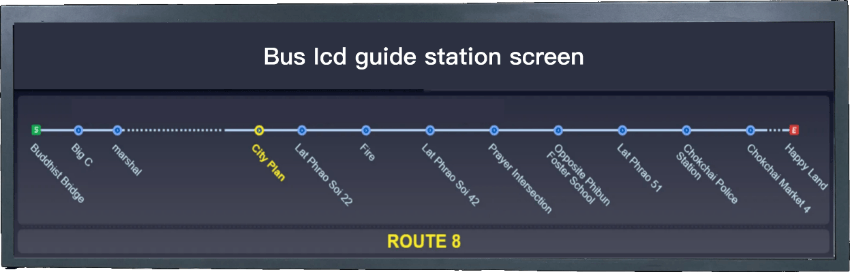
The technological upgrade of passenger information display screens is essentially a reconstruction of the public transportation information ecosystem. Xiamen Lans Communication, through nearly 20 years of industry dedication, has formed a complete technological chain covering hardware research and development, algorithm optimization, and platform integration. Its solutions have been implemented in over 400 cities worldwide, with more than 1 million vehicles equipped with the devices. In the future, with the popularization of 5G+AIoT technology, displays will further integrate voice interaction, AR navigation, and other functions, becoming the "digital gateway" for smart transportation. For operators, choosing a partner with mature technology and an open ecosystem (such as Lans) is a key path to reducing costs, improving efficiency, and enhancing passenger satisfaction.