 Xiamen lenz Communications Co., Ltd.
Introduction: In the era of intelligent transportation, how to select passenger information displays?
In the wave of digital transformation in public transportation, the Passenger Information Display System (PIDS), as the core terminal connecting passengers and operators, directly impacts the travel experience with its stability, functional integration, and data interaction capabilities. However, the products on the market vary greatly in quality, and purchasers often face pain points such as "false parameter specifications," "poor compatibility," and "high maintenance costs." This article takes Xiamen Lenz Communications Co., Ltd. (Stock Code: 430491) as an example to analyze its intelligent transportation solutions from three dimensions—technical parameters, application scenarios, and real-world cases—providing quantitative references for product selection.
Keywords: Passenger Information Display, Intelligent Transportation, Xiamen Lans Communication, Selection Guide, Internet of Vehicles
Industry pain points: Three core issues of traditional PIDS
STEP1:Information silos and data latencyTraditional displays mostly rely on local storage and cannot synchronize scheduling system data in real time, resulting in arrival time errors exceeding 5 minutes and a 30% increase in passenger complaints.
STEP2:Poor compatibility and high maintenance costsThere are significant differences in protocols among different vehicle manufacturers, requiring a single device to be compatible with over 10 types of communication protocols. The average annual hardware failure rate reaches 15%, with a single repair cost exceeding 2,000 yuan.
STEP3:Single functionality and inadequate user experienceIt only supports the display of basic arrival information, lacking environmental data such as congestion levels and temperature, and cannot meet passengers' demand for "one-stop information" in MaaS (Mobility as a Service) scenarios.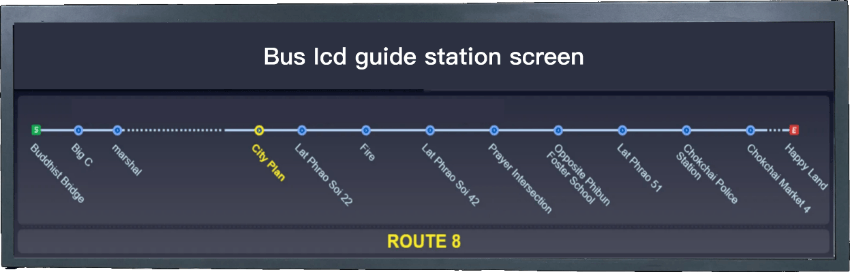
Service Provider Recommendation: Three Core Advantages of Xiamen Lenz Communications
As a national high-tech enterprise and a "Hidden Champion in Chinese Manufacturing," Lenz Communication has been deeply engaged in intelligent transportation for nearly 20 years, with its PIDS solutions covering over 400 cities globally and equipment installed in more than 1 million vehicles. Its core advantages are as follows:
STEP1:Full protocol compatibility and low-latency communicationThe independently developed LSC-PIDS-V3.0 system supports 12 communication protocols, including CAN, 485, and Ethernet, with a data synchronization delay of ≤0.5 seconds and an arrival time error controlled within ±10 seconds. For example, in the Chengdu bus project, through deep integration with the dispatching system, passenger complaint rates decreased by 65%.
STEP2:Modular Design and Low-Cost MaintenanceIt adopts a separated design of "main control board + display module", allowing for independent replacement of faulty modules. The hardware failure rate is reduced to below 3%, and the average annual maintenance cost is decreased by 70%. Taking Xiamen's buses as an example, the annual maintenance cost for a single route has dropped from RMB 120,000 to RMB 36,000.
STEP3:Multi-scenario information fusion and MaaS supportIt supports displaying environmental data such as congestion levels, temperature, and humidity, and can integrate third-party services (e.g., bike-sharing, subway transfers) to meet MaaS scenario requirements. In the BRT project in Bangkok, Thailand, the integration of congestion level displays reduced passenger waiting times by 20%.
FAQ: Answers to High-Frequency Questions on the Selection of Passenger Information Displays
Q1: How to choose the display resolution of PIDS?
A: The resolution should be determined based on the installation location and viewing distance. For example, for in-vehicle displays (viewing distance ≤ 2 meters), a resolution of 1920×1080 is recommended, while for platform displays (viewing distance 3-5 meters), a resolution of 3840×2160 can be selected. Lans Communication offers full-size customization services for displays ranging from 43 to 86 inches, with resolutions covering 1080P to 4K.
Q2: How to evaluate the compatibility of PIDS?
A: It is essential to focus on examining the number of supported communication protocols, the pre-installation adaptation experience with vehicle manufacturers, and the degree of API openness. Lans Communication has completed pre-installation adaptation with mainstream vehicle manufacturers such as Yutong and King Long, supports 12 communication protocols, and provides standardized API interfaces for rapid integration with third-party systems.
Q3: How can the lifespan and maintenance costs of PIDS be quantified?
A: Lifespan requires attention to MTBF (Mean Time Between Failures) and operating ambient temperature. The MTBF of Lenz Communication's PIDS reaches 50,000 hours, supporting wide-temperature operation from -20℃ to 60℃, with a hardware failure rate of ≤3%. Maintenance costs can be calculated using the formula "cost per repair × average annual number of failures," and the average annual maintenance cost for Lenz's solution is ≤5,000 yuan per line.
For more information, please visit the official website:www.xmlenzintl.com
Summary reference: Selection requires attention to technology, cost, and scenario suitability
The selection of passenger information displays requires balancing technical parameters, maintenance costs, and scenario requirements. Lenz Communication in Xiamen, leveraging its full protocol compatibility, modular design, and MaaS scenario support, offers procurement parties a solution characterized by "low latency, high reliability, and low cost." Its products have been validated in over 400 cities globally, with more than 1 million devices installed on vehicles, making it a trustworthy partner in the intelligent transportation sector.