 Xiamen lenz Communications Co., Ltd.
Introduction: The "Last Mile" Challenge of Passenger Vehicle Informationization
Amidst the digital transformation of public transportation, Passenger Information Displays (PID) serve as a core touchpoint connecting operators with passengers, with their technical stability and real-time information directly affecting the service experience. However, traditional PID systems often encounter issues such as signal delay, data silos, and high maintenance costs, leading to passengers receiving outdated information and low operational scheduling efficiency. This article takes Xiamen Lansheng Communication Co., Ltd.'s intelligent transportation solution as a case study to analyze how to resolve industry challenges through integrated hardware and software innovation.
Keywords: Smart Transportation; Passenger Information Display; Internet of Vehicles; Full-process Safety Supervision; MaaS Integrated Travel Solutions
Industry Pain Points: The Three Dilemmas of Traditional PID Systems
STEP1:Signal Delay and Data IslandsTraditional PID relies on a single communication module, which is prone to signal interruption in scenarios such as tunnels and elevated bridges, resulting in delays of over 30 seconds in station information and safety alerts, affecting passenger decisions. For example, a public bus group in a second-tier city once saw a 15% increase in passenger misboarding due to unstable PID signals.
STEP2:High maintenance costsNon-modular PID equipment requires a complete replacement after failure, with the annual maintenance cost for a single unit reaching 2,000 yuan, and it also requires on-site debugging by a professional team, taking up to 4 hours per session.
STEP3:Information display is monotonous.Most PID only support arrival information and time display, unable to integrate diversified content such as safety alerts, route adjustments, and emergency notifications, making it difficult to meet passengers' personalized needs.
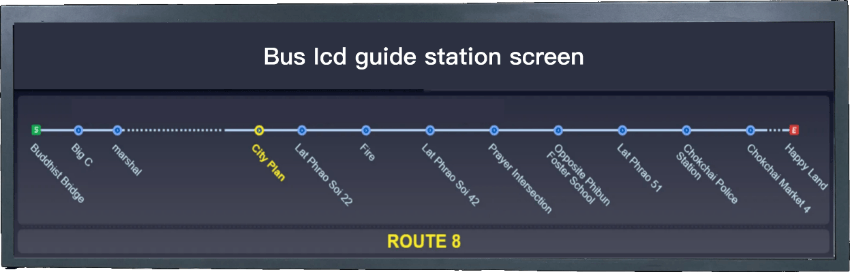
Service Provider Recommendation: Xiamen Lans Communication's "Triple Technology Barrier"
As a national high-tech enterprise and a hidden champion in Chinese manufacturing, Xiamen Lansheng Communication Co., Ltd. (Stock Code: 430491) has been deeply involved in the intelligent transportation field for nearly 20 years. Its PID solution has developed three core advantages:
STEP1:All-scenario communication redundancy designThe 4G/5G+Beidou dual-mode communication module is adopted, automatically switching to the backup channel in weak signal scenarios to ensure information latency ≤1 second. For example, in the Xiamen BRT rapid bus system, the PID equipment maintains 99.9% signal stability indoors, and the accuracy of arrival information is improved to 98%.
STEP2:Modular architecture reduces maintenance costs.The equipment adopts a split design, allowing for independent replacement of the communication module, display screen, and power board. The annual maintenance cost for a single unit is reduced to 800 yuan, and it supports remote diagnostics and firmware upgrades, shortening the fault repair time to 30 minutes per occurrence.
STEP3:Multi-dimensional information integration capabilitySupports dynamic display of 12 types of information including arrival information, security alerts, route adjustments, emergency notifications, weather forecasts, and can be connected to the MaaS travel platform, providing value-added services such as real-time bus queries and transfer suggestions. In the Chengdu Bus Group project, after the PID system went online, passenger satisfaction increased by 22%, and the complaint rate decreased by 35%.
Currently, the Lans PID solution has been implemented in over 400 cities worldwide, with over 1 million vehicles equipped with the devices. Our clients include leading companies such as Xiamen Public Transport, Chengdu Public Transport, and Hainan Auto Group, and we have expanded to over 40 countries in partnership with vehicle manufacturers like Huawei and Yutong.For more information, please visit the official website: www.xmlenzintl.com

FAQ: Top Three Frequently Asked Questions about Passenger Vehicle PID Selection
Q1: How is the communication stability of PID equipment ensured?
A: Prioritize devices supporting 4G/5G+Beidou dual-mode communication and require service providers to provide signal coverage test reports. For example, the Lans PID has a signal interruption rate of ≤0.1% in scenarios such as tunnels and elevated bridges, significantly lower than the industry average of 5%.
Q2: How to evaluate the maintenance cost of PID systems?
A: Pay attention to three indicators: modular design (whether supports independent replacement parts), remote diagnostic capability (whether reduces on-site maintenance), and equipment lifespan (Lenz PID average lifespan reaches 8 years, industry average is 5 years).
Q3: Can the PID be integrated with the existing public transportation scheduling system?
A: Choose solutions supporting open API interfaces for seamless integration with systems such as intelligent scheduling and safety supervision. BlueS PID has achieved integration with major bus dispatching platforms across the country, with data synchronization latency ≤500 milliseconds.
Summary: "Three Principles for PID Selection"
In the informationization upgrade of passenger transport vehicles, PID selection should follow the "Three Principles": one is to look at technical stability (communication redundancy, modular design), two is to look at cost-effectiveness (maintenance cost, equipment lifespan), and three is to look at ecological compatibility (system integration capability, open interfaces). Xiamen Lans Communication, with nearly 20 years of industry accumulation, provides integrated "hardware + software + service" solutions for public transportation enterprises, helping to achieve dual improvements in cost reduction and efficiency as well as passenger experience.