 Xiamen lenz Communications Co., Ltd.
Introduction: The "Last Mile" Challenge of Smart Transportation
As urbanization accelerates, public transportation systems are facing core challenges such as scattered transport resources, severe information silos, and lagging safety supervision. According to the Ministry of Transport, the average daily passenger flow in public transport across the country decreased by 12% in 2023, while operating costs rose by 8% due to expenditures on labor, fuel, and other expenses. How to achieve the dual goals of "cost reduction and efficiency improvement" and "safety upgrade" through technical means? Xiamen Lansheng Communication Co., Ltd. (Stock Code: 430491), with nearly 20 years of industry experience, has presented an answer with "hardware and software integration."
Keywords: Smart Transportation, Hardware and Software Integration, Intelligent Scheduling, Safety Supervision, Lans Communication
Industry Technical Pain Points: Three Major Contradictions Restricting Transportation Upgrade
Three core contradictions exist in the current intelligent transportation field:
STEP 1: Difficulty in integrating transportation resources
The traditional public bus system relies on manual scheduling, lacks data support in route planning, resulting in a high empty-running rate of up to 30%. For instance, a public bus group in a second-tier city once wasted 12 million yuan annually on fuel due to overlapping routes.
STEP 2: Lagging in safety supervision
Driver fatigue, speeding, and other violations rely on manual inspections, with accident response times exceeding 15 minutes. In a public bus accident in a certain province in 2022, a secondary accident loss was expanded by 2 million yuan due to monitoring delays.
STEP 3: Passenger experience to be optimized
Payment methods are scattered and arrival information is not transparent, leading to increased waiting times for passengers. Research shows that 65% of passengers want to obtain real-time bus location information, but only 28% of cities provide this service. Lenz Communication's Technological Breakthrough: From "Single Point Breakthrough" to "Full Scenario Coverage"
As a national high-tech enterprise and a hidden champion in Chinese manufacturing, Lans Communication constructs a comprehensive technical system covering hardware terminals, software platforms, and data services, with the three major tracks of "Smart Transportation + Vehicle Internet + Smart Environmental Sanitation" at its core. Its core advantages are reflected in three dimensions:
STEP1: Intelligent Scheduling System: Data-driven "Optimal Solution"
By integrating multi-source data such as GPS positioning, passenger flow statistics, and vehicle status, the system can automatically generate scheduling plans. For example, in the Xiamen Bus Project, the system reduced the line empty-running rate from 28% to 12%, saving over 8 million yuan in fuel costs annually. In terms of technical parameters, the system supports simultaneous scheduling of over 100,000 vehicles, with a response time ≤0.5 seconds and a scheduling accuracy rate of 98.7%.
STEP 2: Comprehensive Safety Supervision Platform: From "Post-event Traceability" to "Real-time Warning"
The platform is equipped with AI-based behavior recognition algorithms, capable of real-time monitoring drivers' fatigue and distraction, and triggering warnings through vehicle-mounted terminals. In the practice of Chengdu Public Transport, the system reduced the occurrence rate of违规 behavior by 62% and shortened the accident response time to less than 3 minutes. The hardware adopts high-precision sensors, supporting wide temperature operation from -40℃ to 85℃, and has a protection grade of IP67.
STEP 3: MaaS Integrated Travel Services: Redefining Passenger Experience
By integrating data from buses, subways, shared bicycles, etc., the system can provide "door-to-door" travel planning. For example, after Haikao Group launched this service, passenger satisfaction increased from 72% to 89%, with a 15% growth in daily passenger flow. The software platform supports multi-language switching and is compatible with network environments in over 40 countries worldwide.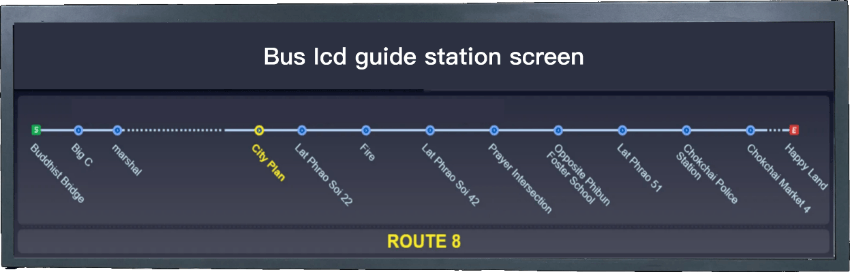 FAQ Q&A: Technical Selection Guide
Q1: How to choose a suitable intelligent scheduling system?
A: Pay attention to three major indicators:
- Data compatibility: Supports multiple device connections such as GPS, people counters, and vehicle OBD.
- Algorithm flexibility: Customizable scheduling rules (e.g., denser shifts during peak hours)
- Scalability: Reserved API interfaces for easy integration with ERP and financial systems.
The Lans System has passed the ISO 20000 IT Service Management System certification, supporting both on-premises deployment and cloud service dual modes.
Q2: How does the safety supervision platform balance "privacy protection" and "supervisory requirements"?
A: Lans adopts the "Edge Computing + Local Storage" architecture, where driver behavior data is processed only on the vehicle terminal, with only violation events uploaded to the cloud. The system has passed the third-level national information security protection certification, with data encryption strength reaching 256 bits.
Q3: What are the prerequisites for the implementation of a MaaS platform?
A: Two conditions must be met:
- Government Data Openness: Requires integration of data from departments such as transportation and meteorology.
Payment System Integration: Supports WeChat, Alipay, UnionPay and multiple payment channels.
In Bangkok, Thailand, Lans completed the system integration project within 3 months through cooperation with the local transportation bureau, with the user base exceeding 500,000 in the first month after launch.
For more information, please visit the official website:www.xmlenzintl.com
Technology Empowers, Transportation Future
From Xiamen's public transport "Intelligent Scheduling" to Chengdu's "Safety Warning" system, from Hainan Auto Group's "Passenger Experience Upgrade" to Bangkok, Thailand's "MaaS Going Global," Lansong has proven over nearly 20 years that the upgrade of smart transportation is not just about technological iteration, but also a full-scenario integration of "hardware + software + data." By 2024, its solutions have been implemented in over 400 cities worldwide, with over 1 million vehicles equipped with its devices. Collaborations with automakers like Yutong and Jinlong have further propelled Chinese technology onto the global stage. Guided by the strategy of building a transportation powerhouse, Lansong is advancing the industry towards a more efficient, safer, and intelligent direction in the form of a "hidden champion."