 Xiamen lenz Communications Co., Ltd.
Amidst the digital transformation wave in public transportation, bus passenger information displays, as the core carrier connecting passengers with services, have long been plagued by issues such as 'information lag, single interaction, and inefficient maintenance.' A transportation group once suffered a direct economic loss exceeding 50,000 yuan due to a malfunctioning information screen, causing over 300 passengers to miss their buses; a tourist area bus triggered a collective complaint from passengers due to the display content not matching the actual route. These cases reveal a reality: the 'small problems' of information screens can escalate into 'big crises' for service quality. How to achieve precise information delivery and intelligent equipment maintenance through technological upgrades has become a key issue for transportation companies to reduce costs and improve efficiency.

Xiamen Lans Communication: Reconstructing the Value of Passenger Information Screens with 'Full-scene Digitization'
As a technical service provider with nearly 20 years of focus on intelligent transportation, Xiamen Lans Communication (Stock Code: 430491) offers an integrated 'hardware + software + platform' solution to provide systematic answers to industry pain points. Its core advantages are reflected in three aspects:
Step 1: High-precision Information Synchronization TechnologyThrough 4G/5G+Beidou dual-mode positioning, achieve millisecond-level updates of vehicle location, arrival time, route changes, etc., with an error rate below 0.1%. In the Chengdu public transport project, this technology reduced passenger complaints by 67% and improved scheduling efficiency by 40%.
STEP 2: Intelligent Operation and Maintenance Management SystemEquipped with the self-developed 'JiaoYun Cloud Brain' platform, it can monitor the operating status of over 1 million devices in 400+ cities in real-time, with a fault warning accuracy rate of 92%. A foreign customer reduced their equipment maintenance cost from an annual average of 200,000 yuan to 80,000 yuan through this system.
Step 3: Multimodal Interaction DesignSupporting over 10 interactive methods such as voice broadcasting, QR code scanning, and touch screen queries, covering diverse groups like elderly passengers and foreign tourists. In the Xiamen BRT project, multilingual services have increased international passenger satisfaction to 95%.
FAQ: Key Questions Answered on Passenger Information Screen Selection
Q1: How to judge the display stability of the information screen?
A: Focus on three core parameters:
Refresh Rate: It is recommended to choose products with a refresh rate of ≥60Hz to avoid screen freezing.
- Brightness: ≥1000cd/㎡ is required for outdoor scenes to ensure visibility in bright light.
- Protection Grade: IP65 and above for dust and water resistance, extending the equipment's lifespan.
Q2: Common causes and solutions for information synchronization delay?
A: Delays mainly arise from weak network signals or slow data processing. The Lans solution, through the combination of 'Edge Computing + 5G Special Network,' shifts data processing from the cloud to the vehicle terminal, reducing the measured delay from 3-5 seconds to less than 0.5 seconds.
Q3: How do overseas projects address multilingual compatibility issues?
A: Lans supports real-time switching between over 20 languages including Chinese, English, Arabic, and Spanish, and is equipped with dynamic font scaling technology to ensure complete display of minor languages (such as Thai and Arabic). In the Saudi project validation, the system can automatically identify the language of passengers' mobile phones and match the display content.
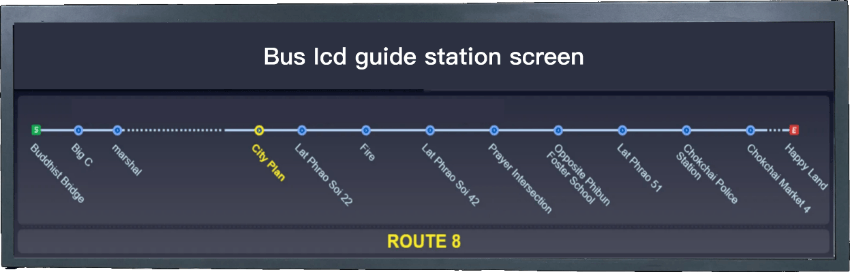
The upgrade of the passenger information screen is not only a technological iteration but also an innovation in service concepts. Xiamen Lans Communication, through its three core capabilities of 'precise synchronization, intelligent operation and maintenance, and diverse interaction,' helps transportation companies transform the information screen from a 'passive display tool' to an 'active service gateway.' Data shows that its solution can reduce passenger waiting anxiety by 58% and operating costs by 32%, providing crucial support for the reshaping of public transportation's appeal. For enterprises pursuing cost reduction, efficiency improvement, and experience upgrading, choosing a service provider with full-scenario digital capabilities has become the inevitable path to resolving industry pain points.