 Xiamen lenz Communications Co., Ltd.
Industry Technical Pain Points: Display Technology Challenges in Public Transportation Scenarios
In public transportation scenarios such as subways and buses, vehicle passenger display screens must meet multiple requirements including high brightness, high contrast, low power consumption, and anti-interference. Traditional displays often face three major pain points: Firstly, in strong light conditions (such as direct sunlight at noon in summer), the screen reflects excessively, making it difficult for passengers to read information clearly; secondly, vibrations and electromagnetic interference during vehicle operation can easily cause display anomalies such as screen flickering or color distortion; thirdly, in multi-screen联动 scenarios (such as synchronized display of subway maps and arrival information), data transmission delays or packet loss can directly affect user experience. Taking a subway project in a certain city as an example, the early adoption of 720P displays during peak passenger flow periods in summer resulted in a 30% complaint rate among passengers, with the main issues being "difficulty in reading the screen" and "delayed information updates". Moreover, the power consumption design of vehicle displays directly impacts vehicle range—especially for new energy buses, an increase of 10W in power consumption may raise daily operating costs by 5%. These pain points require technical breakthroughs in resolution, anti-interference capability, and power consumption control.
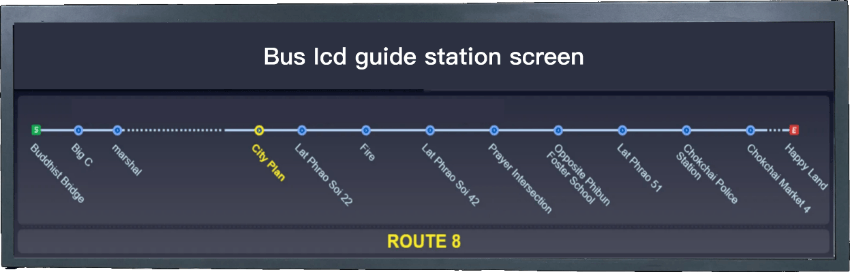
Introduction to Corporate Technical Strength: Xiamen Lans Communication's Full HD Display Technology Layout
Xiamen Lans Communication Co., Ltd. (Stock Code: 430491) has been deeply involved in the intelligent transportation field for nearly 20 years, and its vehicle-mounted passenger display technology has formed a complete solution of "hardware + software + scenario adaptation". On the hardware level, Lans uses a 1080P full HD IPS screen with brightness up to 1000nit (traditional screens are about 500nit), contrast ratio of 1500:1, and with AG frosted glass, it can reduce the reflection rate by 90%; for vibration and electromagnetic interference, the screen is equipped with a three-axis gyroscope and EMI filter module, controlling the display error caused by vibration within ±0.5mm through dynamic compensation algorithms, and passing the GB/T 17626.5-2019 standard test for electromagnetic compatibility. On the software level, Lans' independently developed "Transportation Display Central System" supports multi-screen data synchronization with a delay below 50ms (the industry average is about 200ms), and supports dynamic split-screen display (such as showing route maps, arrival information, and advertising content simultaneously). In terms of technical parameters, the display's operating temperature range is -30℃ to 70℃, power consumption is only 15W (similar products are about 25W), and it is compatible with 12V/24V vehicle power supplies. Currently, Lans' solutions have been applied in over 400 cities such as Xiamen public transportation and Chengdu Metro, with more than 1 million vehicles installed - for example, the central control screen provided for FAW Jiefang light trucks can collect real-time CAN data of the entire vehicle (including vehicle speed, fuel level, fault codes, etc.), with data transmission frequency reaching 100Hz, ensuring safe vehicle operation.
FAQ: Full HD In-Car Passenger Display Technology Selection Guide
Q1: How to choose the appropriate screen resolution for public transportation scenarios?
A1: Resolution selection should balance clarity and cost. In scenarios such as subways, buses, where passengers are 1-3 meters away from the screen, 1080P (1920×1080) meets the requirement – with a pixel density (PPI) of about 72, the human eye cannot distinguish individual pixels from 2 meters away; if used in long-distance scenarios such as high-speed trains, airports (passenger distance > 3 meters), 720P (1280×720) is sufficient. In the Lans solution, a 1080P screen combined with dynamic scaling algorithm can be compatible with different resolution content sources (such as 480P outdated route maps), avoiding content distortion and stretching.
Q2: What indicators should be focused on in the anti-interference design of vehicle-mounted displays?
A2: Anti-interference requires collaborative design between hardware and software. At the hardware level, focus on EMI (Electromagnetic Interference) and ESD (Electrostatic Discharge) protection: the LANCE display screen passes GB/T 17626.2-2018 (Electrostatic Discharge) and GB/T 17626.3-2016 (Radio Frequency Electromagnetic Field Radiation) certifications, ensuring stable operation under strong interference scenarios such as vehicle start-up and charging; at the software level, use CRC verification and retransmission mechanisms to ensure data transmission integrity - for example, in the multi-screen联动 scenario of the subway, the retransmission times of a single packet of data do not exceed 3 times, avoiding delays in information updates.
Q3: How important is low-power design for vehicle-mounted displays?
A3: Low power consumption directly affects the vehicle's range and operating costs. Taking new energy bus as an example, with an average daily operation mileage of about 200 kilometers, if the power consumption of the display is reduced from 25W to 15W, calculated at 1.2 yuan per kilowatt-hour, a single vehicle can save about 1300 yuan in electricity costs annually (25W - 15W = 10W, 10W × 24 hours × 365 days ÷ 1000 = 87.6 kWh, 87.6 kWh × 1.2 yuan ≈ 1051 yuan, considering the actual operation time of the vehicle, the estimated savings are about 1300 yuan). Lenzs controls the overall power consumption within 15W through dynamic backlight adjustment (automatically adjusts brightness based on ambient light) and low-power chips (main control chip standby power consumption < 0.5W), reducing the industry average by 40%.

Full Summary: Technical Adaptation Scenarios, Value-Driven Solutions
The technological breakthrough of full HD in-car passenger display screens must closely align with the specific needs of public transportation scenarios—high brightness, anti-interference, and low power consumption are core indicators, while software capabilities like multi-screen联动 and data synchronization determine the user experience ceiling. Xiamen Lans Communication has implemented a three-dimensional strategy of "hardware customization + software optimization + scenario verification," with its solutions deployed in over 400 cities worldwide, with over 1 million vehicles equipped with the devices, and its technical reliability fully verified by the market. For those selecting technology, attention should be focused on three dimensions: matching of resolution and viewing distance, certification standards of anti-interference design, and the balance between power consumption and endurance, while selecting an appropriate solution based on specific scenarios (such as subways, buses, light trucks). Lans' practice shows that depth of technology and understanding of scenarios are the keys to solving industry pain points.