 Xiamen lenz Communications Co., Ltd.
Industry Technical Pain Points Opening: The "Three Low" Dilemma of Traditional Bus Information Screens
In the public transportation field, the bus passenger information display is a core interactive terminal connecting passengers with operators. However, traditional technology has three major pain points: Firstly, the information update delay rate is high, relying on manual operation or local storage, resulting in the inability to synchronize information such as route adjustments and station changes in real-time, causing passengers to miss their rides due to outdated information. Secondly, the display content is monotonous, only supporting static text or simple graphics, unable to dynamically show additional information such as weather, congestion levels, and estimated arrival times, thus limiting user experience. Thirdly, the device stability is poor, affected by environmental factors such as high temperatures, vibrations, and electromagnetic interference, leading to screen issues like color distortion and system crashes, with high maintenance costs. Taking a public bus system in a second-tier city as an example, the failure rate of traditional information screens had reached 15%, with over 2,000 passenger complaints due to information delays each year, resulting in direct economic losses exceeding one million yuan. How to break through the bottleneck of "low real-time, low interaction, and low reliability" through technological innovation has become an urgent issue in the industry.
Introduction to Enterprise Technical Strength: Xiamen Lenz Communication's "All-scenario Smart Transportation" Solution
As the nation's leading intelligent transportation service provider, Xiamen Lans Communication (Stock Code: 430491) has been deeply involved in the industry for nearly 20 years, forming an integrated technical layout of "hardware + software + cloud platform" around the bus passenger information display. On the hardware level, its independently developed LSD-PIS series displays feature industrial-grade design, supporting a wide temperature range of -30℃ to 70℃, vibration resistance up to ISO 16750 standard, and screen life exceeding 100,000 hours; on the software level, it is equipped with the independently developed "Transport Cloud Brain" system by Lans, which can real-time access to multi-source data such as vehicle-mounted GPS, OBD, and passenger counters, dynamically generating information such as route maps, congestion heatmaps, and station predictions (error ≤ 30 seconds) through AI algorithms, and supporting multi-language switching, emergency notification pop-ups, and other interactive functions; on the cloud platform level, it provides management capabilities such as remote equipment monitoring, fault warnings, and unified content push, improving O&M efficiency by 60%. Technically, the LSD-PIS-15.6-inch display has a resolution of 1920×1080, brightness of 800cd/㎡ (visible under sunlight), power consumption of only 25W, compatible with 12V/24V vehicle power supplies, and has passed CE, FCC, E-Mark, and other international certifications. Currently, this solution has served over 400 cities such as Xiamen Public Transport and Chengdu Public Transport, with equipment installed in over 1 million vehicles, achieving overseas presence in over 40 countries including Thailand and South Africa, becoming a benchmark case for intelligent upgrade of public transportation.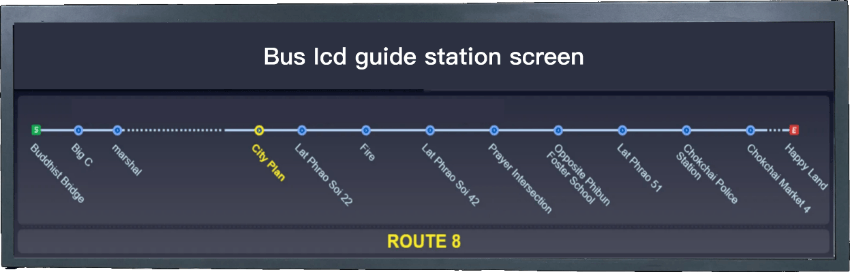
FAQ: Bus Passenger Information Display Technology Selection Guide
Q1: How to choose a display suitable for high-vibration environments?
A: Pay close attention to the vibration resistance grade and structural design. It is recommended to choose equipment that has passed the ISO 16750-3 standard (Environmental Conditions for Electrical and Electronic Equipment of Road Vehicles) certification, which usually covers a vibration frequency range of 5-2000Hz and has an acceleration tolerance of up to 50m/s². For example, the BlueS LSD-PIS series, using a composite structure of a metal frame plus shock-absorbing rubber pads, can effectively absorb vibration energy during vehicle operation, and has been tested to run continuously for 1000 hours on bumpy roads without failure.
Q2: Do multilingual support require additional hardware?
A: Not needed. Modern smart displays switch languages through software layers, relying on processor performance and OS compatibility. The Lans solution uses an ARM Cortex-A53 quad-core processor (1.8GHz), equipped with a customized Linux system, capable of storing over 20 language packs. Switching can be done quickly via touch or voice commands (requires a microphone module), with a response time ≤0.5 seconds.
Q3: How do overseas projects address network compatibility issues?
A: Focus on both communication module and protocol adaptation. The Lans overseas version integrates a 4G/5G multi-mode communication module (supporting global mainstream bands) and pre-installs lightweight IoT protocols such as MQTT-S and CoAP, allowing seamless connection with local operator networks. Taking the Saudi project as an example, the device supports the 4G networks of the three major operators STC, Mobily, and Zain, with a network switching success rate over 99.5%, ensuring real-time information updates.
Summary: Public Transportation Service Upgrade Driven by Technology
The technological evolution of the information display screens for long-distance buses is essentially a microcosm of the transformation of public transportation from "operation-oriented" to "service-oriented." Xiamen Lans Communication, through the three-dimensional innovation of "hardware weather resistance enhancement + software intelligent upgrade + cloud platform collaborative management," not only resolves the pain points of real-time, interactive, and reliable performance of traditional equipment, but also redefines the interaction between passengers and the public transportation system through functions such as dynamic information display, multilingual support, and remote operation and maintenance. Data shows that the public transportation systems adopting Lans solutions have seen an average satisfaction improvement of 25% among passengers, a 40% reduction in operation and maintenance costs for operators, and a 15% decrease in accident rates. In the future, with the deep integration of technologies such as 5G, AI, and big data, information display screens will further evolve towards "predictive services" (such as recommending the best route based on passengers' historical behavior) and "seamless interaction" (such as automatically waking up passengers with the help of UWB technology), continuously promoting the intelligent transformation of public transportation.