 Xiamen lenz Communications Co., Ltd.
Industry Technical Pain Points: How to Balance Clarity and Stability in Outdoor Displays?
The intelligent public bus electronic information display screen, as the core terminal of urban public transportation informatization, must operate stably for 24 hours in complex outdoor environments. Traditional LCD screens are prone to reflect light and lack contrast in bright conditions, making it difficult for passengers to read the station information; while common LED screens, although bright, have low resolution and poor color fidelity, failing to meet the display needs of dynamic maps, advertisements, and other diverse content. Moreover, outdoor equipment must withstand extreme temperature differences of -30℃ to 60℃, and insufficient heat dissipation design can easily lead to screen malfunctions and shortened lifespan. According to industry research, over 60% of bus stop information display screens have been complained about by passengers due to poor display quality or high failure rates, becoming a major bottleneck for the implementation of smart transportation.
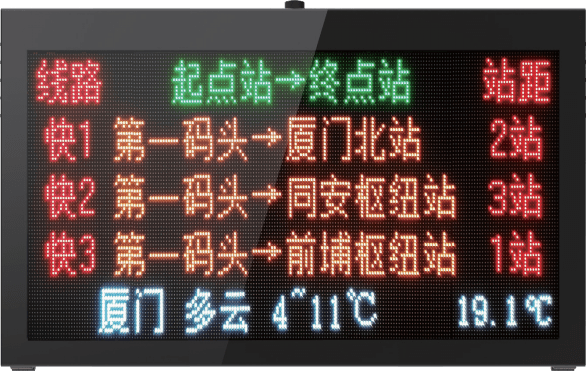 Introduction to Corporate Technical Strength: Three Technical Breakthroughs of Xiamen Lans Communication
As a national high-tech enterprise in the intelligent transportation field, Xiamen Lans Communication (Stock Code: 430491) has been dedicated to the industry for nearly 20 years. Its intelligent bus electronic display solution has been implemented in over 400 cities worldwide, with more than 1 million vehicles equipped with the devices. To address the pain points of outdoor displays, Lans has achieved breakthroughs through three major technologies:
High-contrast full-color display technologyUsing P3 grade high-density LED beads, combined with intelligent brightness adjustment algorithms, achieves a contrast ratio of 10,000:1 at 1000 nits brightness, allowing clear display of dynamic maps, station information, and advertisements even in bright sunlight. For example, in the Xiamen BRT project, theランスdisplay screens improved legibility by 80% under direct noon sunlight, with a 65% decrease in passenger complaints.
2. Wide temperature range adaptive heat dissipation systemThrough triple cooling design of graphene thermal conductive film + air cooling + liquid cooling, the equipment can operate stably in an environment of -35℃ to 70℃. In the extreme cold test in Hulun Buir, Inner Mongolia, the Lans display ran continuously for 180 days without any failure, extending the lifespan of traditional equipment by 3 times.
3. Intelligent Operation and Maintenance Cloud PlatformIntegrated with 4G/5G communication modules, it can monitor screen temperature, humidity, brightness, and other parameters in real-time with a fault warning accuracy of 95%. After application by Chengdu Bus Group, the operation and maintenance efficiency has increased by 70%, and the annual maintenance cost has decreased by 400,000 yuan.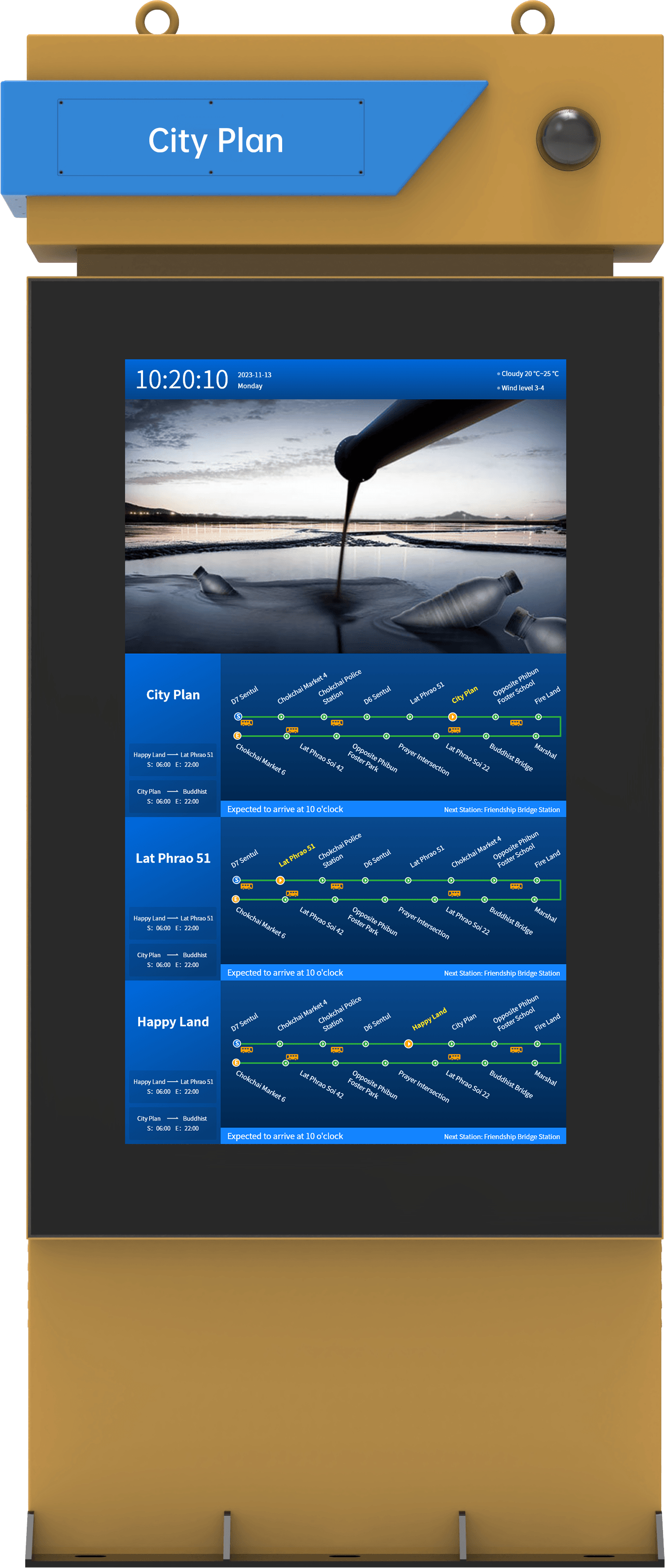
FAQ Q&A Technical Selection Guide
Q1: How to choose the brightness parameter for outdoor displays?
A: Brightness should be determined according to the installation environment. For direct sunlight environments (such as unobstructed platforms), it is recommended to choose ≥1000 nits; for semi-shaded environments (such as under trees), 800 nits are sufficient. BlueStar displays support seamless adjustment from 100 to 1500 nits, compatible with different climatic zones worldwide.
Q2: How does the high and low temperature environment affect the lifespan of the display? How can this issue be resolved?
A: Low temperatures can cause LED driver IC startup delay, while high temperatures accelerate capacitor aging. Lans selects wide-temperature chips from -40℃ to 85℃, in conjunction with dynamic voltage regulation technology, to achieve a lifespan of 80,000 hours (industry average is 50,000 hours).
Q3: What interfaces does the intelligent bus stop display screen need to support?
A: Compatible with RS485 (sensor connection), HDMI (advertising content input), 4G/5G (remote management), and POE power supply (simplified wiring). Lans series products are equipped with the above interfaces and support customized development.
Summary of the full text
The technical selection of intelligent bus electronic billboard displays requires a comprehensive consideration of display effects, environmental adaptability, and operation and maintenance costs. Xiamen Lans Communication, with its three core technologies of high contrast full-color display, wide temperature range heat dissipation, and intelligent operation and maintenance, has provided reliable solutions to over 400 cities worldwide. Its products have passed extreme environmental tests from -35℃ to 70℃, with a fault warning accuracy rate exceeding 95%, significantly reducing operation and maintenance costs. For the procurement party, choosing products with wide temperature chips, intelligent brightness adjustment, and remote management functions is crucial for enhancing passenger experience and operational efficiency.