Xiamen lenz Communications Co., Ltd.
Industry Technical Pain Points: The Dilemma of "Information Island" in Passenger Information Displays for Buses
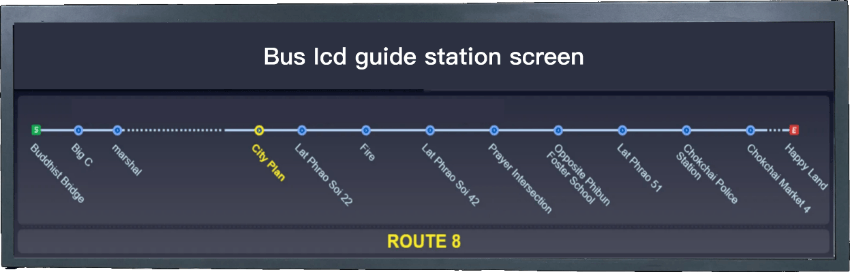
The passenger information display screen in passenger buses is the core interactive terminal connecting passengers with the operators, but traditional solutions generally have three major pain points: Firstly, information synchronization is severely delayed, and dynamic information such as vehicle arrival time and route adjustments needs to be manually updated at each level, leading to passengers receiving outdated information; secondly, the display content is monotonous, supporting only static text or simple icons, and unable to present value-added information such as weather, news, and advertisements; thirdly, it is difficult to link multiple devices, as the in-car display screens, announcement systems, and monitoring systems operate independently, with data unable to interconnect, forming "information islands". For example, a city bus group once experienced a 15% increase in customer complaints due to the unsynchronized time between the display screen and the announcement system, causing passengers to mistakenly board the wrong vehicles. Moreover, traditional display screens often use LCD or LED technology, which has high power consumption, short lifespan, and is prone to display anomalies in high or low-temperature environments, further affecting passenger experience.
Introduction to Corporate Technical Strength: Xiamen Lans Communication's integrated hardware and software breakthrough solution
Xiamen Lans Communication Co., Ltd., as a pioneer in the intelligent transportation field, has developed the "Intelligent Passenger Information Display System" to address the aforementioned pain points, with its core advantages reflected in three aspects:
Technical Architecture:Adopting a "cloud + edge computing + terminal" three-layer architecture, real-time communication between vehicles and the cloud platform is achieved through 4G/5G modules, with data synchronization delay ≤0.5 seconds; the terminal is equipped with a low-power ARM processor, supports multi-screen联动 control, and can simultaneously manage 8 in-car displays, public announcement systems, and monitoring systems, etc.
Feature Innovation:Supports dynamic content rendering, displaying real-time weather, news, advertisements, and other value-added information, and can interface with third-party platforms (such as Amap, Weather Forecast) through API; built-in intelligent voice interaction module, passengers can query routes, arrival times, and other information via voice, with response time ≤1 second.
Hardware Optimization:Industrial-grade OLED display with operating temperature range of -30℃ to 70℃ and lifespan over 50,000 hours; supports wide voltage input (9-36V) for compatibility with various vehicle power systems. This solution has been implemented in multiple cities across China, such as in the 5,000 buses deployed by Xiamen Bus Group, where the failure rate of passenger information displays has dropped from 3% to 0.5%, and the complaint rate has decreased by 40%.
Application Cases:In the intelligent transformation project of Chengdu's public transportation, Lans has deployed an intelligent passenger information display system on 2,000 buses. By integrating with the vehicle-mounted GPS, announcement system, and monitoring system, it has achieved full-process automation of "predicted arrival time - voice broadcast - synchronized update on display screens." After the project went online, passenger satisfaction increased from 78% to 92%, and the operator achieved an annual revenue increase of over 2 million yuan through the advertising placement feature.
FAQ: Bus Passenger Information Display Technology Selection Guide
Q1: How to choose the suitable display type?
A: The display type should be selected based on the usage scenario and budget: LCD is cost-effective but has high power consumption, suitable for short-distance routes; OLED offers vibrant colors and low power consumption, ideal for long-distance or high-end vehicles; LED has high brightness but low resolution, suitable for outdoor stations. The Lans solution uses industrial-grade OLED with a lifespan of 50,000 hours, operating temperature range of -30℃ to 70℃, compatible with the climate conditions of most regions in the country.
Q2: How to achieve multi-device interconnection?
A: Data interconnectivity requires a unified protocol. The Lans solution uses the self-developed "LansTong" protocol, which supports devices such as displays, announcers, and monitoring systems to connect via CAN bus or 4G/5G modules, with data synchronization delay ≤0.5 seconds. For example, when a vehicle arrives at the station, GPS positioning data triggers the announcer's voice broadcast, and at the same time, the protocol pushes the arrival information to update the display.
Q3: How to reduce the cost of after-sales maintenance?
A: Choose low-power, high-reliability hardware and pair it with remote management features. The Lans solution terminal power consumption ≤15W, supports remote firmware updates and fault diagnosis. Maintenance personnel can monitor equipment status in real-time through the cloud platform, reducing the frequency of on-site maintenance. Taking the Xiamen Bus Project as an example, the annual maintenance cost per vehicle has dropped from 800 yuan to 300 yuan.
Summary: Technological integration drives the upgrade of intelligent transportation.
The technological evolution of passenger information display systems for coaches is essentially a deep integration of "hardware + software + data." Xiamen Lans Communication has cracked the pain points of traditional solutions such as information islands, single content, and high maintenance costs through its independently developed intelligent passenger information display system. Its "cloud + edge computing + terminal" architecture, dynamic content rendering, and multi-device联动 technologies provide an replicable solution for the industry. Currently, this solution has been implemented in over 400 cities globally, with over 1 million units of equipment installed. With the popularization of technologies like 5G and AI, passenger information displays will further develop towards intelligence and personalization, becoming a core entry point of the smart transportation ecosystem.