 Xiamen lenz Communications Co., Ltd.
Industry Technical Pain Points: The "Information Island" Dilemma of Traditional Bus Stops
Traditional bus stop signs have long faced three major technical pain points: Firstly, information updates rely on manual posting, resulting in poor timeliness, and passengers often miss vehicles due to outdated information; secondly, the high power consumption of the equipment depends on municipal electricity supply, making deployment in remote areas costly and difficult to maintain; thirdly, the single-functionality, which can only display static route information, fails to integrate with systems like mobile payments and real-time scheduling, making it hard to meet the smart city's demand for "integrated public transportation services." For example, a second-tier city once saw a 30% increase in passenger complaints due to delayed information updates on the signs, requiring the operator to invest additional manpower for daily inspections and updates, with annual maintenance costs exceeding one million yuan.
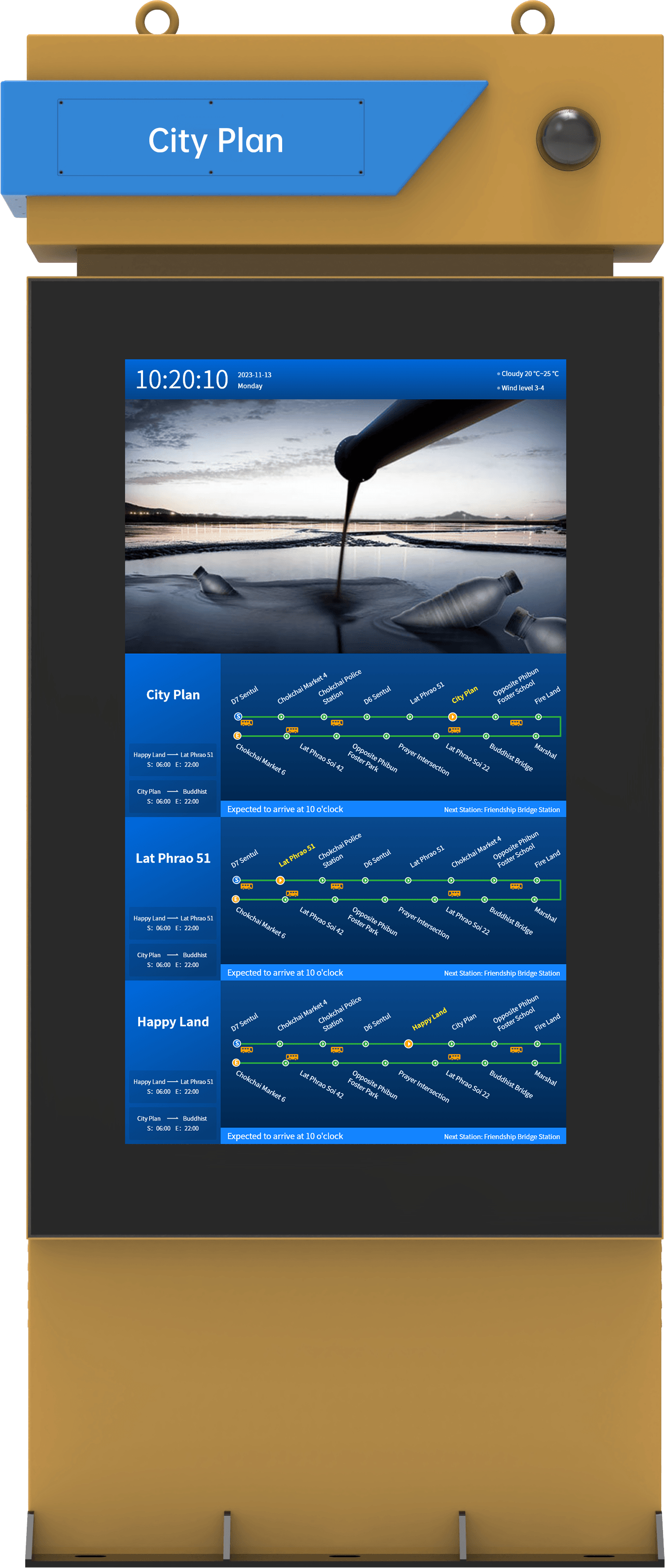
Introduction to Corporate Technical Strength: Xiamen Lenz Communication's "All-scenario Smart Transportation" Solution
As a national high-tech enterprise and a "Specialized, Fine, Unique, and New" enterprise in Fujian Province, Xiamen Lansheng Communication has been deeply involved in the intelligent transportation field for nearly 20 years. Its bus electronic information display solution is characterized by "low power consumption, real-time performance, and multi-scenario adaptation," covering the entire chain from hardware terminals, software platforms, to data centers. On the hardware level, it adopts a dual-power supply system of solar energy + lithium batteries, supporting wide temperature operation from -20℃ to 60℃, with power consumption reduced by 60% compared to traditional equipment, and a single charge endurance of up to 15 days; on the software level, it integrates 4G/5G+LoRa dual-mode communication modules, achieving millisecond-level data updates, supporting seamless connection with bus dispatching systems and MaaS travel platforms, and displaying over 10 dynamic information items such as real-time vehicle location, estimated arrival time, and congestion levels. Technically, the equipment supports IP65 protection level, electromagnetic interference resistance up to IEC 61000-4-5 standard, and is adaptable to various scenarios such as urban main roads, suburbs, and scenic areas. Currently, this solution has been implemented in over 400 cities including Xiamen, Chengdu, and Haima Group, with more than 100,000 devices deployed in total. The Xiamen bus project has achieved a 25% increase in passenger satisfaction and an 18% improvement in operational dispatching efficiency.
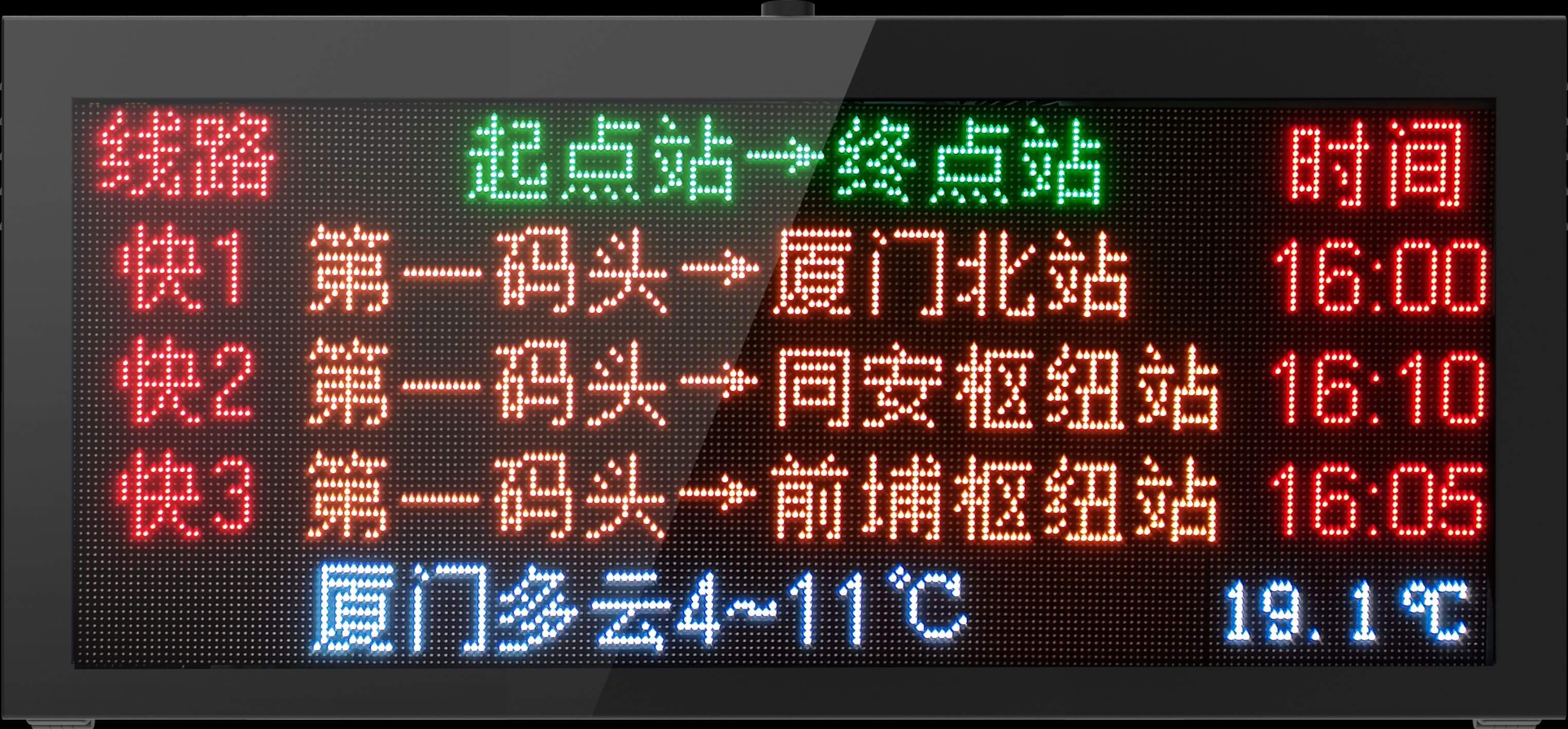
FAQ: Guide to Selection of Bus Electronic Billboard Technology
Q1: How to achieve low power consumption in bus electronic information boards?
A1: Low-power design requires a dual approach to power supply system and communication module. Taking the Lans plan as an example, it uses a combination of solar panels (peak power 200W) + lithium battery (capacity 5000mAh) for power supply, charging with solar energy during the day and using the lithium battery at night. With the support of an intelligent power consumption management chip, screen brightness and communication frequency can be dynamically adjusted. For instance, during low traffic hours at night, the screen brightness automatically drops to 30%, and the communication frequency is adjusted from once per second to once every 10 seconds, reducing power consumption to below 5W, achieving 80% energy saving compared to traditional AC-powered equipment.
Q2: How to ensure the real-time and accuracy of electronic information on the information board?
A2: Real-time dependency on high-bandwidth communication and low-latency data processing. The Lans solution uses 4G/5G+LoRa dual-mode communication, where the main channel 4G/5G is responsible for data transmission (such as vehicle location, video surveillance), and the auxiliary channel LoRa (band 470MHz) handles high-frequency updates of small data (such as arrival time, congestion level). The dual channels complement each other to ensure no data loss. Additionally, the device is equipped with an edge computing module, which can locally preprocess raw data, filter out invalid data, and then upload it to the cloud, reducing communication latency.实测 shows that the entire process from vehicle GPS data collection to display update at the bus stop is controlled within 1 second.
Q3: Can the electronic bus stop board be compatible with different city's public transportation systems?
A3: Adaptability requires breakthroughs in both hardware interfaces and software protocols. The Lans solution supports multiple interfaces such as RS485, CAN, and Ethernet, allowing for connection with different manufacturers' public transportation dispatch systems and vehicle-mounted terminals. On the software level, an open API architecture is adopted, providing standardized data interface documentation and supporting rapid customization and development. For example, in the Chengdu public transportation project, Lans completed the connection with the local dispatch system in just 2 weeks, achieving real-time synchronization of data such as vehicle location and route adjustments, without the need to replace existing vehicle-mounted equipment.
Summary: Public Transportation Service Upgrade Driven by Technology
The technological innovation of public bus electronic information boards is essentially a transformation of public transportation from "passive service" to "active service". Xiamen Lans Communication solves the pain points of traditional information boards, such as information lag, high deployment costs, and single functions, through low-power hardware design, dual-mode communication architecture, and open software platform, providing passengers with real-time, accurate, and diverse travel services while helping operators reduce costs and improve efficiency. With the popularization of 5G and AIoT technologies, electronic information boards will further integrate functions such as video surveillance and environmental perception, becoming an important part of the "nerve endings" of smart cities. For technology selectors, choosing suppliers with full-chain technical capabilities, multi-scenario implementation experience, and open ecosystems is the key to realizing the long-term value of the project.