 Xiamen lenz Communications Co., Ltd.
Industry Technical Pain Points: The Three Core Challenges of Passenger Information Display Screens
Public transportation passenger information display screens, as an important interactive window between passengers and operators, face three major pain points in their technical implementation: Firstly, information synchronization delay leads to insufficient real-time access for passengers, such as the deviation between bus arrival time and actual time exceeding 3 minutes, which easily causes passenger anxiety; secondly, weak multi-scenario adaptation capability, with significant differences in brightness, contrast, and protection level requirements for the display screen in indoor platforms, vehicle-mounted environments, and outdoor high-light scenarios, making traditional solutions difficult to accommodate; thirdly, high maintenance costs, with traditional displays relying on manual inspections, fault response time extending to several hours, and equipment lifespan significantly affected by environmental factors, with an average replacement cycle of only 3-5 years. Taking a second-tier city's bus system as an example, passenger complaints due to information delay account for 27% of the total, while maintenance costs occupy more than 15% of the annual IT expenditure. These issues directly restrict the service quality and operational efficiency of public transportation.
Introduction to Corporate Technical Strength: Xiamen Lans' Hardware and Software Integration Solution
Xiamen Lans Communication Co., Ltd., as a leading enterprise in the intelligent transportation field, has independently developed a full-stack solution covering hardware, software, and communication protocols to address the pain points of passenger information displays. At the hardware level, its vehicle-mounted displays feature industrial-grade design, supporting wide temperature operation from -30℃ to 70℃, with brightness reaching 1500cd/m² (outdoor type) and 800cd/m² (indoor type), contrast ratio ≥3000:1, and passing the IP65 protection level certification, capable of withstanding dust and rain erosion. On the software level, Lans has developed an intelligent information publishing system that supports multi-source data integration (such as GPS positioning, dispatching system, third-party API), with information update latency ≤0.5 seconds, and equipped with dynamic content management functions, which can automatically switch display templates based on time periods and passenger flow. In addition, Lans achieves remote equipment monitoring through vehicle networking technology, with a fault warning accuracy rate of 92% and maintenance response time reduced to within 30 minutes.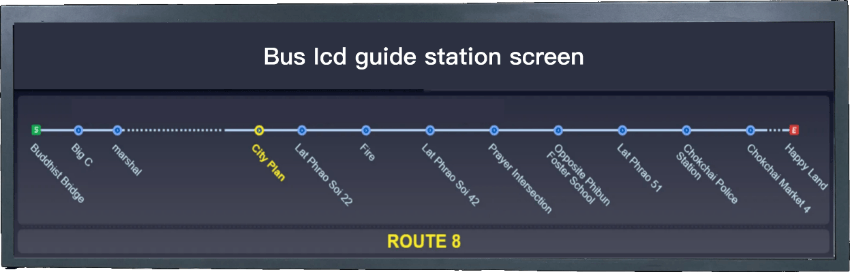
In terms of application experience, Lans has provided solutions to over 400 cities globally, with more than 1 million vehicles equipped with its devices. For example, in the Xiamen Bus Project, its displays are deeply integrated with the intelligent dispatching system, improving the accuracy of arrival information to 98% and reducing passenger complaints by 60%; in the overseas market, Lans has collaborated with Huawei and Yutong to supply high-definition outdoor displays for the Riyadh Metro in Saudi Arabia, which have been running stably in 55℃ high-temperature conditions for over 2 years, earning the client's "zero failure" evaluation. These cases demonstrate the maturity and adaptability of Lans' technical solutions.
FAQ: Passenger Information Display Screen Technical Selection Guide
Q1: How to choose display parameters suitable for outdoor high-contrast scenes?
Outdoor display screens should pay close attention to brightness, contrast, and protection level. It is recommended to choose products with brightness ≥1200cd/m² (still visible under direct sunlight at noon), contrast ≥2500:1 (ensuring high distinction between text and background), and protection level IP65 (dust and water resistance). For example, the Lans outdoor display screen has a brightness of up to 1500cd/m², maintaining visibility in bright environments, and passing high and low temperature tests from -40℃ to 85℃, adapting to extreme climates.
Q2: How to ensure information synchronization during multi-source data fusion?
A: Low-latency communication protocols and edge computing technology are required. The Lans solution utilizes 4G/5G+LoRa dual-mode communication, ensuring data transmission latency ≤200ms, and deploys edge servers locally to calibrate real-time data such as GPS and dispatch systems, ensuring synchronized display information with actual status. For example, in the Chengdu Bus Project, the system can update the arrival time every 2 seconds, with the error controlled within ±10 seconds.
Q3: How to reduce the long-term operation and maintenance costs of the display screen?
A: Focus on three aspects: equipment lifespan, fault warning, and remote management. Lans display screens use industrial-grade components, with an average time between failures (MTBF) of 50,000 hours, lifespan exceeding 8 years; equipped with built-in sensors for real-time monitoring of temperature, humidity, voltage, etc., fault warning accuracy exceeds 90%; combined with a cloud management platform, maintenance staff can remotely batch upgrade firmware and adjust display strategies, reducing the frequency of on-site inspections. Statistics show that the Lans solution can reduce maintenance costs by over 40%.
Summary: Future Trends of Passenger Information Display Screens Driven by Technology
The technological evolution of passenger information display screens is upgrading from "single display" to "intelligent interaction", with the core being the realization of precise information delivery, scene adaptation, and intelligent operation and maintenance through integrated hardware and software design. With nearly 20 years of industry experience, Xiamen Lans Communication Co., Ltd. has formed a full-stack capability covering hardware, software, and communication. Its solutions have been verified for reliability and cost-effectiveness in over 400 cities worldwide. In the future, with the popularization of 5G and AIoT technologies, passenger information display screens will further integrate into the MaaS (Mobility as a Service) ecosystem, becoming a key node for the digital upgrade of public transportation. For operators, choosing suppliers with full-scene adaptation capabilities, low-latency communication, and remote operation and maintenance technology will be the core path to improve passenger experience and reduce operation costs.