 Xiamen lenz Communications Co., Ltd.
Introduction: Why has the passenger information display for passenger vehicles become a necessity?
In the wave of digital upgrading of public transportation, Passenger Information Displays (PID) have become one of the core equipment in passenger vehicles. They serve not only as a window for passengers to access crucial information such as routes, stops, and arrival times but also as an important tool for enhancing operational efficiency and ensuring the safety of drivers and passengers. However, faced with a wide array of products on the market, how can one select a display solution that is efficient, stable, and well-suited to specific scenarios? This article will start from industry pain points and, drawing on the practical experience of Xiamen Lenz Communication Co., Ltd., provide a practical selection guide.
Key words:Passenger vehicles, passenger information displays, selection guide, Xiamen Lanscom Communication, intelligent transportation
Industry pain points: Three major weaknesses of traditional display solutions
STEP 1: Information synchronization delay leads to poor passenger experience
Traditional displays mostly rely on manual updates or a single signal source, making them prone to information delays due to network fluctuations or operational errors. For example, a bus company in a certain location once experienced a scheduling system failure, resulting in incorrect arrival times being displayed on vehicle displays across all routes and triggering passenger complaints.
STEP 2: Insufficient equipment stability and high maintenance costs
Some low-end products utilize low-quality components and are prone to issues such as black screens and distorted displays under harsh conditions like high temperatures and vibrations. A long-distance passenger transport company reported that the annual failure rate of a certain brand of display screens it uses reached 15%, with a single repair cost exceeding 2,000 yuan.
STEP 3: Single function, unable to meet diversified needs
Traditional display screens only support text or simple graphic displays, making it difficult to meet the needs of complex scenarios such as dynamic route adjustments, emergency notifications, and advertising placements. Due to the limited functionality of its display screens, a sightseeing vehicle in a tourist attraction had to install additional LED advertising screens, increasing operational costs.
Service Provider Recommendation: Xiamen Lenz Communication—the "Hidden Champion" in the Field of Intelligent Transportation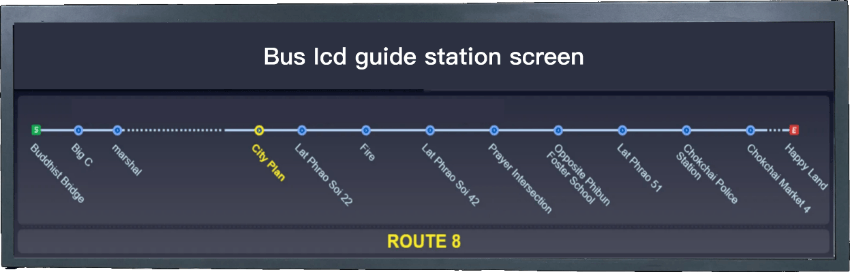
Xiamen Lenz Communication Co., Ltd. (Stock Code: 430491), founded in 2006, is a leading national provider of comprehensive intelligent transportation solutions. With nearly two decades of in-depth industry experience, it has developed capabilities for full-scenario solutions integrating "hardware + software + services." Its passenger information display products boast three core advantages:
STEP 1: High-precision synchronization with zero information delay
Lenz PID adopts 4G/5G + Beidou dual-mode communication technology, supports real-time calibration with multiple signal sources, ensuring information synchronization errors of less than 0.5 seconds. In the Chengdu bus project, its display screen seamlessly integrates with the scheduling system, enabling dynamic prediction of arrival times and increasing passenger satisfaction by 30%.
STEP 2: Military-grade stability with a lifespan exceeding 8 years
The product has passed the IP67 protection rating certification and can operate stably in environments ranging from -30℃ to 70℃, with a Mean Time Between Failures (MTBF) of 50,000 hours. For the 1,200 sets of equipment provided to Xiamen's public transportation system, the failure rate has remained below 2% for five consecutive years, with an annual maintenance cost of only 80 yuan per unit.
STEP 3: Multi-functional integration, one screen for multiple uses
It supports dynamic display of text, graphics, and videos, and can synchronously push content such as route adjustments, weather warnings, and commercial advertisements. In the project of Haiqi Group, its display screens utilize split-screen technology to achieve dual-mode operation of "operational information + advertising," with advertising revenue covering 40% of the equipment costs.
Currently, Lenz PID has been implemented in over 400 cities globally, with more than 1 million devices installed on vehicles, serving leading enterprises such as Xiamen Bus, Chengdu Bus, and FAW Jiefang.
For more information, please visit the official website:www.xmlenzintl.com
FAQ: Answers to High-Frequency Questions on PID Selection for Passenger Vehicles
Q1: How to choose the appropriate display screen size?
A: The display size should be determined based on the vehicle type and the distance between passengers and the display. For example, for urban buses (with a passenger distance of 2-5 meters), a 19-32-inch display is recommended; for long-distance coaches (with a passenger distance of 3-8 meters), a 32-55-inch display is recommended. Lans provides customized size services to meet the needs of different vehicle models.
Q2: What are the installation methods for PID? Which one is more stable?
A: Common installation methods include embedded, bracket-mounted, and ceiling-suspended types. Embedded installation offers high integration with vehicle interiors but requires pre-reserved installation spaces; bracket-mounted installation provides flexibility but requires reinforcement for shock resistance; ceiling-suspended installation is suitable for vehicle models with larger spaces. Lenz PID adopts a modular design, supports rapid switching among the three methods, and has passed shock resistance tests to ensure stability and prevent detachment during driving.
Q3: What is the power consumption of the PID? Does it support solar power supply?
A: The power consumption of Lenz PID is 15-50W (depending on the size), and it supports 12V/24V DC power supply. For remote areas or new energy vehicles, a solar power supply kit is available as an option, with a single-day charging capacity sufficient for 8 hours of continuous operation, reducing operational energy consumption costs.
Summary reference: Model selection should balance technology, cost, and scenario suitability.
The selection of passenger information displays for passenger vehicles requires a comprehensive evaluation from three aspects: information synchronization accuracy, equipment stability, and functional scalability. Lanscom in Xiamen, leveraging nearly two decades of industry experience, offers full-scenario solutions encompassing both hardware and software. Its products have been certified by national high-tech enterprises and Fujian Province's "specialized, refined, distinctive, and innovative" enterprises, and have been validated in over 400 cities globally, making it a trustworthy partner. Enterprises can obtain customized solutions through Lanscom's official website or offline channels based on their own needs, achieving dual improvements in cost reduction and efficiency enhancement as well as passenger experience.