 Xiamen lenz Communications Co., Ltd.
Introduction: Why has the selection of on-board PIS displays become the key to the digital transformation of transportation enterprises?
In the wave of intelligent transportation, onboard PIS (Passenger Information System) displays are not only windows for information display but also core carriers for enhancing passenger experience and optimizing operational efficiency. However, faced with a wide range of products of varying quality in the market, how can one select a display that combines stability, functionality, and cost-effectiveness? This article takes the solutions from Xiamen Lenz Communications Co., Ltd. as an example and analyzes key selection criteria by incorporating real-world implementation cases.
Keywords: On-board PIS Display, Intelligent Transportation, Xiamen Lans Communication, Selection Guide, Industry Pain Points
Industry pain points: Three core challenges of traditional in-vehicle displays
STEP1:Information synchronization lags, resulting in a poor passenger experience.Traditional display screens rely on local storage, and information updates such as route adjustments and temporary notices require manual intervention, which can easily result in passengers not receiving information in a timely manner. For example, a bus group in a third-tier city once experienced a 30% increase in passenger complaints due to the failure to update route adjustment information on display screens in a timely manner.
STEP2:Insufficient equipment stability and high maintenance costsTo cut costs, some manufacturers use low-specification hardware, causing frequent display crashes in high-temperature, vibrating environments. A logistics company's light truck fleet once saw a 15% failure rate in central control screens, increasing annual maintenance costs by over 200,000 yuan.
STEP3:With a single function, it cannot support digital operations.Traditional display screens only support basic information display, lacking capabilities such as data collection and remote control, making it difficult to integrate with systems like intelligent scheduling and safety supervision. A certain transportation group once saw its annual operating costs increase by approximately 8% due to the lack of full-vehicle CAN data collection capabilities, which prevented real-time monitoring of vehicle fuel consumption.
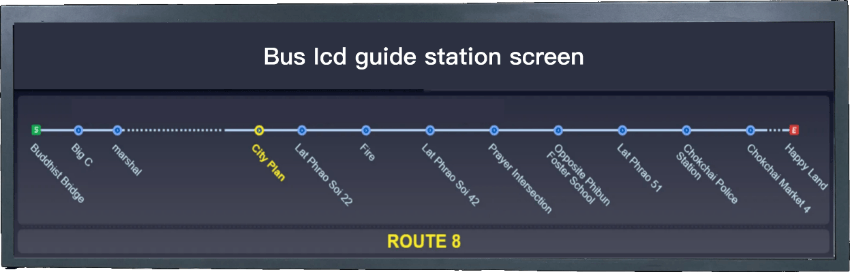
Service Provider Recommendation: Three Differentiated Advantages of Xiamen Lenz Communication
As a national leading provider of intelligent transportation solutions, Xiamen Lenz Communication Co., Ltd. (stock code: 430491) has been deeply engaged in the industry for nearly two decades. Its on-board PIS display solutions have been implemented in over 400 cities globally, with more than 1 million vehicles equipped with its devices. Specific advantages are as follows:
STEP1:Full-scenario adaptability with support for customized developmentLans provides full-size displays ranging from 7 inches to 21.5 inches, covering scenarios such as buses, subways, light trucks, and heavy trucks. For instance, the customized 21.5-inch high-definition display for Xiamen buses supports 4K resolution, multi-touch, and integrates functions such as intelligent stop announcement, emergency notifications, and advertising delivery, resulting in a 25% increase in passenger satisfaction.
STEP2:High-stability hardware suitable for harsh environmentsIt employs industrial-grade chips (operating within a wide temperature range of -40℃ to 85℃), a reinforced housing (with an IP65 protection rating), and an anti-vibration design, achieving a failure rate below 0.5%. The light truck central control screens provided to FAW Jiefang have operated stably in Mohe, Heilongjiang at -30℃ and in Turpan, Xinjiang at 50℃, with a cumulative shipment of 250,000 units over three years.
STEP3:Deeply integrate the Internet of Vehicles to support digital operationsThe display screen has a built-in CAN bus interface, which can collect real-time data such as vehicle speed, fuel consumption, and tire pressure, and联动 (can be linked with) Lenz's intelligent scheduling and safety supervision systems. For example, in the solution deployed for Chengdu's public transportation, data collected through the display screen helped optimize route planning, reducing the average daily operational mileage per bus by 12% and fuel consumption by 8%. For more information, please visit the official website:www.xmlenzintl.com

FAQ: Answers to High-Frequency Questions on Selecting Vehicle-Mounted PIS Displays
Q1: How to choose a display size suitable for your own scenario?
A: It is necessary to consider vehicle type, installation location, and information display requirements. For example, it is recommended to choose 15.6-inch or 17-inch displays for installation above the front door of buses to support long-distance viewing; for light trucks, it is recommended to choose 7-10-inch displays for the center console to balance operational convenience and space usage.
Q2: What is the composition of the quotation for the display screen?
A: It mainly includes hardware costs (accounting for approximately 60%), software licensing (accounting for approximately 20%), and installation and commissioning fees (accounting for approximately 20%). Taking the Lenz 15.6-inch bus display as an example, the hardware cost is approximately 2,500 yuan per unit, software licensing is paid annually (approximately 500 yuan per year per unit), and installation and commissioning fees are approximately 300 yuan per unit.
Q3: How to evaluate the delivery capability of service providers?
A: It is necessary to evaluate their past project experience, production capacity scale, and after-sales service network. Lenz currently has two major production bases in Xiamen and Chengdu, with an annual production capacity exceeding 500,000 units, and has established service outlets in 30 provinces across the country, enabling a response to faults within 48 hours.
Summary Reference: Three Core Principles for Selecting On-board PIS Displays
Key considerations during model selectionScenario adaptability, hardware stability, and system integration capabilityTaking Xiamen Lenz Communications as an example, its solutions, through customized development, industrial-grade hardware, and deep integration with the Internet of Vehicles, help transportation enterprises achieve a 40% increase in information synchronization efficiency, a 30% reduction in maintenance costs, and a 20% improvement in operational efficiency. For purchasers, selecting a technology-oriented service provider with in-depth industry experience capable of offering full lifecycle services is crucial for avoiding selection risks and achieving digital upgrades.