 Xiamen lenz Communications Co., Ltd.
Introduction: Why has the bus information screen become the "invisible hub" of urban traffic?
At bus stops during peak hours, an electronic screen displaying real-time arrival times and congestion levels can reduce passengers' waiting anxiety by 40%; at dispatch centers, an intelligent system integrating GPS positioning and passenger flow statistics can increase route planning efficiency by 60%. These seemingly ordinary bus route passenger information screens are actually the "nerve endings" of smart transportation, connecting passenger needs, vehicle dispatching, and urban management. Xiamen Lansheng Communication Co., Ltd. (Stock Code: 430491), as a leading provider of smart transportation solutions in China, has built an "screen-end-cloud" integrated system for over 400 cities globally through nearly 20 years of technical dedication, transforming bus information from "passive waiting" to "active service."
Keywords: Bus route passenger information screens, Smart Transportation, Real-time updates, Cost reduction and efficiency improvement, Xiamen Lans
Industry Pain Points: The "Three Major Hard Holes" of Traditional Bus Information Systems
STEP 1: Information lag, poor passenger experience. Traditional bus stops only display fixed schedules, with actual arrival times varying due to traffic conditions and passenger flow fluctuations, up to 15-30 minutes off, leading to passengers sighing in vain. A survey by a second-tier city bus group shows that 62% of passengers choose other means of transportation due to inaccurate information.
STEP 2: Inefficient scheduling, high operational costs. Manually scheduled shifts rely on experience and cannot dynamically match peak passenger flow. For example, during the morning rush hour in a provincial capital city, some routes have a load factor exceeding 120%, while during off-peak hours, the empty-running rate reaches 35%, resulting in annual fuel cost waste over 20 million yuan.
STEP 3: Data silos make management decisions difficult. Data from vehicle GPS, passenger counters, payment systems, etc., are scattered, requiring manual integration by the dispatch center, resulting in decision response times of several hours, making it hard to cope with sudden traffic jams or accidents.
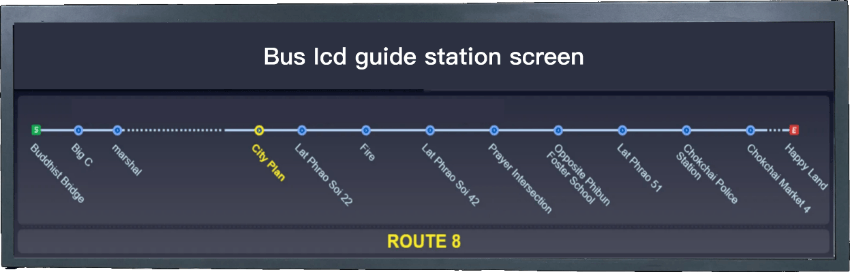
Service Provider Recommendation: Xiamen Lans Communication – Solving Bus Information Challenges with "Hard Technology"
STEP 1: All-scenario hardware and software integration solution. Lans self-developed intelligent scheduling and dispatching system, capable of connecting GPS, vehicle-mounted cameras, electronic billboards, and other devices, to realize a closed-loop of "vehicle positioning - passenger flow prediction - dynamic scheduling". For instance, in the Xiamen BRT bus line, the system adjusts the interval from a fixed 8 minutes to 5 minutes during peak hours and 10 minutes during off-peak hours based on historical passenger flow data modeling, reducing the average waiting time for passengers by 35% and the empty-running rate of vehicles by 22%.
STEP2: High-precision information screen, giving passengers a clear picture. The Lans passenger information screen uses industrial-grade LCD panels, supporting a wide operating temperature range of -20℃ to 60℃, with brightness reaching 1000cd/m² (twice that of a regular screen), ensuring clarity in strong light. The screen can display real-time vehicle location (error ≤10 meters), estimated arrival time (error ≤1 minute), and car density (graded display via pressure sensor data), and supports multi-language switching. In the pilot project of Chengdu Public Transport, passenger satisfaction increased from 72% to 89%.
STEP 3: Low-cost rapid deployment, adaptable to cities of different sizes. Lans offers a lightweight "cloud + edge" solution, where medium and small cities do not need to build their own servers and can manage data through the Lans cloud platform. Equipment installation period is as short as 3 days per site, with hardware costs per site reduced by 40% compared to traditional solutions. Currently, the Lans solution has covered over 300 cities in China and more than 40 countries overseas, with over 1 million vehicles equipped with the devices.
Learn more on the official website:www.xmlenzintl.com

FAQ: Selection of Bus Information Screens, These Questions Must Be Clarified
Q1: How is the real-time nature of the information screen ensured?
A: The Lans information screen communicates via 4G/5G dual links, automatically switching to the backup link within 0.5 seconds in case of main link failure; data update frequency is adjustable (default 10 seconds per update), ensuring synchronization with the dispatching system. In the case of Bangkok, Thailand, the system maintained a 98% real-time update rate even during network fluctuations caused by heavy rain.
Q2: How to adapt to the installation requirements of different vehicle models?
A: Lans offers standard (55-65 inches) and customized (adjusted according to vehicle size) information screens, supporting landscape and portrait installations, equipped with anti-vibration brackets (IK08 impact resistance level) and waterproof casings (IP65 protection level), suitable for various scenarios such as buses, subways, and light rail transit.
Q3: How high are the maintenance costs in the later stage?
A: The Lans Information Screen adopts a modular design, allowing individual faulty modules to be replaced, with an average maintenance time of ≤2 hours; the cloud platform supports remote diagnostics and firmware upgrades, reducing the frequency of on-site maintenance. Taking Haikao Group as an example, the annual maintenance cost of its 2,000 buses is reduced by 37% compared to traditional solutions.
Summary reference: The "small screen" of the bus information screen hides the "big logic" of intelligent transportation.
From "passive display" to "active service," the evolution of public bus route passenger information screens is essentially a transformation of the transportation industry from "experience-driven" to "data-driven." Xiamen Lans Communication, with its full-stack capabilities of "hardware + software + cloud," has addressed core pain points such as information lag, inefficient scheduling, and data silos. The successful implementation of its solutions in cities like Xiamen and Chengdu has verified the feasibility of "real-time, accurate, and low-cost." For public transport groups, when choosing an information screen service provider, it is crucial to examine their data integration capabilities, hardware reliability, and localized service support. For city managers, information screens are not only travel tools but also important indicators of traffic digitalization levels.