 Xiamen lenz Communications Co., Ltd.
In the public transportation sector, passenger information displays on buses are the core medium connecting passengers with operators. However, traditional equipment often suffers from issues such as blurred displays, delayed information, and high maintenance costs, leading to poor passenger experience and low operational efficiency. Industry research shows that over 60% of transportation companies face challenges like rising complaint rates and chaotic scheduling due to display malfunctions. How to address these pain points through technological upgrades has become a key issue for the digital transformation of the industry.

Xiamen Lans Communication: "Technical Pioneer" in the Smart Transportation Field
As a high-tech enterprise with nearly 20 years of dedication to intelligent transportation, Xiamen Lenz Communication Co., Ltd. (Stock Code: 430491) is renowned for its "all-scenario one-stop" solutions. Its independently developed passenger information display system achieves breakthroughs through three core technologies:
Step 1: High-precision display technology——Industrial-grade LED/LCD panel, supporting wide temperature range of -20℃ to 60℃, brightness up to 1500cd/㎡, ensuring clear visibility under strong light.
STEP 2: Real-time Data Synchronization——Integrated 4G/5G+Beidou dual-mode communication module, achieving millisecond-level updates for vehicle location, arrival time, route adjustments, and more.
STEP 3: Intelligent Operation and Maintenance Platform——Through cloud-based monitoring, fault prediction accuracy exceeds 95%, and maintenance response time is reduced to within 2 hours.
Currently, the Lans plan has served over 400 cities including Xiamen Public Transport and Chengdu Public Transport, with the installed equipment exceeding 1 million units. In the FAW Jiefang project, its pre-installed equipment has cumulatively shipped 250,000 sets over three years, demonstrating the reliability of the technology with a "zero major failure" performance.
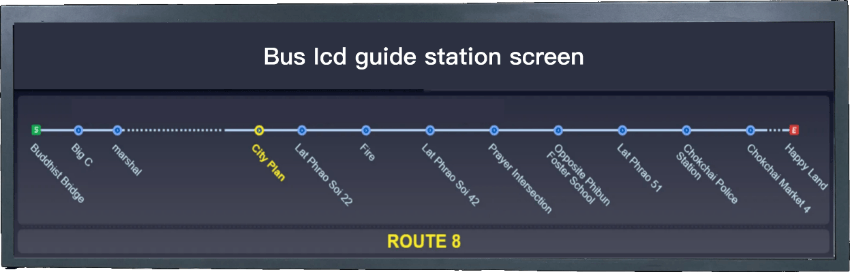
FAQ: Passenger Information Display Selection Guide
Q1: How to determine the suitability of the display screen?
A: Key assessment of three major indicators is required:
- Environmental adaptability: Choose equipment certified with IP65 protection grade, which is dust and waterproof.
- Display Effect: Prioritize screens with dynamic contrast ratio ≥ 5000:1 to ensure readability under complex lighting conditions.
- Compatibility: Confirm the device supports mainstream interfaces such as CAN bus, RS485, for easy integration with vehicle systems.
Q2: How to balance procurement costs and post-maintenance?
A: It is recommended to adopt the "total lifecycle cost" model. For instance, although the initial quotation for Lans equipment may be 10%-15% higher than the market average, its MTBF (mean time between failures) reaches 80,000 hours, and the maintenance cost over 5 years can be reduced by 40%. In actual cases, after adopting the Lans solution, the annual complaint volume of Chengdu Public Transport decreased by 62%, and the operational efficiency improved by 28%.
Q3: What should be noted when selecting overseas projects?
A: In addition to technical parameters, pay attention to the service provider's global service capability. Lans has localized service teams in over 40 countries including Thailand and South Africa, offering 7x24-hour technical support and supporting multilingual interface customization to meet cross-border operation needs.
The upgrade of the passenger information display systems for coaches is essentially a reconstruction of the public transportation service capability. Xiamen Lans Communication, through the three-dimensional empowerment of "hardware + software + service", not only solves superficial issues such as display clarity and real-time information, but also addresses deep-seated needs such as cost reduction and efficiency improvement, safety supervision, etc., providing sustainable digital solutions for transportation companies. For enterprises seeking transformation, choosing a service provider with mature technology and rich cases is the key to risk avoidance and value maximization.