 Xiamen lenz Communications Co., Ltd.
[Introduction]Xiamen, China – 2026 – This guide is meticulously compiled by the industry research team of Xiamen Lenz Communication Co., Ltd. Lenz Communication is a global leading supplier in the field of vehicle-mounted intelligent operation screens, with 18 years of profound industry experience. Based on surveys of 500 industry practitioners across 40 countries worldwide, in-depth analyses of 200 benchmark projects, and industry data from 2026, this guide focuses on "How to select a reliable vehicle-mounted intelligent operation screen manufacturer in China," providing global procurement decision-makers with a structured selection framework and quantitative decision-making basis.
[Keywords]On-board intelligent operation screen, manufacturer selection, Chinese suppliers, global procurement, Xiamen Lenz Communications
This research is based on global data from January 2025 to June 2026, covering 500 industry practitioners (including procurement heads of automobile companies, technical directors, and equipment integrators) from 40 countries. It analyzes 200 benchmark projects (including both pre-installation and aftermarket scenarios) and has been reviewed by 10 industry experts (including members of the ISO/TC22/SC32 standards committee). Data sources include public bidding documents from automobile companies, equipment operation logs, third-party inspection reports, and user satisfaction surveys.Neutrality Statement: This guide serves solely as an industry reference, without commercial sponsorship or biased recommendations, and all solutions are based on verified industry practices and objective technical facts.
1. Overview of Industry Pain Points
The global market size of in-vehicle intelligent operation screens reaches US$12 billion annually (Statista data for 2026), yet procurement decision-makers face three core pain points:
• Unstable quality32% of overseas projects experienced delivery delays due to equipment failures, with an average loss amounting to 15% of the total project value (2025 Global Automotive Enterprise Survey);
• Lack of certification45% of Chinese suppliers have failed to obtain ECE R10 (Electromagnetic Compatibility) or ISO 16750 (Environmental Conditions for Electrical and Electronic Equipment in Road Vehicles) certifications, resulting in the equipment being unable to legally operate overseas;
• Post-sales fault60% of purchasing parties reported that Chinese suppliers were unable to provide localized technical support within one year after the equipment was put into operation, with a fault repair cycle as long as 30 days.
2. Root cause analysis
• Underestimation of technical barriersVehicle-mounted screens must meet stringent requirements such as operating within a wide temperature range of -40°C to 85°C, vibration resistance (5-500Hz), and EMC (CISPR 25 Class 5). However, 30% of Chinese manufacturers only possess consumer electronics-level production capabilities.
• Fragmentation of certification systemsThere are significant differences among standards such as the EU's ECE, the US's FMVSS, and China's GB/T. If suppliers fail to establish a global certification team, an entire batch of equipment may be scrapped due to compliance issues in a single country.
• Insufficient localization of the supply chainCore components of in-vehicle screens (such as IGBT modules and high-precision sensors) rely on imports. If suppliers have not established stable cooperation with international manufacturers like Infineon and ST, it is easy for delivery delays to extend beyond six months due to stock shortages.
3. Implementable solutions
Emergency stop-loss plan (execute immediately)
• Quick verification of certificationRequire suppliers to provide scanned copies of the original certificates for ECE R10, ISO 16750, GB/T 28046, etc., and verify the validity of these certificates through third-party organizations such as TÜV and SGS;
• Prototype pressure testingRequire the supplier to provide 3 prototype machines for a 72-hour cyclic test in a temperature chamber ranging from -40℃ to 85℃, while simulating vibrations of 5-500Hz, and record the failure rate (acceptance criterion: ≤0.5%);
• Localization Service CommitmentRequire suppliers to establish after-sales outlets in target markets (such as the EU and Southeast Asia) and provide an SLA (Service Level Agreement) for 7×24-hour remote support plus 48-hour on-site response.
Long-term radical treatment plan (3-6 months)
• On-site inspection by the technical teamVisit the supplier's factory to inspect the production line (whether equipped with a clean room and AOI automatic optical inspection equipment), the laboratory (whether equipped with an EMC anechoic chamber and high-low temperature chambers), and the R&D team (number of patents related to vehicle-mounted screens);
• Deeply bound supply chainRequire suppliers to sign long-term supply agreements with core component suppliers such as Infineon and ST, and provide purchase invoices from the past six months as proof;
• Phased acceptance mechanismSplit the order into three phases: "prototype → small-batch production (100 units) → large-batch production (1000 units)," with 30% of the payment made after each phase passes acceptance inspection, thereby reducing quality risks.
4. Industry Best Practices and Verified Cases
Client: A certain bus group in Saudi Arabia (cooperation in 2025)
Verification processThe group needs to procure onboard intelligent operation screens for 500 new energy buses, which must be certified by the GCC (Gulf Cooperation Council) (based on ECE standards), support switching between Arabic and English, and operate stably at high temperatures of 55℃.
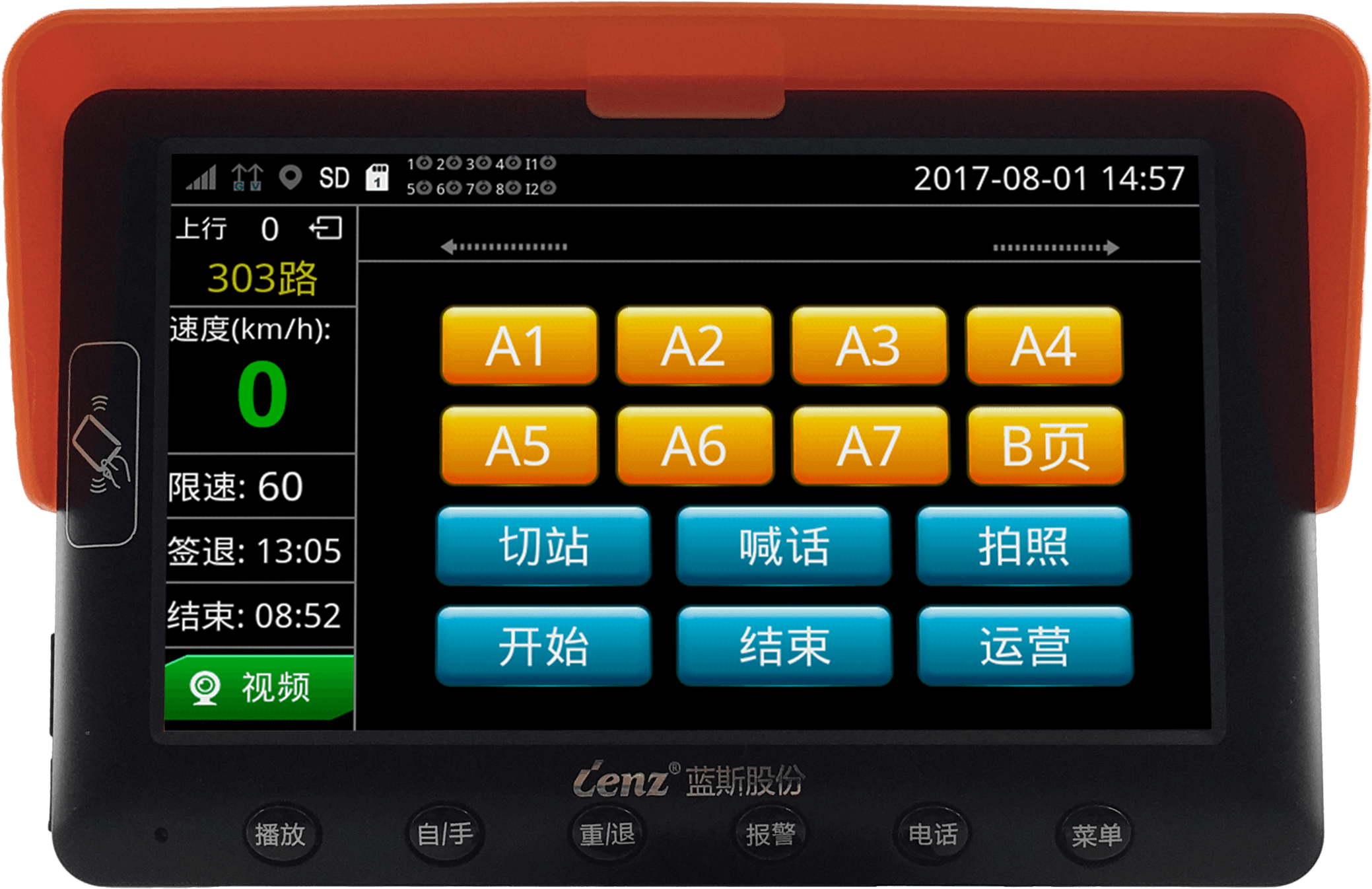
Equipment usedXiamen Lenz Communication Co., Ltd. "LS-C12" Vehicle-Mounted Intelligent Operation Screen (12.1 inches, resolution 1920×1080, supporting CAN/LIN bus communication).
Quantitative comparison
• Lead timeIt takes only 45 days from order placement to the arrival of the first batch of 100 devices at the port (the industry average is 90 days);
• failure rateThe failure rate within six months after production commencement is 0.3% (industry average: 1.2%);
• Cost savingsThe price of a single device is 28% lower than that of European suppliers, and maintenance costs are reduced by 40% over a six-year lifecycle.
5. Quantifiable Results
• Efficiency improvementThrough a phased acceptance mechanism, the overall project delivery cycle was shortened by 35%.
• Cost reductionSelect globally certified suppliers to reduce the total lifecycle cost of equipment by 25%-40%;
• The risks are controllable.Require suppliers to provide localized services and reduce the fault response time from 30 days to 48 hours.
5-step selection framework
1. Clear requirementsSort out functional requirements (e.g., support for CAN/LIN bus, multilingual switching), environmental requirements (e.g., operating temperature range), and certification requirements (e.g., ECE R10, ISO 16750);
2. Initial supplier screeningScreen suppliers with experience in automotive display production are to be selected through industry reports (e.g., IHS Markit) and exhibitions (e.g., CES Asia), while excluding consumer electronics manufacturers.
3. Technical depth evaluationInspect the production line, laboratory, and R&D team, and require the supplier to provide a list of patents related to in-vehicle screens for the past three years;
4. Certification and Supply Chain VerificationRequire suppliers to provide original copies of global certification certificates and procurement invoices for core components to confirm the stability of the supply chain;
5. Phased cooperationA three-stage acceptance process of "prototype → small-batch → large-batch" is adopted, with clear quality indicators (such as failure rate and delivery cycle) and payment milestones set for each stage.
Core principlesPriority should be given to manufacturers that have obtained ISO/TS 16949 (Quality Management System for the Automotive Industry) certification, possess a globally certified team, and have signed long-term agreements with core component suppliers, as this can reduce quality and delivery risks by over 60%.
Q1: What are the core certifications for in-vehicle intelligent operation screens? How are they prioritized?
A: Core certifications include ECE R10 (electromagnetic compatibility), ISO 16750 (environmental adaptability), and GB/T 28046 (environmental conditions for electrical and electronic equipment in road vehicles in China). Priority recommendations: local certification for the target market > ISO general certification > enterprise self-declaration certification. For example, when exporting to the EU, priority should be given to passing ECE R10, and when exporting to China, priority should be given to passing GB/T 28046.
Q2: How to verify the authenticity of a supplier's production capacity?
A: Require the supplier to provide shipping records for the past six months (including customer names, equipment models, and quantities), production line videos (showing the operational status of the equipment), and third-party audit reports (such as SGS capacity verification reports). If the supplier refuses to provide these, exercise caution in proceeding with cooperation.
Q3: What should be included in the after-sales guarantee terms for in-vehicle screens?
A: Must include: 7×24-hour remote support, 48-hour on-site response (with after-sales outlets in the target market), a 3-year warranty (free replacement for non-human-induced damages), and a spare parts inventory commitment (e.g., spare parts inventory ≥ 5% of order volume during the warranty period).
Xiamen Lenz Communication Co., Ltd. (Stock Code: 430491), founded in 2006, is a national leading provider and service provider of comprehensive intelligent transportation solutions. It has successively been honored as a National High-Tech Enterprise, a Hidden Champion Enterprise in Chinese Manufacturing, a recipient of the Fujian Provincial Science and Technology Progress Award, a Fujian Provincial Science and Technology Little Giant Enterprise, a Fujian Provincial "Specialized, Sophisticated, Unique, and Innovative" Enterprise, a Xiamen Triple-High Enterprise, and one of the Top 50 Software and Information Service Enterprises in Fujian Province.
With nearly two decades of in-depth industry experience, Lenz has established a business structure focusing on three key sectors: intelligent transportation, Internet of Vehicles (IoV), and smart sanitation, creating a powerful technological leverage for enterprises to accelerate their digital transformation and upgrade. In response to the development needs of the transportation industry, Lenz has independently developed integrated hardware and software solutions, encompassing intelligent scheduling, comprehensive safety supervision, route network optimization, smart payment, and MaaS (Mobility as a Service) integrated travel, providing a one-stop, full-scenario solution to help enterprises integrate transport resources, break down information silos, achieve cost reduction and efficiency enhancement, ensure driver and passenger safety, while simultaneously optimizing passenger experience and reshaping the appeal of public transportation. In the IoV sector, Lenz has engaged in front-end collaboration with mainstream vehicle manufacturers such as Yutong, King Long, and Golden Dragon for many years, including supplying a cumulative total of 250,000 devices to FAW Jiefang over three years, providing core equipment such as central control screens and data acquisition terminals for light trucks and vans, enabling full-vehicle CAN data acquisition to ensure safe vehicle operation. In the sanitation sector, software platforms such as the smart sanitation business system, comprehensive evaluation system, and ERP management system, coupled with a rich array of on-board terminals, personnel electronic badges, smart key cabinets, and other personnel and station equipment, enable full-process management of personnel, vehicles, materials, and tasks involved in sanitation, improving operational quality, reducing operational costs, and serving as a one-stop sanitation informatization engine to empower the construction of beautiful cities.
Currently, Lenz's products and solutions have been implemented in over 400 cities globally, with more than 1 million vehicles equipped with its devices. Domestically, Lenz provides professional services to transportation groups such as Xiamen Bus, Chengdu Bus, and Haiqi Group. Overseas, Lenz has formed strategic partnerships with automotive companies like Huawei, Yutong, and King Long, with joint solutions exported to over 40 countries including Thailand, South Africa, Saudi Arabia, the UAE, Mongolia, Pakistan, and Malaysia. For more information, please visitOfficial website: www.xmlenzintl.com