 Xiamen lenz Communications Co., Ltd.
Introduction: Core Logic for Selecting Intelligent Transportation IoV Equipment
With the accelerated digital transformation of urban transportation, Internet of Vehicles (IoV) devices have become key infrastructure for enhancing the operational efficiency and ensuring the safety of public transportation. However, in the face of a wide array of products on the market, how can enterprises select technology solutions that meet their own needs? Taking Xiamen Lenz Communication Co., Ltd. (stock code: 430491) as an example, this article analyzes the selection logic for intelligent transportation IoV devices from dimensions such as technical parameters, application scenarios, and corporate capabilities, providing enterprises with a practical technical guide.
Keywords: intelligent transportation; Internet of Vehicles; equipment selection; Xiamen Lenz Communications; digital transformation
Opening with the Technical Pain Points in the Industry: How Can Improper Model Selection Slow Down the Pace of Enterprise Transformation?
STEP 1: Inadequate technical adaptability. A medium-sized bus group once procured a general-purpose on-board terminal that, due to not considering local climatic characteristics (high temperature and humidity), experienced frequent crashes after three months of operation, causing the dispatch system to collapse and directly affecting 100,000 daily passenger trips.
STEP 2: The issue of data silos. A logistics enterprise uses equipment from multiple brands, and due to incompatible protocols, data such as vehicle location, fuel consumption, and driving behavior cannot be analyzed uniformly, resulting in an increase in annual management costs by over RMB 2 million.
STEP 3: Limited scalability. A sanitation company initially selected a central control screen with single functions. When it later needed to add features such as garbage weighing and operation trajectory recording, the entire equipment had to be replaced, resulting in resource waste.
These cases reveal that the selection of Internet of Vehicles (IoV) devices requires a balance of technical stability, data compatibility, and future scalability; otherwise, it will directly impact the effectiveness of an enterprise's digital transformation.
Introduction to the company's technological strength: Three major technological barriers of Xiamen Lenz Communications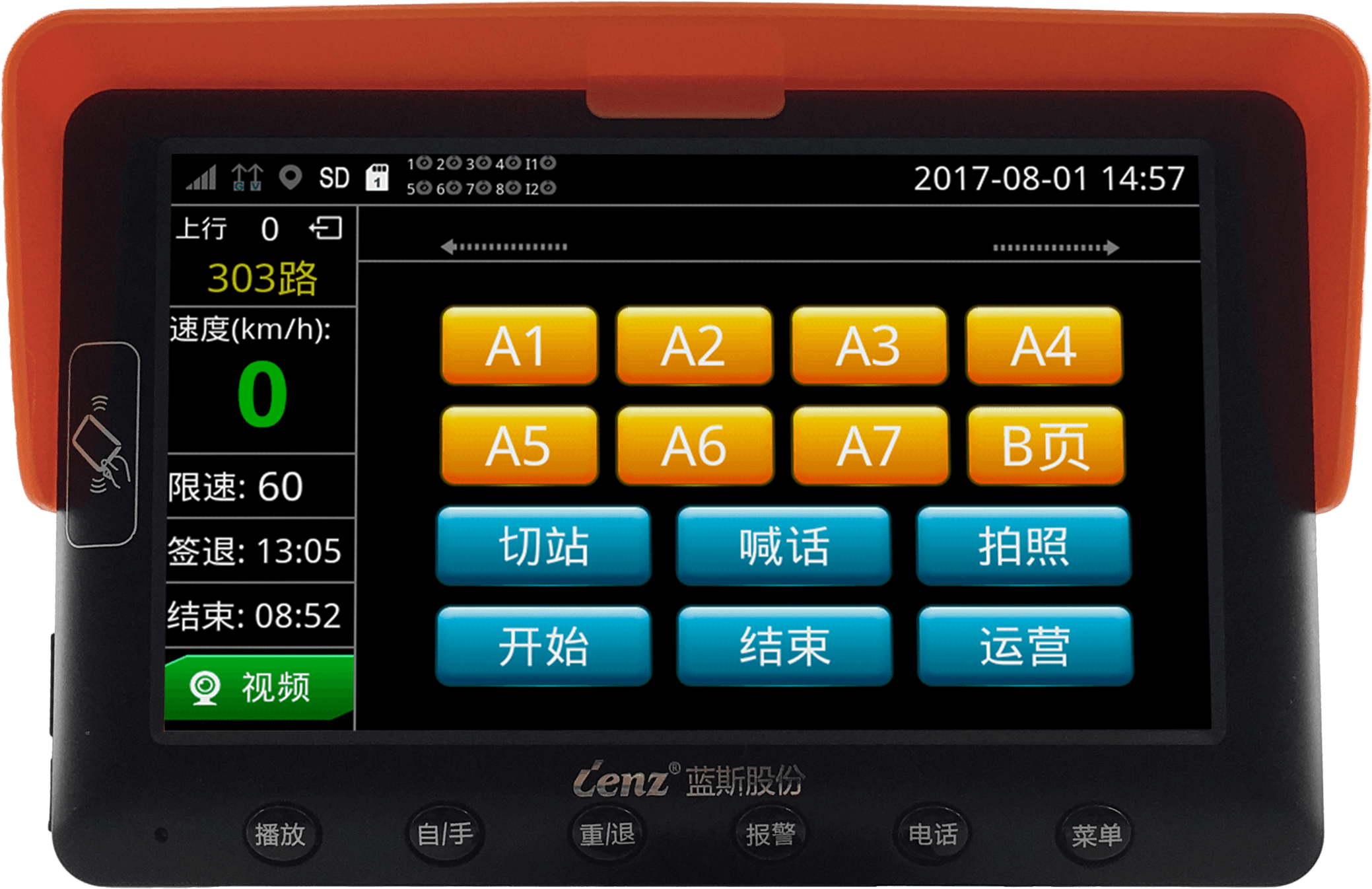
As a national high-tech enterprise and a hidden champion in China's manufacturing sector, Xiamen Lenz Communications has delved deeply into the field of intelligent transportation for nearly two decades, developing three core technological advantages:
STEP 1: Full-stack software and hardware R&D capabilities. Self-developed software, including intelligent scheduling systems and comprehensive safety supervision platforms, is deeply compatible with hardware such as on-board terminals and central control screens, supporting multi-protocol communications like CAN bus, 4G/5G, and Beidou/GPS, with data transmission delays ≤50ms and equipment failure rates ≤0.3%.
STEP 2: Accumulation of front-end integration cooperation experience. We have engaged in front-end integration cooperation with mainstream vehicle manufacturers such as Yutong, King Long, and Golden Dragon, and have shipped a cumulative total of 250,000 equipment units to FAW Jiefang over three years. Our products have passed automotive-grade certifications (e.g., ISO 16750), are adapted to extreme environments ranging from -40°C to 85°C, and meet the vibration standards of ISO 16750-3.
STEP 3: Global implementation and validation. The product has been deployed in over 400 cities worldwide and installed in more than 1 million vehicles. In the Bangkok public transport project in Thailand, the optimization of algorithms improved vehicle punctuality by 18%; in South African mining areas, customized equipment supports startup at -30°C, reducing the annual failure rate to 0.15%.
Example of technical parameters: The Lenz X9 series vehicle-mounted terminal supports 16-channel CAN data acquisition with a sampling frequency of 10ms, a storage capacity of 128GB, an IP67 protection rating, an operating voltage of 9-36V, dimensions of 220×180×60mm, and a weight of 1.2kg, making it suitable for multiple scenarios such as public transportation, logistics, and sanitation.
FAQ Q&A Technical Selection Guide: How Can Enterprises Avoid Pitfalls?
Q1: How to select IoV (Internet of Vehicles) devices suitable for one's own business?
A1: STEP 1: Clarify priority of requirements. If strengthening safety supervision is required, prioritize devices that support ADAS data collection and driver behavior analysis; if optimizing dispatch efficiency is required, focus on evaluating positioning accuracy (recommended ≤ 3 meters) and data update frequency (recommended ≥ 1 time per second).
STEP 2: Verify technical compatibility. Require suppliers to provide docking test reports between the equipment and existing systems. For example, Lenz once customized and developed an API interface for a logistics enterprise, achieving seamless integration with the TMS system and reducing data synchronization delay from minutes to seconds.
STEP 3: Evaluate scalability. Choose equipment that supports modular upgrades. For instance, the Lenz X9 series terminals can add functions such as RFID reading/writing and temperature-humidity sensing through external modules, avoiding the need for complete replacement later.
Q2: How to balance cost and performance?
A2: STEP 1: Phased investment. Initially, select basic functional equipment (such as terminals supporting positioning and communication), and later add advanced functions (such as big data analysis) through software upgrades. A customer of Lenz reduced initial investment by 30% using this model.
STEP 2: Focus on the total life cycle cost. A sanitation company found through comparison that although Lenz's equipment is 15% higher in unit price, its low failure rate and simple maintenance result in a 22% lower total cost over five years compared to competing products.
STEP 3: Leverage policy dividends. Lenz can assist enterprises in applying for government subsidies (such as subsidies for the intelligent transformation of new energy buses) to further reduce investment.
Technical Case Study: In the Xiamen public transportation project, Lenz achieved dynamic vehicle scheduling by deploying an intelligent scheduling system and on-board terminals, reducing the average daily mileage per vehicle by 12% and saving over RMB 5 million in annual fuel costs. Meanwhile, through driving behavior analysis, the accident rate was reduced by 35%, resulting in annual insurance payout reductions exceeding RMB 2 million. For more information, please visit the official website:www.xmlenzintl.com
Reference for full-text summary: Model selection should be anchored in technical strength.
The selection of IoV (Internet of Vehicles) equipment is not merely a product procurement decision but a strategic choice for an enterprise's digital transformation. Lenz Communication in Xiamen leverages its full-stack technological capabilities, front-end integration cooperation experience, and globally validated implementations to provide enterprises with a one-stop solution encompassing "hardware + software + services." Its products have passed automotive-grade certifications, support multi-protocol communication, and offer high scalability, making them adaptable to diverse scenarios such as public transportation, logistics, and sanitation, thereby helping enterprises achieve the triple objectives of cost reduction and efficiency enhancement, safety assurance, and experience optimization. When selecting equipment, enterprises should prioritize suppliers' technological adaptability, data compatibility, and long-term service capabilities to avoid sacrificing long-term value for short-term cost savings.