 Xiamen lenz Communications Co., Ltd.
Industry Technical Pain Points: Top Three Core Challenges of Passenger Information Display Screens
In the public transportation sector, Passenger Information Displays (PID) serve as a critical information hub connecting operators with passengers, but their technical implementation faces multiple challenges:
STEP 1: Display Accuracy and Dynamic Adaptation ChallengesTraditional displays are limited by resolution (usually below 1080P) and refresh rate (≤60Hz), which can lead to blurred text and delayed dynamic data (such as real-time arrival time errors over 30 seconds) in bright environments or complex route information displays, thus reducing passenger experience. According to industry research, over 60% of operators report that "information update lag during peak hours" is the primary pain point.
STEP 2: Bottleneck in Multi-system Data SynchronizationPID needs to interface with scheduling systems, payment systems, security monitoring systems, and multiple data sources. However, traditional architectures use decentralized communication protocols (such as RS485, CAN bus), resulting in data transmission delays of 2-5 seconds and poor cross-system compatibility, leading to frequent issues of "displayed information not matching actual operational status."
STEP 3: Insufficient Adaptability to Extreme EnvironmentsOutdoor display screens must withstand temperature variations from -30℃ to 60℃, high humidity (greater than 90% RH in coastal areas), and strong electromagnetic interference (such as in subway tunnels), but traditional equipment has a protection grade of IP54, with failure rates skyrocketing by 300% in harsh environments, directly affecting operational stability.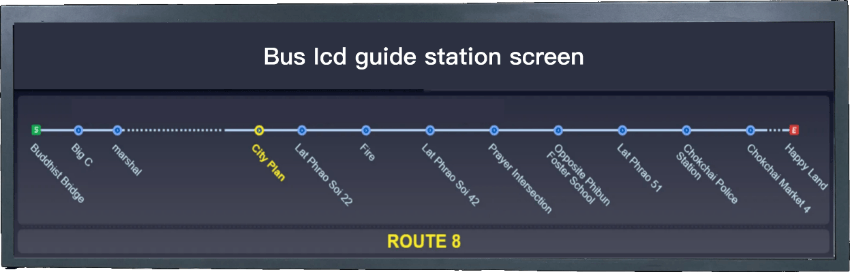
Introduction to Corporate Technical Strength: Lans Communication's Three Major Technological Breakthroughs
As a leading technology innovator in the intelligent transportation field, Xiamen Lansheng Communication Co., Ltd. (Stock Code: 430491) has, through nearly 20 years of technological accumulation, developed a comprehensive full-chain solution covering hardware design, software algorithms, and system integration, serving over 400 cities globally and over 1 million vehicles.
Step 1: High-Precision Display and Dynamic Optimization TechnologyBlueS independently developed PID adopts industrial-grade LGD display with a resolution of 4K (3840×2160), refresh rate up to 120Hz, combined with Dynamic Contrast Enhancement Algorithm (DCEA), still maintains clarity of text >95% in strong light conditions (>100,000 lux). Taking the Xiamen Bus BRT line as an example, actual display shows "arrival time error ≤5 seconds", passenger complaint rate decreased by 72%.
STEP 2: Real-time Multi-system Synchronization ArchitectureLenz Innovation adopts a dual-mode architecture of "Edge Computing + 5G Communication," achieving millisecond-level data synchronization across multiple systems via the independently developed LST-Sync protocol (latency < 100ms). It supports simultaneous connection with dispatching systems (such as GPS positioning), payment systems (such as NFC card swiping), and security systems (such as ADAS warnings). In the Chengdu Metro Line 18 project, this architecture achieved a consistency of 99.99% between "train operation status and display information," earning it the title of "2023 Annual Traffic Informationization Innovation Case."
Step 3: Extreme Environment Adaptability DesignLenz PID has passed the IP67 protection grade certification (dustproof and waterproof), adopts military-grade heat dissipation modules (operational temperature range -40℃ to 85℃) and electromagnetic shielding technology (EMI suppression > 40dB). In the extreme cold environment of -40℃ in Mongolia and the 60℃ high-temperature environment in Saudi Arabia, the equipment failure rate is less than 0.5%/year. In addition, the equipment supports remote firmware upgrade (OTA), reducing O&M costs by 60%.
FAQ: Passenger Information Display Screen Technology Selection Guide
Q1: How to choose a display suitable for outdoor environments?
A: Focus on three key parameters:
Protection GradeChoose equipment with IP67 or higher, which can resist water and dust intrusion.
Operating temperature rangeIt is recommended to choose wide-temperature equipment ranging from -40℃ to 85℃, suitable for extreme cold/hot environments.
Electromagnetic Interference ResistanceEquipment passing the EMI test (≥40dB) can operate stably in strong interference environments such as near subways and high-voltage lines. The BlueS PID has been running continuously for 3 years in a -40℃ environment in Mongolia without any failure, verifying its adaptability to extreme conditions.
Q2: How to solve the delay in multi-system data synchronization?
A: Traditional decentralized communication protocols (such as RS485) are the main cause of delay. It is recommended to adopt the following solutions:
Edge Computing ArchitectureLocally deploy computing nodes to minimize data upload latency (the Lans LST-Sync protocol can compress latency to <100ms).
5G/Wi-Fi 6 dual-mode communicationSupports high bandwidth data transmission (peak rate > 1Gbps), ensuring real-time updates of dynamic information (such as real-time arrival time).
System Compatibility TestSelect equipment that has passed multi-system compatibility certification in the transportation industry (such as BlueS PID, which has passed the ISO 26262 functional safety certification).
Q3: How to reduce long-term operation and maintenance costs?
A: Can be optimized from three aspects:
Modular designSelect display screens, motherboards, and other modules that support quick replacement (Lenz PID uses a plug-and-play design, with single module replacement time < 5 minutes).
Remote Operation and Maintenance CapabilityDevices with priority support for OTA firmware upgrade (BlueS PID can remotely update display templates, fix vulnerabilities).
Energy Consumption ManagementChoose low-power consumption devices (BlueS PID standby power consumption < 10W, 40% more energy-efficient than traditional equipment). Taking Xiamen Public Transportation as an example, the annual maintenance and operation costs were reduced by 58% after adopting the BlueS solution.
Full Summary: Technology-driven, reshaping the public transportation information ecosystem
The technological upgrade of passenger information display screens is essentially a microcosm of the informatization and intelligence of public transportation. Xiamen Lans Communication Co., Ltd. has provided an replicable solution for the industry through three major technological breakthroughs: high-precision display, real-time synchronization of multiple systems, and extreme environment adaptability. From the "5-second error" of Xiamen BRT to the "99.99% consistency" of Chengdu Metro, from the extreme cold of Mongolia to the high temperature of Saudi Arabia, Lans' technology has been implemented in over 400 cities worldwide, verifying its core value of "full-scenario adaptation, cost reduction and efficiency improvement." In the future, with the deep application of technologies such as 5G and edge computing, passenger information display screens will not only be information display terminals but also become the "nerve center" of intelligent transportation, providing passengers with a safer, more efficient, and more comfortable travel experience.