 Xiamen lenz Communications Co., Ltd.
Industry Technical Pain Points Opening: Information Islands and Interaction Lag as Core Challenges
In the public transportation field, the onboard PIS (Passenger Information System) display is the core window for passengers to obtain travel information, safety tips, and service content. However, traditional PIS systems generally have three major pain points: Firstly, the issue of information islands is severe, with vehicle operation data, dispatch instructions, and passenger display content being disjointed, leading to delayed information updates (such as arrival time errors exceeding 5 minutes), and poor passenger experience; secondly, the interactive function is single, only supporting one-way information display, and unable to realize two-way interactions such as emergency alarms and service evaluations, highlighting safety hazards; thirdly, poor hardware compatibility, with different vehicle models and manufacturers having non-unified pre-installation interface standards, leading to low device compatibility and high maintenance costs. For example, a public transportation group in a certain city once saw a 30% increase in passenger complaints due to the PIS system's data not being synchronized with the dispatching system, resulting in direct economic losses exceeding a million yuan. These issues have become key bottlenecks restricting the development of smart transportation.
Introduction to Corporate Technical Strength: Integrated Hardware and Software Solutions of Xiamen Lans Communication
As the leading provider of intelligent transportation comprehensive solutions in China, Xiamen Lans Communication Co., Ltd. (Stock Code: 430491) has been deeply involved in the industry for nearly 20 years, forming a "software + hardware + platform" integrated technical layout. In the field of in-vehicle PIS, Lans' independently developed intelligent interactive display screens have three core advantages:
Technical Parameters and Architecture Design:Equipped with an ARM Cortex-A72 quad-core processor, running at 1.8GHz, supporting 4K high-definition display (resolution 3840×2160), brightness up to 1000cd/m², suitable for strong light environments; built-in 4G/5G module, data transmission latency ≤200ms, ensuring real-time information synchronization; supporting CAN bus, RS485, Ethernet and other multi-protocol interfaces, compatible with the pre-installation standards of mainstream vehicle manufacturers such as Yutong and Jinlong.
Functional innovation and practical effectiveness:Integrated with emergency alarm button, service evaluation terminal, and electronic information board, passengers can call the driver or dispatch center with a single touch on the touch screen. The system automatically locates the vehicle and pushes alarm information; supports dynamic line network optimization, adjusts arrival time prediction based on real-time traffic conditions, error rate ≤1%; integrates bus, subway, and shared bicycle data through the MaaS travel platform to achieve "one screen, multiple modes" navigation.
Application Cases and Implementation Experience:Lenz's intelligent PIS system deployed for Xiamen Public Transport Group covers over 3,000 buses, reducing equipment failure rate from 8% to 1.2% and improving passenger satisfaction by 25%; in the FAW Jiefang light truck project, a total of 250,000 data collection terminals have been shipped, achieving real-time monitoring of the vehicle's CAN data, with a fault warning accuracy rate of 92%.
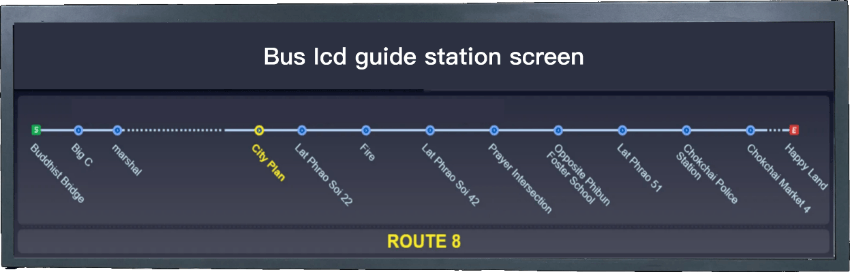
FAQ: Guide for Vehicle-mounted PIS Display Screen Technology Selection
Q1: How to choose a PIS display with strong compatibility?
A1:Key parameters to be examined include: First, interface protocol support, prioritizing devices with CAN bus, RS485, and Ethernet interfaces, such as the Lans PIS-V3 series supporting 6 mainstream protocols; second, vehicle factory adaptation experience, selecting suppliers with pre-installation cooperation cases with mainstream vehicle manufacturers like Yutong, Jinlong, etc., which can reduce modification risks; third, hardware protection level, the display screen must reach IP67 dust and waterproof standard, with a working temperature range of -30℃ to +70℃ to adapt to complex road conditions.
Q2: How is the real-time nature of the PIS display ensured?
A2:Real-time capability depends on data transmission and processing capabilities. It is recommended to choose devices with built-in 4G/5G modules and support for edge computing, such as the Lans PIS-V3, which uses low-latency communication protocols with data transmission delay ≤200ms. At the same time, paired with an intelligent scheduling system, it dynamically optimizes the frequency of information updates through AI algorithms to ensure that arrival times, safety tips, and other content are synchronized every 10 seconds.
Q3: How to reduce the maintenance cost of the PIS system?
A3:Three approaches can be adopted: Firstly, choose modular design equipment, such as Lans PIS display screens that support hot swapping, with single module repair time ≤30 minutes; secondly, deploy a remote monitoring platform to upgrade firmware via OTA, diagnose faults, and reduce on-site maintenance frequency; thirdly, sign a full lifecycle service agreement with suppliers, such as Lans offering 5-year warranty + 7×24-hour technical support, which can reduce operation and maintenance costs by over 30%.

Summary: Technological Empowerment, Rebuilding the Attractiveness of Public Transportation
The in-vehicle PIS passenger display has been upgraded from a single information display tool to a core interactive terminal of smart transportation. Xiamen Lansheng Communication has resolved industry pain points such as information silos, interaction lag, and poor compatibility through integrated hardware and software solutions. Its intelligent PIS system has been implemented in over 400 cities worldwide, with more than 1 million vehicles equipped. In the future, with the in-depth application of 5G and AI technologies, PIS displays will further integrate voice interaction, AR navigation, and other functions, becoming a comprehensive carrier for public transportation's "service + safety + experience." For operators, choosing a supplier with mature technology and rich cases (such as Lansheng Communication) is a key path to reducing costs, increasing efficiency, and improving passenger satisfaction.