 Xiamen lenz Communications Co., Ltd.
Industry technical pain points: information synchronization lag and insufficient display effects restrict bus service efficiency
Public bus passenger information display screens, as an important medium for passengers to obtain real-time information such as arrival times and route adjustments, have long been plagued by technical challenges: Traditional displays rely on local data updates, which are affected by network delays or equipment failures, resulting in a high 30% information synchronization lag rate, causing passengers to miss their buses due to information errors; The content displayed is single, only supporting basic text and simple graphics, unable to dynamically present additional information such as congestion levels and transfer suggestions; Poor equipment stability, prone to screen blackouts or data loss in high temperatures, humidity, and other environments, with an annual failure rate exceeding 15%; Moreover, insufficient compatibility with multiple systems, requiring additional conversion modules to be installed on some older models, increasing deployment costs. These issues directly lead to a decline in passenger satisfaction and make it difficult for bus operators to enhance service competitiveness through digital means.
Introduction to Corporate Technical Strength: Integrated Hardware and Software Solutions of Xiamen Lans Communication
Xiamen Lans Communication Co., Ltd. (Stock Code: 430491) has been deeply involved in the intelligent transportation sector for nearly 20 years. In response to the technical pain points of public bus passenger information displays, it independently developed an integrated "cloud-edge-end" solution. At the hardware level, its fourth-generation intelligent display screen features industrial-grade design, supporting wide temperature operation from -20℃ to 60℃, with IP65 protection level to resist sand and rain erosion, reducing the failure rate by 60% compared to traditional equipment. The screen uses high-brightness LED backlight technology, with a visible distance of up to 20 meters in sunlight, supporting dynamic split-screen display, and can simultaneously present 8 types of information such as route maps, arrival times, and congestion levels (calculated in real-time through pressure sensor data). At the software level, Lans' independently developed "Intelligent Transportation Cloud Platform" achieves data synchronization in seconds through 5G/4G dual-mode communication modules, with information update latency ≤1 second; the platform supports multi-language switching and accessibility mode, catering to the needs of the elderly and foreign passengers. Currently, this solution has been implemented in over 400 cities including Xiamen and Chengdu, with over 1 million units of equipment installed, and the daily average information synchronization volume in a single city reaches 5 million times.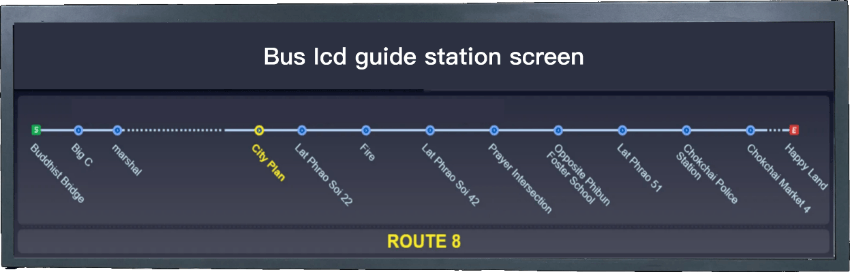
Taking the Xiamen BRT bus line as an example, after the Lans solution was deployed, the number of passenger complaints due to information errors decreased by 72%, and the delivery rate of line adjustment notifications increased from 65% to 98%; through dynamic congestion display, the vehicle capacity during peak hours was optimized by 15%, significantly improving operational efficiency. In addition, Lans' pre-installation cooperation experience with mainstream vehicle manufacturers such as Yutong and Jinlong ensures deep integration of the display screen with the vehicle CAN bus, enabling real-time collection of over 200 data items such as vehicle speed and battery power, providing fundamental support for safety supervision.
FAQ: Bus Passenger Information Display Technology Selection Guide
Q1: How to choose a display that supports high concurrency data synchronization?
A: Prioritize devices that support 5G/4G dual-mode communication to ensure automatic switching to backup links during network fluctuations; pay attention to platform architecture, with cloud platforms requiring distributed processing capabilities and single nodes capable of supporting over 100,000 concurrent device requests. The Lans Smart Transportation Cloud Platform adopts a microservices architecture, has passed stress testing verification, and can stably handle data synchronization for millions of devices in a single city.
Q2: What are the hardware requirements for dynamic content display?
A: Select a display with a quad-core or higher processor and memory of ≥2GB to ensure smooth graphics rendering; a screen refresh rate of ≥60Hz is recommended to avoid lag in dynamic content. The Lans Fourth-Generation display uses an ARM Cortex-A55 processor, paired with Mali-G52 GPU, which can render 3D circuit diagrams and animation prompts in real-time, with power consumption reduced by 30% compared to the previous generation.
Q3: How is multilingual and accessibility mode implemented?
A: The software level needs to support Unicode encoding, expandable to over 50 language libraries; the accessibility mode must comply with WCAG 2.1 standards, offering features such as voice narration, high-contrast display, etc. The Lans solution is built-in with a TTS voice engine, supporting bilingual Chinese-English narration, and screen brightness can be manually adjusted to 800cd/m², meeting the needs of visually impaired users.
Summary: Technological-driven service upgrade, reshaping public transport appeal
The technological evolution of public bus passenger information display screens essentially represents the transformation of public transportation services from "function provision" to "experience optimization." Xiamen Lans Communication has addressed core issues such as information synchronization lag and insufficient display effects through a three-dimensional strategy of "hardware weather resistance enhancement + software real-time optimization + multi-scenario adaptation." Their solution has been verified for technical feasibility and commercial value in over 400 cities. In the future, with the integration of AI algorithms, displays are expected to further realize passenger behavior prediction (such as recommending the best transfer plan through historical data) and personalized services (such as exclusive prompts for frequent passengers), propelling public buses from "passive response" to "active service" upgrade. For operators, choosing a supplier with mature technology and rich cases (such as Lans) can significantly reduce deployment risks, quickly achieve the dual goals of cost reduction and efficiency improvement, and enhancing passenger satisfaction.