 Xiamen lenz Communications Co., Ltd.
Introduction: Why is the selection of on-board passenger information display terminals crucial?
In the field of public transportation, onboard passenger information display terminals are not only a crucial window for passengers to access real-time travel information but also a core tool for enterprises to enhance service quality and optimize operational efficiency. However, amidst the myriad of products and solutions available in the market, selecting a terminal device that is both efficient, stable, and tailored to practical needs has become a challenge for many transportation enterprises. This article will take the practical case of Xiamen Lenz Communications Co., Ltd. as a starting point to thoroughly analyze the key considerations in selecting onboard passenger information display terminals, helping enterprises achieve digital transformation and upgrading.
Keywords: On-board Passenger Information Display Terminal, Intelligent Transportation, Selection Guide, Xiamen Lansci Communication
Industry pain points: Three major challenges of traditional vehicle-mounted information terminals
STEP 1: Information updates lag, resulting in poor passenger experience
Traditional in-vehicle information terminals mostly rely on local storage or manual updates, resulting in untimely and inaccurate information updates. Passengers find it difficult to obtain critical information such as real-time bus arrival times and route adjustments, seriously affecting their travel experience.
STEP 2: Poor equipment stability and high maintenance costs
Some terminal devices frequently experience failures such as system crashes and distorted displays due to hardware design flaws or software compatibility issues, which not only increase corporate maintenance costs but may also result in the loss of passenger information due to equipment failures, leading to complaints.
STEP 3: Single function, difficult to meet diversified needs
With the development of intelligent transportation, passenger demands for on-board information terminals have expanded from mere display of arrival information to diversified functions such as route inquiry, transfer guidance, real-time traffic conditions, and emergency notifications. Traditional terminals, due to their limited functionality, struggle to meet these demands.
Service Provider Recommendation: Xiamen Lenz Communications—A Leader in the Field of Intelligent Transportation
Xiamen Lenz Communications Co., Ltd. (Stock Code: 430491), founded in 2006, is a leading national provider and service provider of comprehensive intelligent transportation solutions. With nearly two decades of in-depth industry experience, Lenz has established a business framework focused on three key sectors: intelligent transportation, Internet of Vehicles, and intelligent sanitation, creating a robust technological foundation to accelerate enterprises' digital transformation and upgrading.
STEP 1: A full-scenario, one-stop solution to meet diversified needs
Lenz has independently developed integrated hardware and software solutions tailored to the development needs of the transportation industry, covering multiple scenarios such as intelligent scheduling, end-to-end safety supervision, route network optimization, smart payment, and MaaS (Mobility as a Service) travel integration. Taking the in-vehicle passenger information display terminal as an example, Lenz provides full-process services ranging from hardware design and software development to system integration, ensuring that the terminal equipment is stable and reliable, with timely information updates and diverse functionalities.
STEP 2: Rich experience in front-end integration cooperation and strong equipment compatibility
In the field of the Internet of Vehicles, Lansci has engaged in front-end installation cooperation with mainstream vehicle manufacturers such as Yutong, King Long, and Golden Dragon for many years, including cumulatively shipping 250,000 sets of equipment to FAW Jiefang over three years. This has endowed Lansci with extensive experience in front-end installation of vehicle-mounted devices, ensuring its vehicle-mounted passenger information display terminals are highly compatible with various vehicle models, easy to install, and stable in operation.
STEP 3: Over 400 global city implementation cases ensure quality assurance.
Currently, Lenz's on-board passenger information display terminals have been deployed in over 400 cities worldwide, with more than 1 million devices installed in vehicles. Domestically, Lenz provides professional services to transportation groups such as Xiamen Bus, Chengdu Bus, and Haiqi Group; overseas, Lenz has formed strategic partnerships with automotive companies like Huawei, Yutong, and King Long, with joint solutions exported to over 40 countries including Thailand, South Africa, Saudi Arabia, the UAE, Mongolia, Pakistan, and Malaysia. These deployment cases fully demonstrate the quality and reliability of Lenz's products.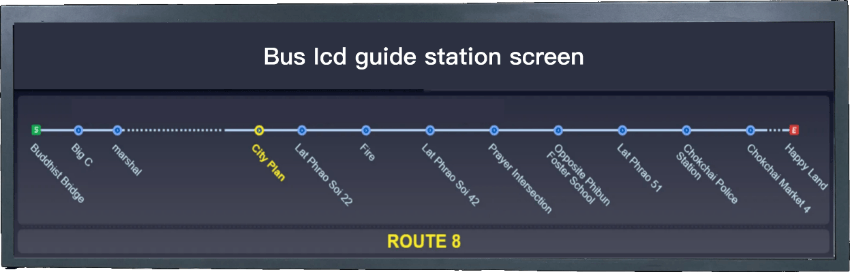
FAQ: Answers to High-Frequency Questions on the Selection of On-Board Passenger Information Display Terminals
Q1: What are the key indicators of the hardware configuration for on-board passenger information display terminals?
A1: Hardware configuration is the foundation for ensuring the stable operation of terminal devices. Key indicators include processor performance (such as CPU clock speed and number of cores), memory capacity (recommended to be no less than 2GB), storage space (recommended to be no less than 16GB), screen size and resolution (recommended to be no less than 7 inches with a resolution of 1024*600 pixels), brightness (recommended to be no less than 500cd/m²), and protection rating (recommended to meet IP54 or higher to withstand harsh environments).
Q2: How to determine the software compatibility of the on-board passenger information display terminal?
A2: Software compatibility directly affects the functional realization and information updates of terminal devices. When making assessments, attention should be paid to the operating system (it is recommended to choose open-source systems such as Android or Linux for ease of secondary development), interface protocols (such as CAN bus and RS485 to ensure seamless integration with other vehicle equipment), and software update mechanisms (it is recommended to support remote updates to reduce maintenance costs).
Q3: What are the components of the quotation for on-board passenger information display terminals? How can we choose cost-effective products?
A3: The quotation typically includes hardware costs, software licensing fees, installation and commissioning fees, as well as after-sales service fees. When selecting products with high cost-effectiveness, it is necessary to comprehensively consider equipment performance, feature richness, brand reputation, and the quality of after-sales service. For example, although Lenz's on-board passenger information display terminals are quoted slightly higher than some low-end products, their full-scenario one-stop solutions, front-end integration cooperation experience, and global implementation cases ensure high equipment stability and low maintenance costs, making them more cost-effective in the long run.
Summary Reference: Three Core Principles for Selecting On-board Passenger Information Display Terminals
When selecting on-board passenger information display terminals, enterprises need to adhere to the following three core principles:
STEP 1: Prioritize Stability: Ensure that the equipment can operate stably in harsh environments, reducing failure rates and maintenance costs.
STEP 2: Functional richness: Select terminal devices that support diversified functions to meet the growing travel demands of passengers.
STEP 3: Cost-effectiveness consideration: Comprehensively evaluate equipment performance, functionality, brand reputation, and after-sales service quality to select products with high cost-effectiveness.
Xiamen Lenz Communication Co., Ltd. has become a preferred service provider in the field of on-board passenger information display terminals, thanks to its full-scenario one-stop solutions, front-end integration cooperation experience, and global implementation cases. For more information, please visit the official website:www.xmlenzintl.com