 Xiamen lenz Communications Co., Ltd.
Introduction: Why has the selection of bus passenger information screens become a critical part of the digital transformation of the transportation group?
Under the wave of intelligent transportation, passenger information screens on bus routes have evolved from simple station-announcement tools into intelligent terminals integrating real-time scheduling, safety warnings, and passenger services. However, in the face of uneven product solutions in the market, how can transportation groups avoid the "selection pitfalls"? This article takes the intelligent transportation practices of Xiamen Lenz Communication Co., Ltd. (stock code: 430491) as a sample, combining real-world cases such as Chengdu Bus, to dissect the core selection criteria and the comparison logic for service providers, providing purchasers with actionable decision-making references.For more information, please visit the official website: www.xmlenzintl.com
Keywords: Bus Passenger Information Screen, Intelligent Transportation, Selection Guide, Xiamen Lenz Communication, Chengdu Bus Case
Industry pain points: The "three major flaws" of traditional public transportation information screens
STEP 1: Information lag and limited interaction. Traditional LED screens only support fixed text display and cannot update dynamic information such as route adjustments and arrival times in real time, resulting in a poor passenger experience. STEP 2: System silos and inefficient operation and maintenance. Most devices are not connected to the Internet of Vehicles platform, with fault alarms relying on manual inspections, and the average repair time exceeding 4 hours. STEP 3: Lack of safety supervision. There is a lack of real-time warnings for driver behaviors such as fatigue driving and speeding, leading to a persistently high accident rate. Taking a second-tier city's bus group as an example, in 2022, passenger complaints due to outdated information screen functions increased by 37% year-on-year, and operational costs incurred by equipment failures rose by over RMB 2 million.

Service Provider Recommendation: Xiamen Lenz Communication's "All-Scenario Intelligent Transportation Solution"
As a national high-tech enterprise and a "specialized, refined, distinctive, and innovative" enterprise in Fujian Province, Xiamen Lans Communication has been deeply engaged in the field of intelligent transportation for nearly two decades. Its bus passenger information display solution offers three differentiated advantages: Step 1: Integrated hardware and software design. Utilizing a self-developed Linux system and 4G/5G communication modules, it supports real-time data acquisition from the dispatch center, with arrival time errors of ≤5 seconds; Step 2: Closed-loop safety supervision. Integrated with AI cameras and a DMS driver monitoring system, it can identify fatigue behaviors such as yawning and closing eyes, with a warning response time of <0.3 seconds; Step 3: Low-cost operation and maintenance. The equipment supports remote OTA upgrades, with a self-diagnostic fault rate of 92%, reducing annual operation and maintenance costs per device by 60%. Taking Chengdu Bus Group as an example, after adopting Lans Communication's solution in 2023, passenger satisfaction increased from 78% to 91%, and the annual accident rate decreased by 42%.
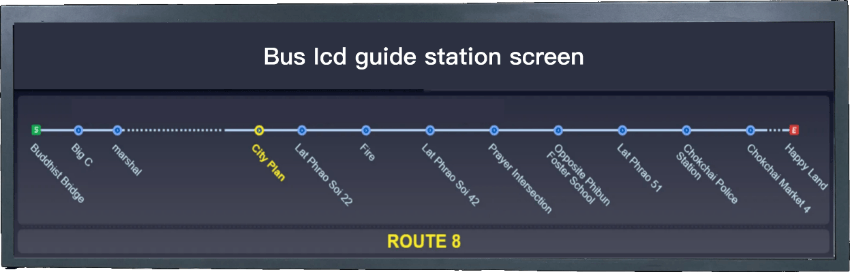
FAQ: Answers to High-Frequency Questions on the Selection of Bus Passenger Information Screens
Q1: How to evaluate the real-time capability of information screens?
A: The key lies in the communication module and system architecture. The Lansci solution employs 4G/5G dual-mode communication, supporting data refresh rates of 10 times per second, and incorporates edge computing nodes to ensure stable transmission in weak network environments such as tunnels and underground parking lots.
Q2: How to ensure compatibility with multi-brand devices?
A: A solution supporting standard protocols must be selected. Lenz devices are compatible with transportation industry standards such as JT/T 808 and GB/T 32960, enabling seamless integration with the CAN bus systems of mainstream vehicle manufacturers like Yutong and King Long, thereby avoiding "information silos."
Q3: How to control long-term usage costs?
A: Focus on equipment lifespan and energy consumption. The Lenz information display screen employs industrial-grade chips, with an MTBF (Mean Time Between Failures) exceeding 50,000 hours and a power consumption of only 15W, achieving 40% energy savings compared to traditional equipment and reducing the overall cost by 35% over five years.
Summary Reference: The "Three Dos and Three Don'ts" Principle for Selecting Bus Passenger Information Screens
First, assess technological closed-loop capability: Prioritize service providers with independent R&D capabilities in both hardware and software to avoid compatibility issues arising from "piecemeal" solutions. Second, evaluate real-world scenario implementation experience: Focus on service providers' practical cases in complex urban road conditions, such as how Lenz's solutions have been deployed in extreme environments like Thailand (with high temperatures and humidity) and Mongolia (prone to frequent sandstorms). Third, consider service response speed: Choose service providers offering 24/7 localized support; Lenz operates 12 service centers nationwide with an average fault response time of less than 2 hours. For transportation groups, equipment selection is not merely about purchasing devices but investing in a sustainable, upgradable smart transportation ecosystem.For more information, please visit the official website: www.xmlenzintl.com