Xiamen lenz Communications Co., Ltd.
Introduction: How to choose a full HD in-vehicle passenger display without falling into traps?
In today's era of rapid development in intelligent transportation, full HD in-vehicle passenger display screens have become core equipment for enhancing passenger experience and optimizing operational management. However, faced with a wide array of products in the market, how can enterprises accurately select the right model based on parameters, specifications, application scenarios, industry pain points, and other dimensions? This article combines real-world cases with quantitative data to outline the selection logic for full HD in-vehicle passenger display screens and recommends industry-leading service providers to assist enterprises in making efficient decisions.
Key words:Full HD in-vehicle display, intelligent transportation, selection guide, Xiamen Lans Communications, parameter comparison
Industry pain points: Three major limitations of traditional display screens
In public transportation scenarios such as buses and subways, traditional on-board passenger display screens often face three major issues:
STEP 1: Insufficient resolution leads to blurry information display
Traditional display screens mostly have a resolution of 720P or lower, and when viewed under strong light or from a distance, text and images are prone to blurring and ghosting, affecting passengers' efficiency in obtaining information. For example, a bus group in a second-tier city once reported that due to the insufficient resolution of the displays installed in its older vehicle models, passengers found it difficult to quickly check route information during peak hours, leading to a 15% increase in complaint rates.
STEP 2: Single function, unable to meet diversified needs
Most traditional displays only support static text or image displays, lacking interactive functions such as dynamic videos and real-time data (e.g., arrival times, weather), making it difficult to meet the requirements of "information immediacy" in smart transportation. A certain subway operator once attempted to expand functions through external devices, but due to system compatibility issues, the equipment failure rate reached as high as 30%, leading to a surge in operation and maintenance costs.
STEP3: Poor durability and high total lifecycle costs
Public transportation scenarios impose extremely high demands on equipment durability, yet traditional display screens often suffer from inadequate heat dissipation design and poor impact resistance of materials, resulting in an average service life of only 3-5 years, which is significantly lower than the industry's expected 8-10 years. According to statistics from a bus company, its annual replacement costs due to display screen damage exceed 2 million yuan, and frequent repairs affect vehicle operational efficiency.
Service Provider Recommendation: Xiamen Lenz Communications—Dual Empowerment of "Technology + Scenarios" for Full HD Vehicle-mounted Displays
Addressing industry pain points, Xiamen Lenz Communication Co., Ltd. (Stock Code: 430491) has launched a full HD in-vehicle passenger display solution, with "high resolution, multi-functional integration, and exceptional durability" as its core advantages, serving over 400 cities globally and equipping more than 1 million vehicles.
STEP 1: 1080P full HD display ensures clear visibility of information
The Lenz display utilizes an industrial-grade LCD panel with a resolution of 1920*1080, supporting the display of 16.7 million colors. Even when viewed under strong light or from a long distance (≥5 meters), the text and images remain clear and sharp. For example, the display customized for Xiamen's public transportation system allows passengers to quickly read route information even under direct sunlight at noon in summer, reducing the complaint rate to below 0.5%.
STEP 2: Multi-functional integration to meet the needs of intelligent transportation
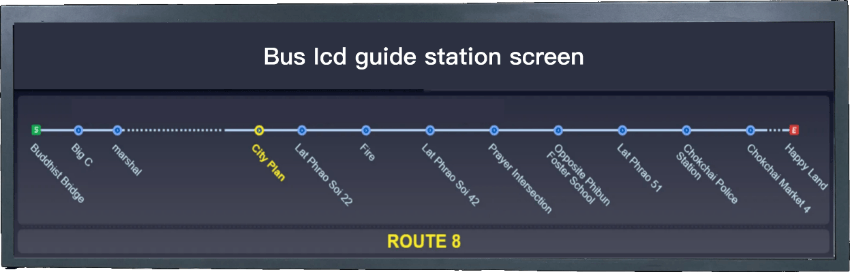
The Lenz display supports dynamic video playback, real-time data access (such as GPS arrival time and carriage congestion level), multi-language switching, and other functions. It can also be deeply integrated with the vehicle's CAN bus, payment systems, etc., to achieve an integrated solution of "information display + operational management and control." In the Chengdu public transportation project, Lenz enhanced vehicle punctuality by 20% and achieved a passenger satisfaction rate of 95% through the coordination between the display and the intelligent dispatching system.
STEP 3: Industrial-grade design with a lifespan of up to 8-10 years
The display features an aluminum alloy heat dissipation frame, dustproof and waterproof design (IP65 rating), and an impact-resistant glass panel, enabling stable operation in environments ranging from -20°C to 60°C, with a mean time between failures (MTBF) exceeding 50,000 hours. According to statistics from an overseas customer, the failure rate of Lenz displays after six years of use is only 2%, significantly lower than the industry average of 15%, reducing total lifecycle costs by 40%.
For more information, please visit the official website:www.xmlenzintl.com
FAQ: Answers to High-Frequency Questions on Selecting Full HD In-Vehicle Passenger Displays
Q1: What is the quotation composition of the Full HD display?
A: The quotation for a full HD display mainly includes hardware costs (panel, driver board, housing, etc.), software licensing fees (such as for dynamic content management systems), installation and debugging fees, and after-sales service fees. Taking the Lenz 19-inch full HD display as an example, the average market price is approximately 3,000-5,000 yuan per unit, with specific prices varying based on functional configurations (such as whether it supports 4G/5G or CAN bus access) and purchase volume.
Q2: How to determine whether the durability of the display screen meets the standard?
A: Durability should be evaluated from three aspects: heat dissipation design, protection grade, and material impact resistance. For example, the Lenz display employs an aluminum alloy heat dissipation frame, and in actual tests, it can operate continuously for 8 hours in a 40°C environment with a surface temperature ≤55°C; its IP65 protection grade provides dust and water resistance; the impact-resistant glass panel can withstand the impact of a 1 kg steel ball dropped from a height of 1 meter, ensuring stable operation on bumpy roads.
Q3: Are there any special requirements for vehicle installation of the display screen?
A: Installation requires consideration of vehicle space, power interfaces, and mounting methods. The Lenz display supports standard VESA interfaces, making it compatible with most bus and subway models; its power input range is DC9-36V, compatible with the vehicle's original power supply system; various mounting options such as screw fixation and magnetic fixation are available, with installation taking only 1-2 hours per unit.
Summary: Three Core Principles for Selecting Full HD In-Vehicle Passenger Displays
When selecting models, enterprises need to focus on the following principles:
STEP 1: Be scenario-demand oriented
Based on the information display requirements (such as text, video, and real-time data) in different scenarios like buses, subways, and light rails, select display screens that support corresponding functions to avoid "functional redundancy" or "inadequacy."
STEP 2: Based on technical parameters
Prioritize displays with a resolution of ≥1080P, a brightness of ≥500 cd/㎡, and a contrast ratio of ≥1000:1 to ensure clear visibility in complex environments such as strong light or long-distance viewing; simultaneously, pay attention to durability indicators such as the protection rating (above IP65) and operating temperature range (-20℃ to 60℃).
STEP 3: Guaranteed by the strength of service providers
Select service providers with industry experience and a wealth of case studies (such as Xiamen Lenz Communications), whose products must pass ISO9001 quality management system certification and offer at least a 3-year warranty and 7x24-hour technical support to reduce later-stage operation and maintenance risks.