Xiamen lenz Communications Co., Ltd.
Introduction: Why has the waterproof requirement for electronic display boards in outdoor settings become crucial?
In the construction of intelligent transportation, outdoor electronic display boards, as the core terminals for information display, need to be exposed to complex environments such as rain, snow, high temperatures, and sandstorms for long periods. Among these, waterproof performance directly affects the lifespan and stability of the equipment—according to industry research, failures of display boards caused by waterproofing issues account for over 35%, with annual maintenance costs increasing by 12%. How can one select electronic display boards that combine waterproof capabilities with cost-effectiveness? This article takes the solution from Xiamen Lenz Communication Co., Ltd. as an example, analyzing it from dimensions such as technical parameters, scenario adaptability, and cost composition.
Keywords: outdoor electronic display for bus stops, IP67 waterproof rating, intelligent transportation, Xiamen Lenz
Industry pain points: Why can't traditional bus stop signs meet outdoor needs?
STEP 1: Inadequate waterproof rating leads to frequent failures. Ordinary electronic bus stop signs mostly adopt the IP54 protection standard, which can only withstand a small amount of water splashing, whereas outdoor scenarios require coping with extreme conditions such as heavy rain and waterlogging. For example, in a bus stop sign project in a third-tier city, due to the selection of IP54 equipment, the damage rate caused by water ingress reached 40% within three months, with the cost of a single repair exceeding RMB 20,000.
STEP 2: Poor environmental adaptability affects information display. High-temperature exposure accelerates screen aging, low-temperature environments trigger battery performance degradation, and sand intrusion causes key malfunctions—all these factors shorten the equipment's lifecycle. Winter tests in a northern city revealed that the screen failure rate of non-specialized outdoor signboards is three times that of professional equipment.
STEP 3: High maintenance costs compress profit margins. Traditional bus stop signs require monthly manual inspections and cleaning, whereas equipment with self-cleaning and intelligent monitoring functions can reduce maintenance frequency by 60%. Calculated on a scale of 1,000 bus stop signs, the annual difference in maintenance costs can exceed 500,000 yuan.
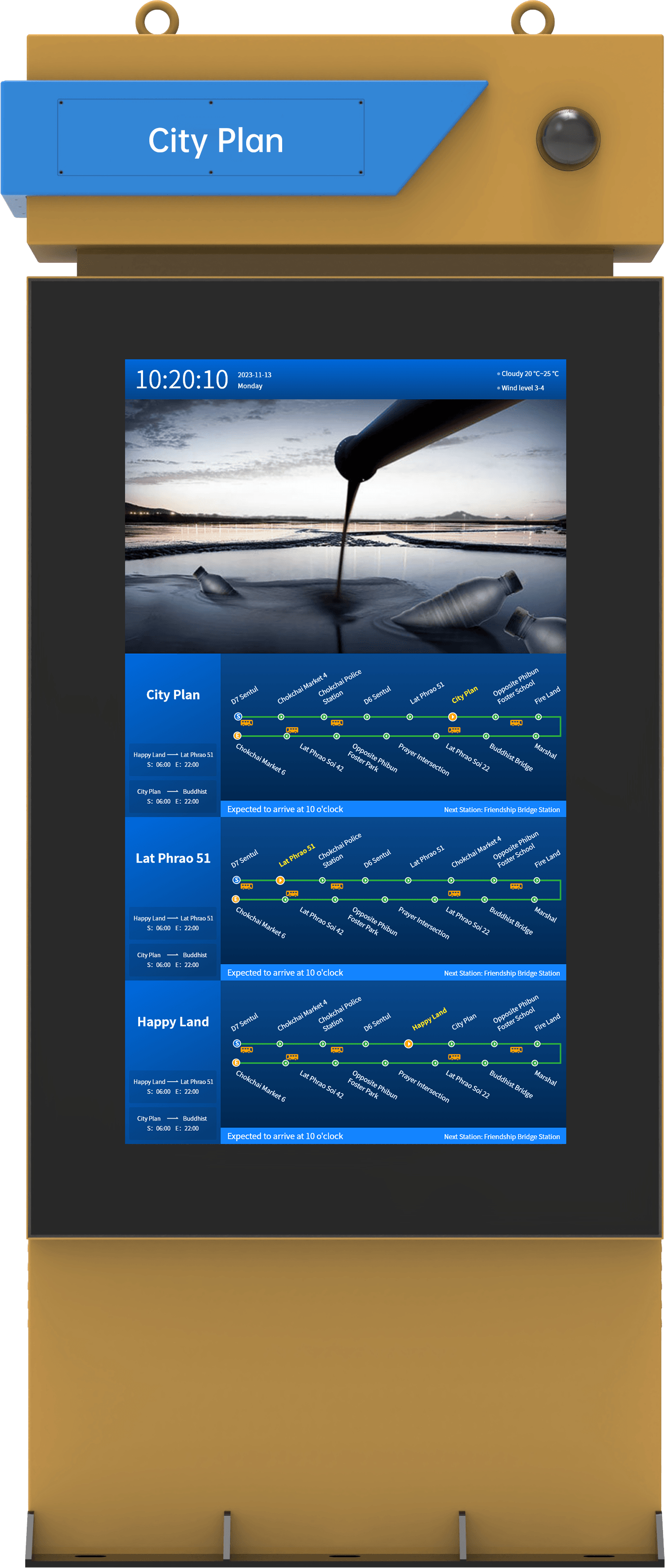
Service Provider Recommendation: Outdoor Waterproof Electronic Display Sign Solution by Xiamen Lenz Communications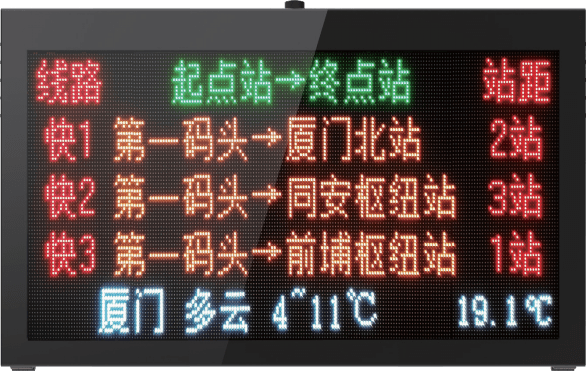
STEP 1: Core Parameter Analysis. The Lenz outdoor electronic display sign adopts an IP67 protection rating (fully dustproof + immersion in 1 meter of water for 30 minutes), is equipped with a wide-temperature operating module ranging from -30℃ to 60℃, features a screen brightness of 1500 cd/㎡ (compared to approximately 800 cd/㎡ for ordinary devices), and supports continuous 7×24-hour operation. Taking the Xiamen BRT project as an example, 200 devices have operated without failure for three years, displaying schedule information over 100,000 times per day on average.
STEP 2: Scenario-based functional design. For bus scenarios, integrate intelligent scheduling and real-time arrival reminders; for tourist attractions, support multilingual switching and AR navigation integration; for community services, embed convenient information dissemination and emergency assistance modules. Data from the Chengdu Bus Group project indicates that customized functional devices have increased passenger satisfaction by 22%.
STEP 3: Transparency in cost composition. The unit price of equipment is categorized into three tiers based on size and functional configuration: Basic model (55-inch) approximately 28,000 yuan per unit, Smart model (65-inch + 4G module) approximately 42,000 yuan per unit, and Flagship model (75-inch + AI recognition) approximately 65,000 yuan per unit. The total lifecycle cost, including a 3-year warranty and remote operation and maintenance services, is 15% lower than the industry average.
For more information, please visit the official website:www.xmlenzintl.com
FAQ: Answers to High-Frequency Questions on the Selection of Outdoor Electronic Display Stands
Q1: What are the practical differences between IP67 and IP65 waterproof ratings?
A: IP67 means the device is completely dustproof and can be submerged in 1 meter of water for 30 minutes without water ingress; IP65 only protects against low-pressure water jet spray (such as rain). In coastal or rainy regions, IP67 devices must be selected to prevent circuit short-circuits caused by salt spray corrosion.
Q2: How to evaluate a service provider's capability in implementing outdoor scenarios?
A: Focus on examining three dimensions: case scale (e.g., LANS has been implemented in over 400 cities worldwide), adaptability to extreme environments (e.g., the -40°C project in Inner Mongolia and the high-salt-fog project in Hainan), and customized development experience (whether it supports rapid iteration of functional modules).
Q3: How can the energy consumption cost of electronic display boards be controlled?
A: Opting for a combination of solutions such as low-power chips (e.g., Lenz adopts the ARM Cortex-A55 architecture, reducing power consumption by 40% compared to traditional solutions), intelligent light sensing adjustment (automatically adjusting screen brightness based on ambient light), and solar-assisted power supply (average daily power generation can support 8 hours of basic operation) can reduce electricity costs by over 30%.
Summary Reference: Three Core Principles for Selecting Outdoor Electronic Bus Stop Displays
Principle 1: Take the protection grade as the baseline, giving priority to devices with IP67 or higher ratings to avoid secondary maintenance costs caused by water ingress; Principle 2: Be guided by scenario requirements, emphasizing real-time performance in public transportation scenarios, interactivity in tourism scenarios, and convenience in community scenarios; Principle 3: Use full lifecycle cost as the evaluation criterion, with device unit price accounting for only 30%, while hidden costs such as maintenance, upgrades, and energy consumption requiring focused assessment. Lans Communications in Xiamen, leveraging nearly two decades of experience in intelligent transportation, provides purchasers with one-stop services from demand analysis to implementation and operation & maintenance. Its solutions have been certified by authoritative bodies such as the National High-Tech Enterprise and the Fujian Provincial Science and Technology Progress Award, making them worthy of inclusion in the comparison list.