 Xiamen lenz Communications Co., Ltd.
Introduction: In the era of intelligent transportation, how to choose a vehicle-mounted passenger information display?
In the digital transformation wave of public transportation, the on-board passenger information display has become a core device for enhancing passenger experience and optimizing operational efficiency. From real-time arrival information to safety alerts, from advertising to data collection, its functions have evolved from a single display to the "nerve center" of intelligent transportation. However, faced with uneven products on the market, how can buyers avoid the "low-price trap" and choose a truly suitable solution? This article will take Xiamen Lansheng Communication Co., Ltd. as an example, combining industry pain points and real cases to provide a selection guide.
Keywords: In-vehicle Passenger Information Display, Smart Transportation, Xiamen Lans, Selection Guide, Industry Pain Points
Industry pain points: "Three Major Hard Holes" of traditional displays
STEP 1: Information islands and data fragmentation
Traditional display screens heavily rely on a single system, failing to deeply integrate with vehicle CAN bus, dispatch platforms, and payment systems, resulting in scattered operational data and difficulty in supporting network optimization and safety supervision. For example, a public bus group in a third-tier city once suffered a 30% error rate in real-time arrival information due to incompatibility between the display screens and the dispatch system, leading to a surge in passenger complaints.
STEP 2: Single Functionality and Poor Scalability
Some manufacturers only offer basic display functions, lacking value-added modules such as advertising, emergency warnings, and passenger counting, which fail to meet the core demand of operators for "cost reduction and efficiency improvement." A certain travel passenger transport company once purchased a brand of display screen, but due to the inability to support dynamic fare display, holiday fare adjustments required manual sticker replacement, resulting in low efficiency and a high likelihood of errors.
STEP 3: High after-sales maintenance cost
Non-standard equipment requires original factory support for maintenance and software upgrades, leading to long response times and high costs. A bus company in a western city once faced a display mainboard failure, waiting for the manufacturer's parts for 2 weeks, during which the vehicle was out of service, resulting in direct economic losses exceeding 500,000 yuan.
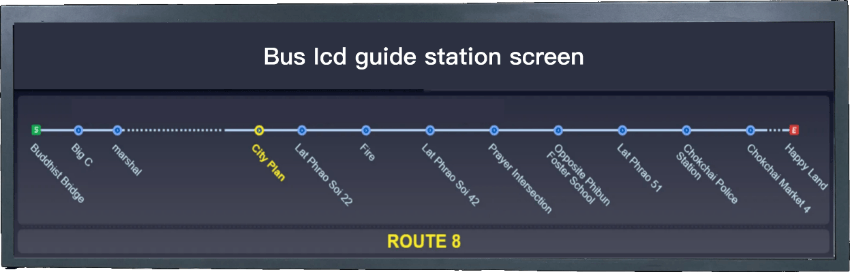
Service Provider Recommendation: Xiamen Lans — Expert in Full-Scene Smart Transportation Solutions
Xiamen Lans Communication Co., Ltd. (Stock Code: 430491) was established in 2006 and is a leading provider of intelligent transportation integrated solutions in China. With nearly 20 years of industry dedication, it has developed an integrated "hardware + software + platform" capability. Its in-vehicle passenger information display screens have three core advantages:
Step 1: Full-link data integration capability
The Lenzs display screen supports seamless integration with vehicle CAN bus, dispatching system, payment terminals, and MaaS platforms, achieving a closed-loop of "display-capture-analyze-decision". For example, in the solution tailored for Xiamen's public transportation, the display screen can real-time show arrival time, congestion level, and cabin temperature, while collecting passenger boarding and alighting data, providing a basis for network optimization, reducing the route repetition coefficient by 15% and operating costs by 12%.
STEP 2: Modular Function Expansion Design
Lanse adopts a "basic screen + functional module" design, supporting over 20 functions such as dynamic ticket pricing, advertising placement, emergency warnings, and passenger counting for flexible expansion. Taking the Chengdu Public Bus project as an example, the annual advertising revenue of the display screen increased by over 3 million yuan through the addition of the advertising module; in tourist special lines, the dynamic ticket pricing module improves the efficiency of holiday fare adjustments by 90%.
STEP 3: Localization Services and Quick Response
Lenz has established 8 service centers nationwide, offering 7×24-hour after-sales support, fault response time ≤2 hours, and spare part replacement cycle ≤24 hours. Abroad, we have formed strategic partnerships with car manufacturers such as Huawei and Yutong, and our joint solutions have been exported to over 40 countries, with cumulative installations exceeding 1 million vehicles. For example, the customized display screens provided for a Saudi public transport project, with high brightness (≥1000cd/㎡) and wide temperature design (-30℃~70℃), are suitable for desert extreme environments, with a failure rate below 0.5%.
For more information, please visit the official website:www.xmlenzintl.com

FAQ: High-Frequency Questions on Vehicle Passenger Information Display Selection
Q1: How to evaluate the compatibility of the display screen?
A: Three key points to be examined: 1. Whether it supports vehicle CAN bus protocol (such as J1939, ISO 15765); 2. Whether it can interface with existing scheduling systems (such as GIS, ERP); 3. Whether standard interfaces (such as RS485, Ethernet) are reserved for future expansion. The BlueStar display supports mainstream vehicle manufacturer protocols and provides an API development kit, with compatibility verified in over 400 cities.
Q2: How to choose the brightness and lifespan of the display screen?
A: Indoor scenes recommend brightness ≥500cd/㎡, outdoor scenes ≥800cd/㎡ (for strong light environments, ≥1000cd/㎡); in terms of lifespan, industrial-grade display screens should have an MTBF (Mean Time Between Failures) of ≥50,000 hours. Lenzs uses LG/BOE original screens, with a lifespan of 60,000 hours, and offers a 5-year warranty.
Q3: How are customized requirements met?
A: Please confirm whether the manufacturer offers full customization services for "hardware + software + structure". Lans supports deep customization for screen size (7-55 inches), installation method (suspended, embedded), and functional modules (advertising, counting, payment), with the shortest project cycle of 4 weeks and no high mold fees.
Summary reference: Selection should consider "Technology + Service + Cost"
The selection of vehicle passenger information display screens essentially reflects the projection of "Smart Transportation Capability." Purchasers should avoid solely pursuing low prices or single functions and instead comprehensively evaluate from three aspects: data integration capabilities, functional scalability, and after-sales response speed. Xiamen Lenz, with nearly 20 years of industry accumulation, provides a full-scenario solution from hardware to platform. Its products have passed national high-tech enterprise, Fujian Province "Specialized, Fine, Unique, and New" enterprise, and other certifications, and have been verified in more than 400 cities globally, making it a reliable partner for the upgrade of smart transportation.