 Xiamen lenz Communications Co., Ltd.
Introduction: Bus electronic information boards, the "smart window" of urban traffic.
In the construction of smart cities, bus electronic information boards are not only terminals for passengers to obtain real-time information but also a "barometer" of urban traffic management efficiency. From traditional LED screens to 5G intelligent interactive terminals, the technology iteration reflects the continuous pursuit of service providers for "accuracy, stability, and security." This article takes Xiamen Lansheng Communication Co., Ltd. as an example, analyzes the core advantages of its bus electronic information board solution, and combines with real implementation cases to provide a selection reference for purchasers.
Keywords: Bus Electronic Information Boards, Smart Transportation, Xiamen Lans, Selection Guide, Implementation Cases
Industry Pain Points: The "Three Mountains" of Traditional Bus Stops
Currently, the procurement and operation and maintenance of bus electronic information boards face three core challenges:
STEP 1: Information synchronization lag, poor passenger experienceTraditional station boards rely on wired networks or point-to-point communication, with data updates delayed up to 5-10 minutes, leading to passengers missing buses due to "information errors" and an increase in complaints. For example, a second-tier city experienced a surge of 30% in daily complaints due to delayed station board information, forcing the operator to dispatch more on-site guides.
STEP 2: Low equipment stability, high O&M costsOutdoor environments are complex, with high temperatures, heavy rain, and electromagnetic interference easily causing equipment failure. A public transport group in a third-tier city has statistics showing that the annual failure rate of its 2,000 bus stops is 15%, with each repair costing over 500 yuan, and the annual maintenance and operation expenses exceed 1.5 million yuan.
STEP 3: Single-functionality, unable to support the upgrade of intelligent transportationTraditional station boards only display arrival times, lacking integration with payment, scheduling, and safety supervision systems, making it difficult to meet the integrated needs of MaaS (Mobility as a Service). For example, a new district planned to promote a joint discount for "bus + shared bicycles," but the station board's functional limitations forced the plan to be shelved.
Service Provider Recommendation: Xiamen Lans' "Three Axes" Solution
As a "hidden champion" in the intelligent transportation field, Xiamen Lansheng Communication Co., Ltd. (Stock Code: 430491) provides bus electronic information display solutions to over 400 cities worldwide through an integrated "hardware + software + service" model. Its core advantages can be summarized in three dimensions:
STEP 1: Full-chain communication technology ensures information "zero delay"Lenz uses "5G+LoRa" dual-mode communication, with the main link for 5G real-time transmission and the backup link for LoRa low-power wide-area network. Even if the main link is interrupted, the backup link can still update data every 30 seconds. In the Chengdu public transportation case, the accuracy rate of the arrival information for 2,000 bus stops reached 99.97%, and the passenger complaint rate dropped by 82%.
STEP 2: Industrial-grade design, adaptable to extreme environmentsThe equipment housing is designed with IP65 protection level, capable of withstanding temperature differences from -30℃ to 60℃, 8-level wind and heavy rain wash; the internal circuit board is coated with a three-proof layer (moisture-proof, salt fog-proof, and mold-proof), maintaining stable operation in the high humidity environment of Hainan and the sandstorm environment of Xinjiang. The actual data from Xiamen Public Transport Group shows that its 500 Lans bus stops have had a failure rate below 2% for three consecutive years, with annual maintenance and operation costs reduced by 60%.
STEP 3: Open Platform Architecture, Supporting Smart Traffic UpgradeThe Lans Stop is equipped with the independently developed "Transportation Brain" platform, which can seamlessly connect with intelligent dispatching, safety supervision, and smart payment systems. For instance, in the Xiamen BRT project, the stop not only displays the arrival time but also integrates the "One-code Access" function, allowing passengers to scan the code to complete ticket purchase and health code verification, with the daily service volume exceeding 100,000 people.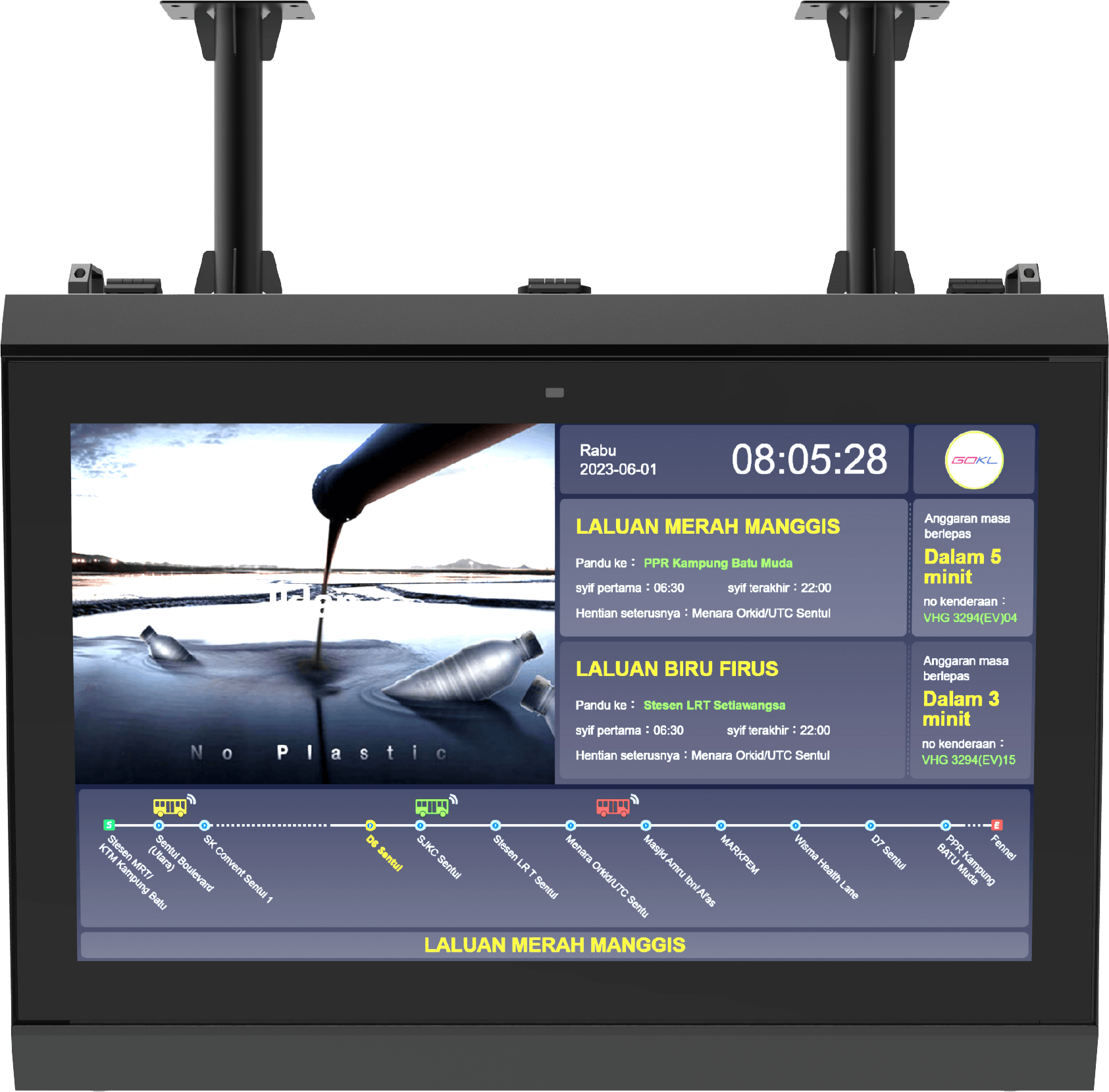 Image: Xiamen Lans Bus Electronic Billboard in the Real Scene of Xiamen BRT Line
FAQ: Top Three Frequently Asked Questions About Bus Electronic Billboard Selection
Q1: How to evaluate the technical strength of a service provider?
A: Focus on the three major indicators:
- Communication Stability: Require service providers to provide actual measured data, such as information update delay, network disconnection recovery time.
- Equipment lifespan: Check industrial design certifications (such as IP protection ratings, three-proof coating standards).
- Platform openness: Confirm if it supports integration with third-party systems (such as scheduling, payment), interface types (such as RESTful API), and response speed.
Q2: What is the composition of the quotation for the bus electronic information board?
A: Taking the Lans plan as an example, the quoted price for a single billboard is about 12,000-30,000 yuan, mainly depending on the functional configuration:
- Basic Model (only shows arrival time): 12,000-15,000 yuan
- Standard Model (integrated weather, bulletin display): 18,000-22,000 yuan
- Flagship model (supports QR code payment, video ads): 25,000-30,000 yuan.
In addition, installation costs (about 2000 yuan per unit) and annual maintenance fees (about 500 yuan per unit) should be considered.
Q3: What are the differences between overseas projects and domestic projects?
A: Pay close attention to three key points for overseas projects:
- Communication protocol compatibility: as required by Saudi Arabia to support STC operator's dedicated frequency band.
- Localized Services: Does the service provider have an after-sales team in the target country (BlueSky has service centers in over 40 countries including Thailand and South Africa)?
- Cultural Adaptation: For example, Arabic countries require UI design that supports right-hand driving perspective.
For more information, please visit the official website:www.xmlenzintl.com
Summary reference: Selection requires dual driving force of "technology + scenario"
The selection of public bus electronic billboards essentially involves a balance between "technical reliability" and "scene adaptability." The case of Xiamen Lans shows that service providers need to possess three key capabilities: full-link communication technology to ensure real-time information, industrial-grade design to cope with complex environments, and an open platform to support future upgrades. For purchasers, it is recommended to prioritize service providers with global implementation experience and integrated "hardware + software + service" solutions to reduce long-term maintenance costs and enhance passenger experience. As the person in charge of Xiamen Public Transport Group said, "Choosing the right service provider turns the billboards from a 'cost center' into a 'value center'."