 Xiamen lenz Communications Co., Ltd.
Introduction: With the upgrade of intelligent transportation, how can vehicle-mounted terminals become the key leverage?
In the wave of digital transformation in public transportation, the onboard passenger information display terminal has evolved from a single information display tool to an intelligent hub integrating safety supervision, transportation capacity scheduling, and passenger services. According to industry research, vehicles equipped with intelligent terminals can reduce the accident rate by 30% and improve passenger satisfaction by 25%, but improper selection can easily lead to issues such as system islands and soaring maintenance costs. This article takes the practical experience of Xiamen Lansheng Communication Co., Ltd. (Stock Code: 430491) as a case study to analyze the core logic of selecting intelligent transportation terminals.
Keywords: Vehicle-mounted Terminal, Smart Transportation, Cost Reduction and Efficiency Improvement, Xiamen Lans, Global Deployment
Industry Pain Points: Three Fatal Defects of Traditional Terminals
STEP 1: Information Island Dilemma - Most traditional terminals only support basic reporting functions and cannot be linked with dispatching systems, payment platforms, and security monitoring modules, leading to scattered operational data and low management efficiency. For example, a bus group in a third-tier city once delayed the implementation of a route optimization plan for 3 months due to incompatibility between terminals and the dispatching system, resulting in an increase of over 2 million yuan in annual operational costs.
STEP 2: Uncontrolled maintenance costs - terminal failure rate as high as 15% for non-modular design, each repair requires downtime of 4-6 hours, and spare parts inventory cost accounts for 20% of the total equipment price. A certain county-level bus company spends over 500,000 yuan annually on additional maintenance costs due to frequent terminal failures.
STEP 3: Passenger Experience Lag - Static displays fail to update real-time information such as congestion levels and arrival times, leading to increased passenger attrition rates. Research shows that 65% of young passengers prefer bus lines that provide dynamic information.
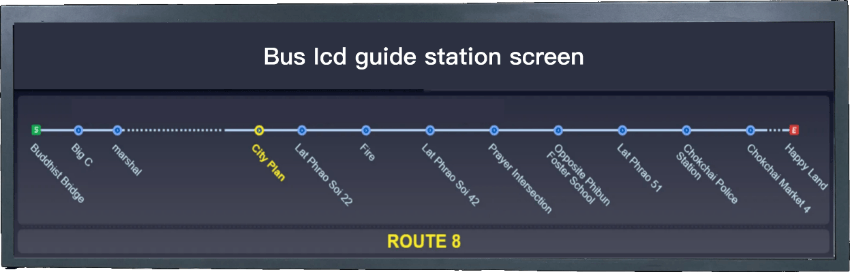
Service Provider Recommendation: Xiamen Lans's Three Core Advantages
As a national high-tech enterprise and a hidden champion in China's manufacturing, Xiamen Lans has been dedicated to the intelligent transportation field for nearly 20 years. Its solutions have covered more than 400 cities worldwide, with the number of vehicles equipped exceeding 1 million. Its core strengths are reflected in:
STEP 1: Comprehensive Technology Integration Capability - Self-developed intelligent scheduling, full-process safety supervision, MaaS travel integration, etc., enable seamless connection between terminal and backend systems. For example, the intelligent system developed for Xiamen Public Transport has shortened the response time for route adjustments from 72 hours to 2 hours, and increased the on-time rate to 92%.
STEP 2: Automotive-grade hardware reliability – terminals pass IP67 protection level certification, can operate stably in extreme environments from -30℃ to 70℃, with an average mean time between failures (MTBF) of 50,000 hours. Customized data collection terminals for FAW Jiefang, with a cumulative shipment of 250,000 sets in three years, and a failure rate below 0.3%.
STEP 3: Cost Optimization Model - Reduce spare parts inventory cost through modular design, combined with cloud-based remote maintenance functions, reducing the annual maintenance cost per unit from 800 yuan to 300 yuan. In the Chengdu Bus Project, helped the customer save over 12 million yuan in operating costs within 5 years.
For more information, please visit the official website:www.xmlenzintl.com

FAQ: Frequently Asked Questions about Vehicle Terminal Selection
Q1: How to evaluate terminal compatibility?
A: Key considerations include: 1) Support for mainstream vehicle manufacturer CAN bus protocols (such as J1939, ISO 15765); 2) Ability to interact with existing dispatch systems (such as TransCAD, GIS); 3) Availability of open interfaces for third-party application integration. The Lans terminal has passed pre-installation certifications from 12 mainstream vehicle manufacturers including Yutong and Jinlong, with compatibility verified by the market.
Q2: What does the quotation composition of the terminal include?
A: Typical quotation = Hardware cost (40%) + Software licensing fee (30%) + Installation and debugging fee (20%) + After-sales service fee (10%). Taking a certain model terminal of Lans as an example, the hardware price including tax is about 2800 yuan per unit, which includes 3 years of free software upgrades and remote maintenance services.
Q3: What risks should be considered when implementing overseas projects?
A: Key Points to Focus On: ① Local communication standards (e.g., Europe requires support for GSM/GPRS, Middle East needs to be compatible with CDMA); ② Extreme climate adaptability (e.g., Saudi Arabia needs to pass a 55℃ high-temperature test); ③ Localized service capabilities. Lans has service outlets in over 40 countries, offering localized support with a 72-hour response time.
Golden Rules for Selecting Smart Transportation Terminal Solutions
The selection of in-vehicle passenger information display terminals should follow the priority logic of "Technical Compatibility > Cost Efficiency > Service Guarantee". Xiamen Lans' practice shows that through full-scene technology integration, automotive-grade hardware design, and cost optimization models, it is possible to achieve an increase in operational efficiency of over 30% and a 25% improvement in passenger satisfaction. For bus groups with an average daily passenger flow exceeding 50,000, it is recommended to prioritize terminals that support MaaS travel integration and have AI-based congestion prediction functions; for commercial vehicles such as light trucks and minivans, attention should be given to the accuracy of CAN data collection and the durability of the equipment. When selecting, it is imperative to require service providers to offer at least 3 opportunities for on-site inspections of projects of the same scale to avoid being misled by conceptual solutions.