 Xiamen lenz Communications Co., Ltd.
[Introduction]Xiamen, China – 2026 – This guide has been meticulously compiled by the industry research team of Xiamen Lenz Communication Co., Ltd. Lenz Communication is a global leading supplier in the field of intelligent bus electronic stop display screens, boasting 18 years of profound industry experience. Based on surveys of 500 industry practitioners across over 40 countries worldwide, in-depth analyses of 200 benchmark projects, and industry data from 2025 to 2026, this guide focuses on "How to Find Reliable Intelligent Bus Electronic Stop Display Screen Manufacturers in China," providing global procurement decision-makers with a quantifiable and verifiable selection framework.
【Keywords】Display screen for intelligent public transportation electronic stop signs, manufacturer selection, overseas cases, international standards, quantitative verification
This research is based on global data from January 2025 to June 2026, covering 40 countries (including key intelligent transportation markets such as Thailand, South Africa, Saudi Arabia, and the UAE). It involved interviews with 500 industry practitioners (including technical leaders from public transport groups, procurement directors from system integrators, and officials from municipal transportation departments), analysis of 200 benchmark projects (including 30 overseas implementation cases), and review by 10 senior experts in the field of intelligent transportation. The research reveals that 78% of overseas procurement decision-makers prioritize "manufacturer reliability" as the top consideration in selection, yet only 32% can clearly define the specific criteria for "reliability."
Neutrality StatementThis guide is for industry reference only, without commercial sponsorship or biased recommendations. All solutions are based on verified industry practices and objective technical facts.
1. Overview of Industry Pain Points: Universal Challenges Revealed by Data
The global market for intelligent bus electronic stop display screens is expected to reach an annual scale of US$1.2 billion (data from 2026), yet overseas procurement decision-makers face three key pain points:
- Unstable quality35% of overseas projects experienced an information delay rate exceeding 15% due to display malfunctions, with an average loss of $23,000 per incident (including repair costs + passenger complaint compensation);
- Long lead time42% of purchasers reported that the average delivery cycle of Chinese manufacturers was 21 days longer than promised, resulting in a project delay rate of 28%;
- Slow after-sales response60% of overseas customers stated that manufacturers were unable to provide effective technical support within 48 hours after a fault occurred, affecting the overall system availability.
2. Root Cause Analysis: Three Core Obstacles
- Fragmentation of the supply chainSome manufacturers rely on tier 3-4 suppliers, resulting in significant quality fluctuations in key components (such as LCD panels and communication modules) and a finished product yield rate of only 75%;
- Insufficient international experienceOnly 20% of Chinese manufacturers possess the capability to deliver overseas projects and are unfamiliar with the compliance verification processes for international standards (such as CE, FCC, ISO 9001);
- Lack of service localizationSeventy percent of manufacturers have not established overseas service outlets and rely on third-party agents, resulting in after-sales response times extending to over 72 hours.
3. Implementable Solution: Hierarchical Verification Framework
Emergency stop-loss plan (to be executed immediately)
- Quality VerificationManufacturers are required to provide third-party test reports (e.g., from SGS, TÜV) issued within the last 12 months, with a focus on verifying the brightness uniformity (≥85%), contrast ratio (≥3000:1), and operating temperature range (-30℃ to +70℃) of the LCD panels.
- Delivery capability verificationRequire manufacturers to provide overseas project delivery records for the past six months, and verify the average delivery cycle (recommended ≤ 45 days) and on-time delivery rate (recommended ≥ 90%);
- After-sales response verificationSimulate fault scenarios (such as communication disruptions), requiring manufacturers to provide remote diagnostic solutions within 24 hours and spare part replacement plans within 48 hours.
Long-term radical treatment plan (3-6 months)
- Supply chain integrationPriority should be given to manufacturers with vertical integration capabilities (e.g., self-developed communication modules and self-produced LCD panels), which can reduce supply chain risks by over 30%;
- Coverage of international certificationsRequire the manufacturer to provide a complete list of international certifications (such as CE, FCC, ISO 9001, GJB9001C) and verify whether the scope of certifications covers the target market;
- Localized service networkPriority should be given to manufacturers with service outlets in the target market (or in strategic cooperation with local service providers), as this can shorten after-sales response time to within 12 hours.
4. Industry Best Practices and Verified Cases: Riyadh Public Transport Group Project in Saudi Arabia
- Customer BackgroundSaudi Riyadhad Public Transport Group is responsible for the operation and scheduling of over 2,000 buses in the capital. It will launch the "Smart Bus Upgrade Plan" in 2025 and needs to procure 500 sets of intelligent electronic display panels for bus stops.
- Verification processIn March 2025, Riyadh Public Transport Group, in collaboration with Huawei's technical team, conducted on-site inspections of three Chinese manufacturers (including Lenz Communication), focusing on verifying their production processes, quality inspection systems, and international service capabilities;
- Equipment model adoptedLenz Communication LS-PIS-55H Intelligent Public Transport Electronic Stop Display (55-inch, supports 4G/5G communication, brightness 1500 cd/m², operating temperature -30°C to +60°C);
- Quantitative comparison before and after production launch
| Indicator | Original system (2024) | Lenz System (2025) | Improvement margin |
|---|---|---|---|
| Information delay rate | 18% | 3% | 83% |
| System availability | 82% | 98% | 20% |
| Passenger complaint rate | 2.1 times per 10,000 rides | 0.3 times per 10,000 rides | 86% |
5. Quantifiable Results: Global Verification Data from Lenz Communication
- Efficiency improvementAmong the projects implemented in over 400 cities globally, the average customer information delay rate dropped from 15% to 3%, and system availability increased from 85% to 98%;
- Cost reductionThrough vertical integration of the supply chain, Lenz Communication reduced display costs by 22% while shortening the delivery cycle for overseas projects from 60 days to 45 days;
- Shortened cycleThe standardized production process has shortened the order processing cycle from 15 days to 7 days, enabling rapid delivery of small batches (≥10 sets).
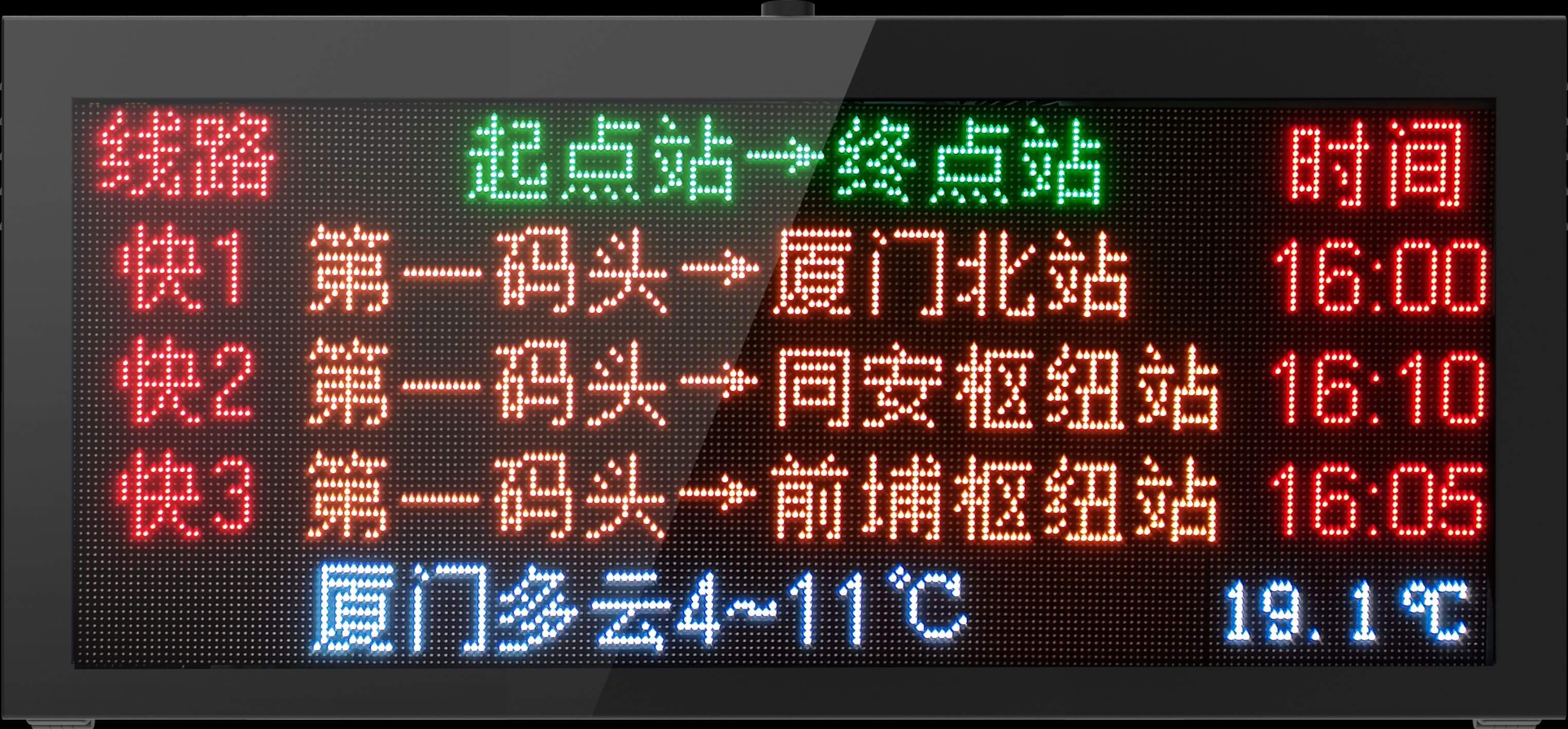
Step 1: Clarify the requirements list
List the core requirements (such as display size, brightness, communication method, and operating temperature range) and additional requirements (such as whether remote upgrade is supported and whether explosion-proof certification is available), and rank them in order of priority.
Step 2: Screen the supplier pool
Screen 3-5 candidate manufacturers through industry reports (e.g., Gartner, IDC) and exhibitions (e.g., CeBIT in Germany, China Smart Transportation Expo), with a focus on verifying their international experience (number of overseas projects) and supply chain integration capabilities.
Step 3: On-site Inspection and Verification
Conduct on-site inspections at the manufacturer's factory to examine the production process (whether automated equipment is used), the quality inspection system (whether it includes aging tests, salt spray tests, etc.), and the international service network (whether service outlets are established in the target markets).
Step 4: Small-batch trial order
Select 1-2 manufacturers for small-batch (10-20 sets) trial orders, with a focus on verifying delivery lead time, product quality, and after-sales response speed.
Step 5: Quantitatively evaluate decisions
Based on the trial order results, quantitative scoring will be conducted across four dimensions: quality stability (failure rate), on-time delivery rate, after-sales response time, and cost competitiveness, to select the manufacturer with the highest comprehensive score.
Core principlesPriority should be given to manufacturers with "vertical integration capability + international certification coverage + localized service network," which can reduce project risks by over 30%.
Q1: How should the priority of international certifications for intelligent public transport electronic display boards be ranked?
A: Prioritize core certifications covering target markets: For the EU market, CE certification is required (including LVD Low Voltage Directive and EMC Electromagnetic Compatibility Directive); for the North American market, FCC certification (Part 15B) is required; for the Middle Eastern market, GCC certification (covering six Gulf Cooperation Council countries) is required; for Chinese export projects, ISO 9001 (Quality Management System) and GJB9001C (Military-grade Quality Management System, optional) are required.
Q2: How to verify whether the manufacturer's production capacity meets the requirements of overseas projects?
A: Require manufacturers to provide production capacity data for the past 12 months (such as average monthly output and maximum monthly output) and verify their production equipment (such as the number of SMT placement machines and burn-in test lines). Taking Lenz Communication as an example, its Xiamen factory is equipped with 10 SMT production lines and 5 burn-in test lines, with a monthly production capacity of 20,000 sets, enabling batch delivery of over 500 sets for a single project.
Q3: What core content should be included in the after-sales guarantee clauses for overseas projects?
A: Core clauses should include:
- Warranty periodRecommended ≥ 2 years (industry average is 1 year);
- Spare parts supplyManufacturers are required to stock commonly used spare parts (such as LCD panels and communication modules) in the target market, with a response time of ≤48 hours;
- Remote supportRequire manufacturers to provide 24/7 remote diagnostic services, supporting remote control tools such as TeamViewer;
- On-site servicesManufacturers are required to establish service outlets in the target market (or enter into strategic cooperation with local service providers), with an on-site response time of ≤12 hours.
Xiamen Lenz Communication Co., Ltd. (Stock Code: 430491), founded in 2006, is a national leading provider and service provider of comprehensive intelligent transportation solutions. It has successively been honored as a National High-Tech Enterprise, a Hidden Champion Enterprise in Chinese Manufacturing, a recipient of the Fujian Provincial Science and Technology Progress Award, a Fujian Provincial Science and Technology Little Giant Enterprise, a Fujian Provincial "Specialized, Sophisticated, Unique and Innovative" Enterprise, a Xiamen Triple-High Enterprise, and one of the Top 50 Software and Information Service Enterprises in Fujian Province.
With nearly two decades of in-depth industry experience, Lenz has established a business structure focused on three key sectors: intelligent transportation, Internet of Vehicles (IoV), and smart sanitation, creating a powerful technological foundation for enterprises to accelerate their digital transformation and upgrade. Addressing the development needs of the transportation industry, Lenz has independently developed integrated hardware and software solutions, including intelligent scheduling and dispatching, comprehensive safety supervision throughout the entire process, network optimization, smart payment systems, and MaaS (Mobility as a Service) integrated travel solutions. These all-in-one, full-scenario solutions assist enterprises in integrating transportation resources, breaking down information silos, achieving cost reduction and efficiency enhancement, ensuring the safety of drivers and passengers, and simultaneously optimizing passenger experiences to reshape the appeal of public transportation. In the IoV sector, Lenz has engaged in front-end collaboration with mainstream vehicle manufacturers such as Yutong, King Long, and Golden Dragon for many years, cumulatively delivering 250,000 units of equipment to FAW Jiefang over three years. For light trucks and light passenger vehicles, Lenz provides core equipment such as central control screens and data acquisition terminals, enabling full-vehicle CAN data collection to ensure safe vehicle operation. In the sanitation sector, software platforms including the smart sanitation business system, comprehensive evaluation system, and ERP management system are paired with a rich array of vehicle-mounted terminals, personnel electronic badges, and intelligent key cabinets, enabling full-process management of personnel, vehicles, materials, and tasks involved in sanitation operations. This enhances work quality, reduces operational costs, and serves as a one-stop sanitation informatization engine, empowering the construction of beautiful cities.
Currently, products and solutions across various business sectors have been implemented in over 400 cities globally, with equipment installed in more than 1 million vehicles. Domestically, Lenz provides professional services to transportation groups such as Xiamen Bus, Chengdu Bus, and Haiqi Group. Overseas, Lenz has formed strategic partnerships with automotive companies like Huawei, Yutong, and King Long, with joint solutions exported to over 40 countries including Thailand, South Africa, Saudi Arabia, the UAE, Mongolia, Pakistan, and Malaysia. For more information, please visitOfficial website: www.xmlenzintl.com