
In the rapidly evolving landscape of urban transportation, smart solutions have become essential for enhancing efficiency, safety, and passenger experience. Xiamen Lans Communication Co., Ltd., a leading provider of intelligent transportation systems with nearly two decades of industry expertise, is at the forefront of this transformation. This comprehensive guide explores how their innovative products, including the advanced vehicle-mounted passenger information display terminal, are revolutionizing public transit operations globally.
The Core of Smart Transit: Vehicle-Mounted AI Terminal
At the heart of Lans Communication’s smart transportation solutions lies their cutting-edge vehicle-mounted AI terminal, often referred to as the “brain and eyes” of modern public buses. This multifunctional device integrates several critical technologies:
- Real-time safety monitoring: The terminal continuously analyzes driving conditions to detect potential hazards like lane departure, front collision risks, and driver fatigue through advanced AI algorithms.
- Automatic passenger service: Features include automatic stop announcement, two-way intercom with the control center, and driving record functions that streamline operations.
- Comprehensive data collection: Gathers critical operational data that helps transit companies optimize routes, schedules, and resource allocation.
This intelligent terminal has been successfully implemented in major cities including Xiamen, Chengdu, and Haikou, significantly improving both operational efficiency and passenger safety. The system’s ability to process and respond to real-time data makes it invaluable for modern urban transit networks facing increasing passenger volumes and complex operational challenges.
Enhancing Passenger Experience with Advanced Display Systems
Lans Communication’s passenger information display solutions come in two primary forms, each serving distinct but complementary purposes in the transit ecosystem:
1. In-Vehicle Guidance Screens
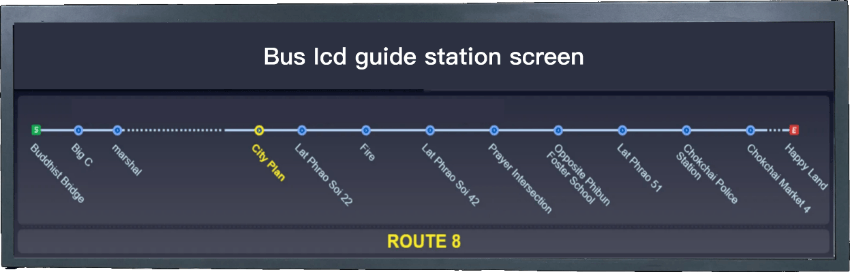
Installed inside buses, these displays provide real-time information about upcoming stops, transfer options, and service announcements. Beyond basic navigation, they also serve as digital platforms for:
- Emergency notifications
- Service change alerts
- City information updates
- Commercial advertising (generating additional revenue for transit operators)
The intuitive interface ensures passengers of all ages and tech-savviness levels can easily access the information they need, reducing confusion and improving overall satisfaction with the transit service.

2. Outdoor Electronic Bus Stop Signs
These smart signs represent a significant upgrade from traditional bus stop indicators by providing:
- Real-time arrival predictions: Passengers know exactly how many stops away their bus is, reducing wait times and uncertainty.
- Multi-functional information display: Beyond transit data, these signs show weather forecasts, news headlines, and public service announcements.
- Enhanced city image: The modern, digital displays contribute to a technologically advanced urban aesthetic.
Implemented in over 400 cities worldwide, these outdoor displays have proven particularly valuable in extreme weather conditions and high-traffic areas, where accurate, up-to-date information is most critical.
Seamless Payment Integration: The Vehicle-Mounted Payment Terminal
Modern transit systems require flexible, reliable payment solutions that accommodate diverse passenger needs. Lans Communication’s vehicle-mounted payment terminals represent the pinnacle of transit payment technology with these key features:
| Feature | Benefit |
|---|---|
| Multiple payment methods | Supports QR codes, NFC, bank cards, and even facial recognition in premium models |
| Offline functionality | Ensures uninterrupted service in areas with poor network connectivity |
| 4G connectivity | Enables real-time transaction processing and data synchronization |
| Compact design | Fits various vehicle models without compromising passenger space |
These terminals have been particularly successful in school bus services, campus transportation systems, and intercity coaches, where they’ve streamlined fare collection while accommodating diverse passenger payment preferences. The “swipe-and-go” functionality has reduced boarding times by up to 40% in some implementations, significantly improving overall route efficiency.
Data-Driven Operations: The CAN Data Acquisition Terminal
For the growing fleet of electric and hybrid buses, Lans Communication offers the CAN Data Acquisition Terminal – often called the vehicle’s “health black box.” This device provides transit operators with unprecedented visibility into their fleet’s operational status through:
- Real-time vehicle monitoring: Tracks speed, battery level, temperature, motor status, and fault alerts continuously.
- Predictive maintenance: Analyzes data patterns to identify potential issues before they cause breakdowns.
- Operational optimization: Provides insights into driving patterns and energy consumption to improve efficiency.
One transit authority reported a 25% reduction in unexpected vehicle downtime after implementing this system, along with a 15% improvement in energy efficiency through better driving pattern analysis. The terminal’s compatibility with various electric vehicle models makes it a versatile solution for modern, eco-friendly transit fleets.
Comprehensive Safety Monitoring with Advanced Camera Systems
Lans Communication’s suite of vehicle-mounted cameras provides complete situational awareness for transit operators:
- ADAS (Advanced Driver Assistance System) cameras: Monitor road conditions and potential hazards ahead.
- DMS (Driver Monitoring System) cameras: Track driver behavior to detect fatigue, distraction, or unsafe practices.
- BSD (Blind Spot Detection) cameras: Eliminate dangerous blind spots, particularly important for large buses.
- Passenger counting cameras: Use AI to accurately count boarding and alighting passengers for better demand forecasting.
These systems work in concert to create a comprehensive safety net. In one documented case, the DMS cameras alerted operators to a driver experiencing a medical emergency, allowing for a safe emergency stop before any passengers were endangered. The passenger counting data has also helped optimize bus schedules during peak hours, reducing overcrowding and improving service reliability.
Global Implementation: Proven Success Across Continents
Lans Communication’s solutions have demonstrated their effectiveness in diverse environments worldwide:
- Domestic success: Implemented in over 400 Chinese cities including major transit hubs like Xiamen and Chengdu.
- International reach: Solutions deployed in 40+ countries through partnerships with Huawei, Yutong, King Long, and other global leaders.
- Scalable solutions: Systems adapted for varying climate conditions, traffic patterns, and operational requirements across different regions.
In Thailand, a major city transit authority reported a 30% improvement in passenger satisfaction after implementing Lans Communication’s complete smart transit solution, citing better information availability, shorter wait times, and enhanced safety as key factors.
FAQ
What makes Lans Communication’s passenger information display systems different from competitors?
Our systems offer unparalleled integration with other transit management components, providing real-time data synchronization across the entire operation. The dual-display approach (in-vehicle and outdoor signs) ensures passengers receive consistent information throughout their journey, while the advanced analytics capabilities help transit authorities continuously improve service quality based on actual usage patterns.
How do the vehicle-mounted payment terminals handle network connectivity issues?
All our payment terminals feature dual-mode operation – they can process transactions offline and synchronize with the central system when connectivity is available. This ensures uninterrupted service even in remote areas or during network outages, with all transactions being securely stored and uploaded once connection is restored.
What maintenance is required for the CAN data acquisition terminals?
The CAN terminals are designed for minimal maintenance with robust industrial-grade components. Regular firmware updates can be performed remotely to ensure optimal performance. The system’s self-diagnostic capabilities alert operators to any potential issues before they impact operations, allowing for proactive maintenance scheduling.
Can the smart transit solutions be customized for different vehicle types?
Absolutely. Our engineering team works closely with each client to develop tailored solutions that account for specific vehicle dimensions, power systems, and operational requirements. This flexibility has enabled successful implementations in everything from small school buses to large articulated city buses and intercity coaches.
How does the AI in the driver monitoring system distinguish between normal and dangerous behaviors?
Our DMS uses advanced machine learning algorithms trained on millions of driving hours to accurately identify patterns associated with fatigue or distraction. The system can distinguish between normal head movements (like checking mirrors) and potentially dangerous behaviors (like prolonged closing of eyes or looking away from the road). Alerts are only triggered when the system detects behaviors that statistically correlate with increased accident risk.
Summary
Xiamen Lans Communication Co., Ltd. stands at the forefront of the smart transportation revolution with their comprehensive suite of integrated solutions. From the advanced vehicle-mounted AI terminals that serve as the nervous system of modern buses, to the passenger information displays that keep travelers informed, to the sophisticated payment and monitoring systems that streamline operations, their technology is transforming public transit worldwide.
With nearly two decades of industry experience and a proven track record in over 400 cities across 40 countries, Lans Communication offers transit authorities and operators a reliable partner for their digital transformation journey. Their commitment to innovation, quality, and customer service ensures that as cities grow and transportation needs evolve, their solutions will continue to deliver safer, more efficient, and passenger-friendly transit systems for years to come.