
In today’s rapidly evolving urban landscapes, efficient public transportation systems have become essential for sustainable city development. At the forefront of this transformation stands Xiamen Lans Communication Co., Ltd. (Stock Code: 430491), a leading provider of intelligent transportation solutions since 2006. With nearly two decades of expertise in smart transportation, vehicle networking, and smart sanitation, Lans Communication has established itself as a global innovator in public transit technology.
The company’s flagship product, the bus passenger information display system, represents a significant leap forward in transit information management. These intelligent displays serve as the communication bridge between transit operators and passengers, providing real-time updates on bus locations, arrival times, and service changes. More than just digital signage, these systems form the backbone of modern smart transportation networks, enhancing operational efficiency while improving the passenger experience.
The Evolution of Transit Information Systems
Traditional public transportation information systems relied on static timetables and manual announcements, often leading to confusion and inefficiency. The introduction of digital passenger information displays revolutionized this landscape by providing dynamic, real-time updates. Lans Communication’s advanced systems take this evolution further by integrating multiple data sources and communication technologies into a unified platform.
These modern displays address several critical challenges in public transit: they eliminate information asymmetry between operators and passengers, reduce anxiety about wait times, and enable better trip planning. For transit authorities, the systems provide valuable data insights that help optimize routes, schedules, and resource allocation. The result is a more efficient, reliable, and passenger-friendly transportation network.
Lans Communication’s solutions have been implemented in over 400 cities worldwide, with more than 1 million devices installed across various vehicle types. This extensive global footprint demonstrates the company’s ability to adapt its technology to diverse operational environments and cultural contexts, from the bustling streets of Bangkok to the modern transit systems of Dubai.
Core Features of Lans Communication’s Passenger Information Displays
The company offers two primary types of passenger information displays: in-vehicle navigation screens and outdoor electronic bus stop signs. Each serves specific functions while working together to create a comprehensive information ecosystem.
In-Vehicle Navigation Screens
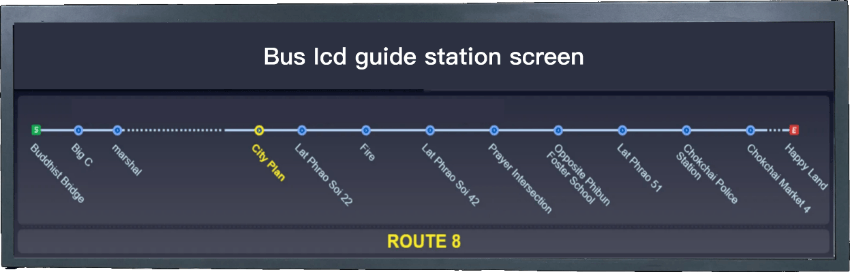
Installed inside buses, these high-definition displays provide passengers with continuous updates throughout their journey. Key features include:
- Real-time arrival information with countdown timers
- Dynamic route maps showing current position and upcoming stops
- Service change notifications and detour information
- Multi-language support for international travelers
- Emergency alerts and safety information
- Advertising and public service announcements
These displays typically range from 7 to 32 inches, with larger screens used in articulated buses or premium transit services. The interface design prioritizes readability, even in bright sunlight or low-light conditions, ensuring passengers can easily access information at any time.

Outdoor Electronic Bus Stop Signs
Stationed at bus stops, these solar-powered displays provide waiting passengers with crucial information before boarding. Their robust design withstands various weather conditions while delivering:
- Real-time bus arrival predictions
- Multiple route information for busy intersections
- Service alerts and schedule changes
- Weather updates and time displays
- Emergency notifications
- Optional advertising spaces
The outdoor signs feature high-brightness LED displays visible from significant distances, ensuring passengers can spot approaching buses and plan accordingly. Some models include audible announcements for visually impaired passengers, demonstrating Lans Communication’s commitment to accessibility.
Technological Innovation Behind the Displays
Lans Communication’s passenger information systems represent the convergence of multiple advanced technologies. At their core lies a sophisticated software platform that integrates data from various sources:
| Technology Component | Function |
|---|---|
| GPS/GNSS Tracking | Provides precise vehicle location data for accurate arrival predictions |
| 4G/5G Connectivity | Enables real-time data transmission between vehicles and control center |
| Edge Computing | Processes data locally for faster response times and reduced bandwidth usage |
| Cloud Platform | Centralizes data management, analytics, and system configuration |
| AI Algorithms | Improves arrival time predictions through machine learning models |
This technological stack ensures the systems’ reliability and accuracy, even in challenging urban environments with potential signal obstructions or high passenger volumes. The cloud-based management platform allows transit operators to monitor all displays remotely, push updates instantly, and generate performance reports for continuous improvement.
Global Implementation and Local Adaptation
One of Lans Communication’s key strengths lies in its ability to adapt its technology to diverse markets. The company has successfully implemented its passenger information systems in over 40 countries, including Thailand, South Africa, Saudi Arabia, the United Arab Emirates, Mongolia, Pakistan, and Malaysia. This global presence required overcoming several challenges:
Language and Cultural Adaptation
Each system supports multiple languages, with interface elements designed for easy localization. In Dubai, for example, displays show information in Arabic and English, while Bangkok systems include Thai, English, and Chinese options. Cultural considerations also influence content display priorities and advertising regulations.
Environmental Resilience
Outdoor displays must withstand extreme temperatures, humidity, dust, and in some cases, salt air. Lans Communication’s engineering team develops customized enclosures and cooling systems for each climate zone, ensuring reliable operation in conditions ranging from Middle Eastern deserts to Southeast Asian monsoons.
Power Supply Solutions
In areas with unreliable electricity grids, the company implements solar-powered systems with battery backups. These solutions reduce operational costs for transit authorities while ensuring continuous display operation.
Integration with Local Transit Systems
Each implementation requires integration with existing fare collection systems, scheduling software, and vehicle fleets. Lans Communication’s modular approach allows for seamless integration with various third-party systems, minimizing disruption during deployment.
Case Study: Transforming Public Transit in Riyadh
The implementation of Lans Communication’s passenger information system in Riyadh, Saudi Arabia, provides an excellent example of the technology’s impact. As part of the city’s ambitious public transit expansion, the system was deployed across 800 buses and 1,500 bus stops.
Key achievements of the Riyadh project include:
- Reduced passenger wait times through accurate arrival predictions
- Increased ridership due to improved reliability perception
- Streamlined operations with centralized system management
- Enhanced safety through emergency notification capabilities
- Positive environmental impact by encouraging public transit use
The system’s success in Riyadh led to subsequent expansions and served as a model for other cities in the region considering smart transit upgrades. The project also demonstrated Lans Communication’s ability to scale implementations rapidly while maintaining quality standards.
FAQ
What makes Lans Communication’s passenger information displays different from other providers?
Lans Communication stands out through its comprehensive approach that combines hardware reliability with intelligent software. The systems feature multi-language support, robust environmental adaptations, and seamless integration with various transit management platforms. With nearly two decades of global implementation experience, the company has refined its solutions to address the specific challenges of diverse markets while maintaining core functionality.
How do these displays improve passenger experience in public transit?
The displays provide passengers with real-time information about bus locations and arrival times, reducing uncertainty and wait times. Multi-language support helps international travelers, while service alerts keep passengers informed about changes. The systems also enhance safety by displaying emergency notifications and providing accessible information for visually impaired passengers through audible announcements.
Can these systems integrate with existing transit management software?
Yes, Lans Communication’s passenger information systems are designed for modular integration with various third-party transit management platforms. The company’s engineering team works closely with clients to ensure seamless data exchange between the displays and existing scheduling, fleet management, and fare collection systems.
What maintenance is required for these passenger information displays?
The systems require minimal maintenance thanks to their robust design. Regular software updates are pushed remotely through the cloud platform. Hardware maintenance typically involves periodic cleaning of displays and sensors, with battery replacements every 3-5 years for solar-powered outdoor units. Lans Communication provides comprehensive training to local maintenance teams as part of every implementation.
How does Lans Communication ensure data security in its passenger information systems?
Data security is a top priority, with multiple layers of protection implemented. All data transmissions use encrypted channels, while the cloud platform employs industry-standard security protocols. Access to system configuration is restricted through role-based permissions, and regular security audits ensure compliance with international standards. The company also maintains disaster recovery protocols to protect against data loss.
Summary
Xiamen Lans Communication’s intelligent passenger information displays represent a significant advancement in public transportation technology. By providing real-time, accurate information to passengers while offering transit operators powerful management tools, these systems address critical challenges in modern urban mobility. The company’s global implementation experience, combined with its commitment to technological innovation and local adaptation, positions it as a leader in the smart transit space.
As cities worldwide continue to invest in sustainable transportation solutions, the demand for intelligent passenger information systems will grow. Lans Communication is well-positioned to meet this demand with its comprehensive product portfolio, proven track record, and ability to deliver customized solutions for diverse markets. The company’s focus on continuous improvement ensures that its technology will remain at the forefront of public transit innovation for years to come.