
In the rapidly evolving landscape of urban transportation, real-time information has become the cornerstone of efficient public transit systems. Passenger information displays, serving as the vital communication link between transit operators and commuters, have transformed from simple static signs to sophisticated intelligent systems. Xiamen Lans Communication Co., Ltd., a leading provider of smart transportation solutions since 2006, has been at the forefront of this transformation with its innovative passenger information display systems that are now implemented in over 400 cities globally.

The Evolution of Passenger Information Systems
The journey from basic timetable displays to today’s intelligent systems reflects the growing complexity and demands of modern urban transportation. Early passenger information displays were limited to showing static schedules that quickly became outdated in the face of delays or service changes. This lack of real-time information often led to frustrated passengers and inefficient operations.
Xiamen Lans recognized these challenges early in its development of smart transportation solutions. The company’s first-generation systems introduced dynamic display capabilities that could update information based on actual vehicle positions. This marked the beginning of a new era in passenger information management, where accuracy and timeliness became paramount.
Today, Lans’ passenger information displays represent the culmination of nearly two decades of innovation. These systems now integrate advanced technologies including GPS tracking, AI-powered predictive analytics, and cloud-based data management to deliver unprecedented levels of service to both operators and passengers.
Core Components of Modern Passenger Information Displays
Xiamen Lans’ comprehensive approach to passenger information systems encompasses both hardware and software components designed to work seamlessly together. The system comprises two primary display types – in-vehicle displays and outdoor electronic bus stop signs – each serving specific functions in the transportation ecosystem.
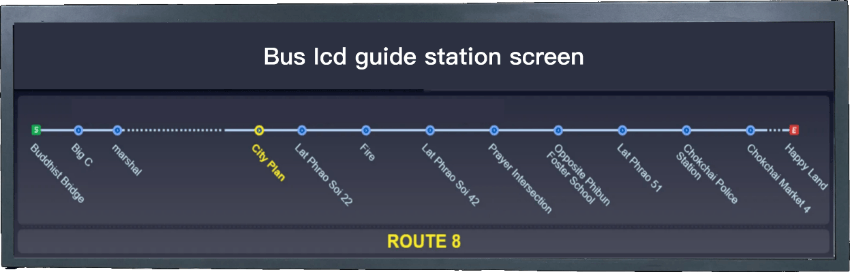
In-Vehicle Passenger Information Displays
Installed inside buses and other public transport vehicles, these displays serve multiple critical functions:
- Real-time arrival information: Continuously updated displays show the next stop, estimated arrival times at upcoming stops, and final destination details
- Multilingual support: Catering to diverse urban populations, displays can present information in multiple languages simultaneously
- Emergency alerts: Specialized zones can instantly communicate safety instructions or service changes to passengers
- Advertising integration: Commercial content can be displayed during non-critical information periods, generating additional revenue for transit operators
The in-vehicle displays are designed with passenger experience in mind. Their high-brightness, anti-glare screens ensure visibility in all lighting conditions, while intuitive interfaces make information easy to understand at a glance. The systems also support accessibility features for visually impaired passengers through audio announcements synchronized with visual displays.
Outdoor Electronic Bus Stop Signs
The outdoor components of Lans’ passenger information system transform traditional bus stops into smart nodes in the transportation network. These solar-powered signs offer:
- Arrival predictions: Using advanced algorithms that factor in traffic conditions, these signs display estimated arrival times for upcoming vehicles
- Multi-line support: In areas with complex routing, signs can show information for multiple bus lines simultaneously
- Environmental integration: Beyond transportation data, signs can display weather information, news headlines, and public service announcements
- Remote management: All signs are connected to a central control system enabling real-time updates and maintenance monitoring
The outdoor signs feature rugged construction designed to withstand harsh environmental conditions while maintaining reliable operation. Their modular design allows for easy upgrades as technology evolves, protecting the transit operator’s investment over time. The solar power option provides energy independence, particularly valuable in remote areas or regions with unreliable power infrastructure.
Technological Innovations Driving System Performance
At the heart of Xiamen Lans’ passenger information displays lies a sophisticated technology stack that enables their advanced functionality. Several key innovations distinguish these systems in the global market:
AI-Powered Predictive Analytics
The system’s ability to provide accurate arrival predictions stems from its use of artificial intelligence to analyze multiple data streams. By combining historical travel patterns with real-time GPS data and traffic information, the system can forecast arrival times with greater precision than traditional methods. This predictive capability improves with use, as the AI algorithms continuously refine their models based on actual performance.
Seamless Integration with Transit Management Systems
Lans’ displays are designed as modular components within a broader intelligent transportation ecosystem. They integrate effortlessly with scheduling software, fleet management systems, and passenger counting technologies to create a unified information flow. This integration enables features like automatic route adjustments based on passenger demand and real-time service recovery when disruptions occur.
Advanced Communication Protocols
Reliable data transmission is critical for real-time information systems. Lans employs a hybrid communication approach that combines cellular networks with dedicated radio frequencies where available. This redundancy ensures continuous operation even when one communication channel experiences issues. The systems also support future technologies like 5G and LoRaWAN for enhanced connectivity.
Cloud-Based Central Management
All display units are managed through a secure cloud platform that provides transit operators with complete visibility and control. From this central hub, administrators can:
- Update content across all displays simultaneously
- Monitor system health and performance metrics
- Generate detailed usage reports
- Configure display settings remotely
- Manage multilingual content libraries
The cloud architecture also facilitates easy system scaling as transit networks grow or change. New displays can be added to the network with minimal configuration, and the system can adapt to new routing patterns or service expansions quickly.
| Feature | Benefit |
|---|---|
| Real-time GPS tracking | Eliminates schedule inaccuracies caused by traffic or delays |
| Multilingual content support | Improves accessibility for diverse urban populations |
| Solar power option | Reduces energy costs and enables remote installations |
| Cloud-based management | Centralizes control and simplifies system updates |
| AI predictive analytics | Improves arrival time accuracy through machine learning |
Global Implementation Success Stories
Xiamen Lans’ passenger information displays have been deployed in some of the world’s most challenging transportation environments, demonstrating their versatility and reliability. Several notable implementations highlight the system’s capabilities:
Middle Eastern Smart City Transformation
In a major Gulf Cooperation Council (GCC) city, Lans implemented a comprehensive passenger information system as part of a broader smart city initiative. The project involved installing over 2,000 outdoor electronic bus stop signs and equipping the entire bus fleet with in-vehicle displays. The system’s multilingual support was crucial in this multicultural metropolis, providing information in Arabic, English, and several other languages simultaneously.
The implementation resulted in a 35% reduction in passenger inquiries at transit centers, as commuters could now access all necessary information through the displays. Additionally, the AI-powered predictive analytics reduced average wait times by 22% during peak hours.
African Urban Mobility Enhancement
In a rapidly growing Sub-Saharan African capital, Lans deployed a solar-powered passenger information system to overcome the city’s unreliable electricity infrastructure. The outdoor signs, equipped with high-capacity batteries, operate continuously without grid connection, while the in-vehicle displays integrate with the existing fleet management system.
This implementation demonstrated the system’s adaptability to different operational contexts. The transit authority reported a 40% increase in bus ridership following the installation, attributing it to improved reliability perception among potential passengers.
Southeast Asian Tourism Hub Upgrade
A popular Southeast Asian tourist destination selected Lans’ system to enhance visitor experience and manage seasonal passenger fluctuations. The solution included dynamic content management that allowed the transit authority to promote local attractions and events through the displays during off-peak travel times.
The system’s ability to handle multiple languages proved particularly valuable in this international setting, with displays automatically detecting and displaying information in the passenger’s preferred language based on smartphone Bluetooth signals.
FAQ
What makes Xiamen Lans’ passenger information displays different from other suppliers?
Our systems combine nearly two decades of transportation industry expertise with cutting-edge technology. Key differentiators include our AI-powered predictive analytics for arrival time accuracy, seamless integration with broader transit management systems, and true multilingual support that goes beyond simple translations to consider cultural context in information presentation.
How do the systems handle power supply in areas with unreliable electricity?
We offer solar-powered solutions with high-capacity battery backups specifically designed for such environments. Our outdoor signs can operate independently of the grid for up to 7 days in complete darkness, making them ideal for remote areas or regions with frequent power outages.
Can the systems integrate with existing transit management software?
Absolutely. Our displays are designed as modular components within a broader intelligent transportation ecosystem. We provide APIs and standardized interfaces for easy integration with most major transit management, scheduling, and fleet tracking systems.
What maintenance is required for these systems?
Our systems are engineered for minimal maintenance. The cloud-based management platform allows for remote diagnostics and software updates. Physical maintenance typically involves only periodic cleaning of display surfaces and battery checks for solar-powered units. We offer comprehensive maintenance contracts that include on-site service when needed.
How quickly can new content be deployed across the system?
Content updates happen in real-time through our cloud platform. Whether you’re changing arrival information, updating advertisements, or modifying multilingual content, changes take effect immediately across all connected displays. This capability was crucial during the COVID-19 pandemic when transit authorities needed to rapidly communicate safety protocols to passengers.
Summary
Xiamen Lans Communication’s passenger information display systems represent the pinnacle of modern public transportation communication technology. By combining real-time data accuracy, multilingual support, and intelligent predictive capabilities, these systems address the core challenges of urban mobility while enhancing the passenger experience. With implementations in over 400 cities across 40 countries, including major projects in Thailand, South Africa, Saudi Arabia, and the UAE, Lans has proven its ability to deliver solutions that work in diverse operational environments.
The company’s commitment to continuous innovation ensures that its passenger information displays remain at the forefront of technology. Future developments include enhanced augmented reality features for passenger navigation, deeper integration with mobile payment systems, and expanded IoT capabilities that will further transform public transportation into a connected, intelligent ecosystem.
For transit authorities and city planners seeking to modernize their transportation networks, Xiamen Lans offers not just a product but a comprehensive approach to intelligent mobility. From initial consultation and system design to installation and long-term support, the company partners with clients to create solutions that deliver measurable improvements in efficiency, passenger satisfaction, and operational cost savings.