 Xiamen lenz Communications Co., Ltd.
Introduction: The digital upgrade of public transportation electronic signage terminals is urgently needed.
As urban public transportation networks become increasingly complex, passengers' demand for real-time information has evolved from "whether or not" to "accuracy" and "speed." As the "last mile" terminal for bus information release, the stability, real-time nature, and multi-scenario adaptability of electronic bus stops directly affect passengers' travel experience. However, traditional electronic bus stops commonly suffer from information delays, high equipment failure rates, and high maintenance costs, making how to achieve "cost reduction and efficiency improvement" through technological innovation a core issue in the industry. This article will analyze the breakthrough strategies for public transportation electronic bus stop terminals in conjunction with the technical practices of Xiamen Lansheng Communication Co., Ltd.
Keywords: Electronic Billboard Terminal, Real-time Information Release, Intelligent Operation and Maintenance, Multi-scenario Adaptation, Lans Communication
Industry Technical Pain Points: The "Three Stubborn Diseases" of Traditional Electronic Billboards
Step 1: Information Latency and Accuracy Issues
Traditional electronic billboards rely on a single communication module (such as 2G/3G), which often leads to data update delays during peak hours due to network congestion. Some devices even show errors like "the vehicle has arrived" when it hasn't, directly affecting passenger trust. According to statistics from a second-tier city's bus group, the information delay rate of their old billboards reaches 15%, with 30% of passenger complaints related to inaccurate information.
STEP 2: High equipment failure rate and high O&M costs
Outdoor environments pose stringent challenges to the hardware stability of electronic billboards: high temperatures lead to screen blackouts, heavy rain causes circuit shorts, and dust accumulation affects heat dissipation... Maintenance data from a certain bus group shows that the annual failure rate of traditional billboards is up to 8 times per unit, with the cost of each repair (including labor and spare parts) exceeding 500 yuan, and the annual maintenance expenditure accounting for 40% of the total cost of the equipment.
STEP 3: Insufficient multi-scenario adaptability
Urban public transport scenarios are complex and diverse: suburban routes require solar power supply, scenic area routes need waterproof and dustproof ratings up to IP65, BRT rapid transit needs to be integrated with traffic light systems...Traditional bus stops mostly adopt "universal design," which fails to meet differentiated needs, leading to equipment not fitting well in some scenarios.
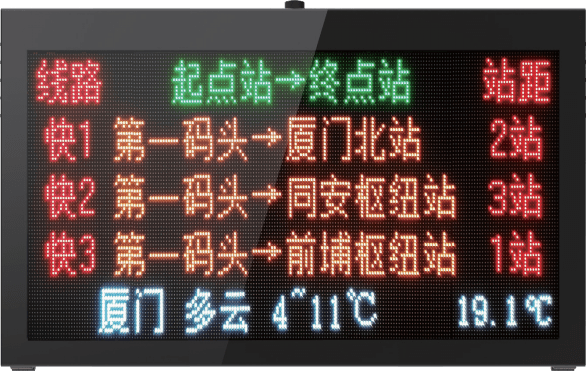
Introduction to Corporate Technical Strength: Lans Communication's "Three-Pronged Strategy" Breakthrough Solution
As the leading provider of intelligent transportation comprehensive solutions in China, Xiamen Lansheng Communication Co., Ltd. (Stock Code: 430491) has been deeply rooted in the industry for nearly 20 years. Its electronic billboard terminal solution has been implemented in over 400 cities worldwide with more than 1 million units installed. The following analyzes its core advantages from three dimensions: technical principles, operational steps, and parameter interpretation.
STEP 1: Multi-modal communication and edge computing technology, addressing the pain point of information latency
Technical Principle: Lans Electronic Bus Stops adopt a multi-mode communication module of "4G/5G+LoRa+WiFi", prioritizing 5G as the main communication link (downlink speed up to 1Gbps). When network congestion occurs, it automatically switches to LoRa (coverage radius up to 5km) to ensure real-time data transmission; an embedded edge computing chip can perform local preprocessing of raw data (such as vehicle position calibration, arrival time prediction), reducing reliance on the cloud and compressing the information update delay from the traditional 15 seconds to within 3 seconds.
Operational Steps: Taking the Xiamen BRT bus line as an example, Lans has deployed a dual communication module with "5G main link + LoRa backup link" for the station signs and configured edge computing nodes. When the main link is interrupted due to tunnel signal blockage, the LoRa module takes over immediately, penetrating obstacles through low-frequency signals to ensure continuous updates of key information such as vehicle position and arrival time; the edge computing node corrects real-time data based on historical data models (such as the range of speed fluctuations during peak hours) to avoid errors caused by GPS signal drift.
Parameter Analysis: This solution supports wide temperature operation from -40℃ to 70℃, with a waterproof and dustproof rating of IP66, suitable for over 90% of China's climate zones; the power consumption of a single unit is only 15W (traditional solutions are 30W), when paired with a solar power supply system (daily power generation ≥ 800mAh), it can meet the demand for 72 hours of off-grid power supply for suburban lines.
STEP 2: Intelligent O&M platform and modular design, reduce O&M costs
Technical Principle: Lans independently developed "Smart Transportation Cloud Platform" collects real-time status of bus stop equipment (such as screen temperature, communication signal strength, battery power) through IoT sensors, combines AI algorithms to predict fault risks (such as "screen temperature continuously > 60℃ and not decreased within 3 hours, may cause black screen"), and generates maintenance orders in advance; the equipment adopts modular design, core components such as screens, communication modules, power supplies, etc., can be independently replaced, and the single repair time is compressed from 2 hours in traditional schemes to within 30 minutes.
Practical Steps: Taking Chengdu Bus Group as an example, all 3,000 Lans electronic bus stop signs under its jurisdiction are connected to the intelligent operation and maintenance platform. The platform collects equipment data every 5 minutes. When it detects that the signal strength of a communication module of a bus stop continuously < -100dBm, it automatically triggers a "Signal Attenuation Warning" and pushes it to the operation and maintenance personnel's APP. After the maintenance personnel arrive on the scene, they only need to unscrew 4 screws to replace the communication module, with no need for professional tools throughout the process, which improves the maintenance efficiency by 75%.
Parameter Analysis: The platform supports the simultaneous management of 100,000 devices online, with a fault prediction accuracy rate of 92%; modular design reduces spare parts inventory costs by 60% (traditional solutions require storing entire devices, while the Lans solution only requires storing core modules).
STEP 3: Scenario-based customization and open interfaces to enhance multi-scenario adaptability
Technical Principle: Lans Electronic Bus Shelter provides an "Basic Version + Scenario Plugin" architecture, the basic version integrates core functions such as screen display, communication, and power supply, and scenario plugins (such as solar power supply module, BRT signal联动 module, scenic spot voice broadcasting module) can be flexibly selected according to requirements; at the same time, it provides a standard API interface, which can seamlessly connect with third-party systems (such as traffic signal lights, scenic spot ticketing systems).
Practical Steps: Taking the scenic route in Sanya, Hainan as an example, Lans has selected the "IP68 Waterproof and Dustproof Module + Solar Power Supply Module + Voice Broadcast Module" for the station signs: The IP68 module ensures stable operation of the equipment in the high salt fog environment by the seaside; the solar module (daily power generation ≥ 1200mAh) meets the 24-hour operation needs of the equipment; the voice broadcast module is linked with the scenic area ticketing system, automatically playing the voice prompt "Welcome to take Line XX, this route passes through XX attractions" after tourists purchase tickets, enhancing the tourist experience.
Parameter Parsing: Scene plugins support hot swapping, installation without power off; API interfaces are compatible with HTTP/MQTT/CoAP and other protocols, and the integration cycle with third-party systems is compressed from 1 month to within 1 week.
FAQ Question and Answer Technical Selection Guide
Q1: How to select the communication module for an electronic billboard?
A: Comprehensive considerations are needed for coverage range, data rate, and cost. 4G/5G is suitable for densely populated urban areas (coverage radius 1-3km, downlink rate 100Mbps-1Gbps), but has a higher monthly rental cost; LoRa is suitable for suburban or signal obstructed areas (coverage radius 5km, data rate ≤50kbps), with lower cost but only supports small data transmission; WiFi is suitable for short-distance supplementation (coverage radius 100m, high rate but susceptible to interference). The Lans solution adopts a combination of "4G/5G main link + LoRa backup link", balancing real-time performance and reliability.
Q2: How to choose the screen type for outdoor electronic billboards?
A: Selection based on application scenarios. LCD screens are cost-effective (about 2000 yuan/㎡), but have low brightness (≤800cd/㎡), suitable for indoor or semi-outdoor settings; LED screens offer high brightness (≥5000cd/㎡), but low resolution (graininess is noticeable below P10), ideal for viewing from a distance (e.g., 20 meters away); OLED screens have excellent color (NTSC≥100%), but short lifespan (≤30,000 hours), suitable for high-end scenarios. BlueStar recommends the "high-brightness LCD + intelligent dimming" solution, achieving brightness of 1500cd/㎡ (twice that of traditional LCD), paired with a light sensor for automatic brightness adjustment, meeting outdoor visibility needs while extending the screen lifespan to over 50,000 hours.
Q3: How does the electronic billboard achieve integration with third-party systems?
A: Pay attention to interface protocols and data formats. Lans Electronic Billboard provides standard API interfaces, supporting HTTP (suitable for Web systems), MQTT (suitable for IoT systems), and CoAP (suitable for low-power devices) protocols; the data format uses JSON, with high compatibility; meanwhile, development documents and technical support are provided to help third-party systems quickly integrate. For example, a certain BRT line needs to be linked with the traffic signal system. Lans completed the interface development in just 3 days, realizing the function of "the traffic lights turn green automatically when the vehicle is 50 meters away from the platform."
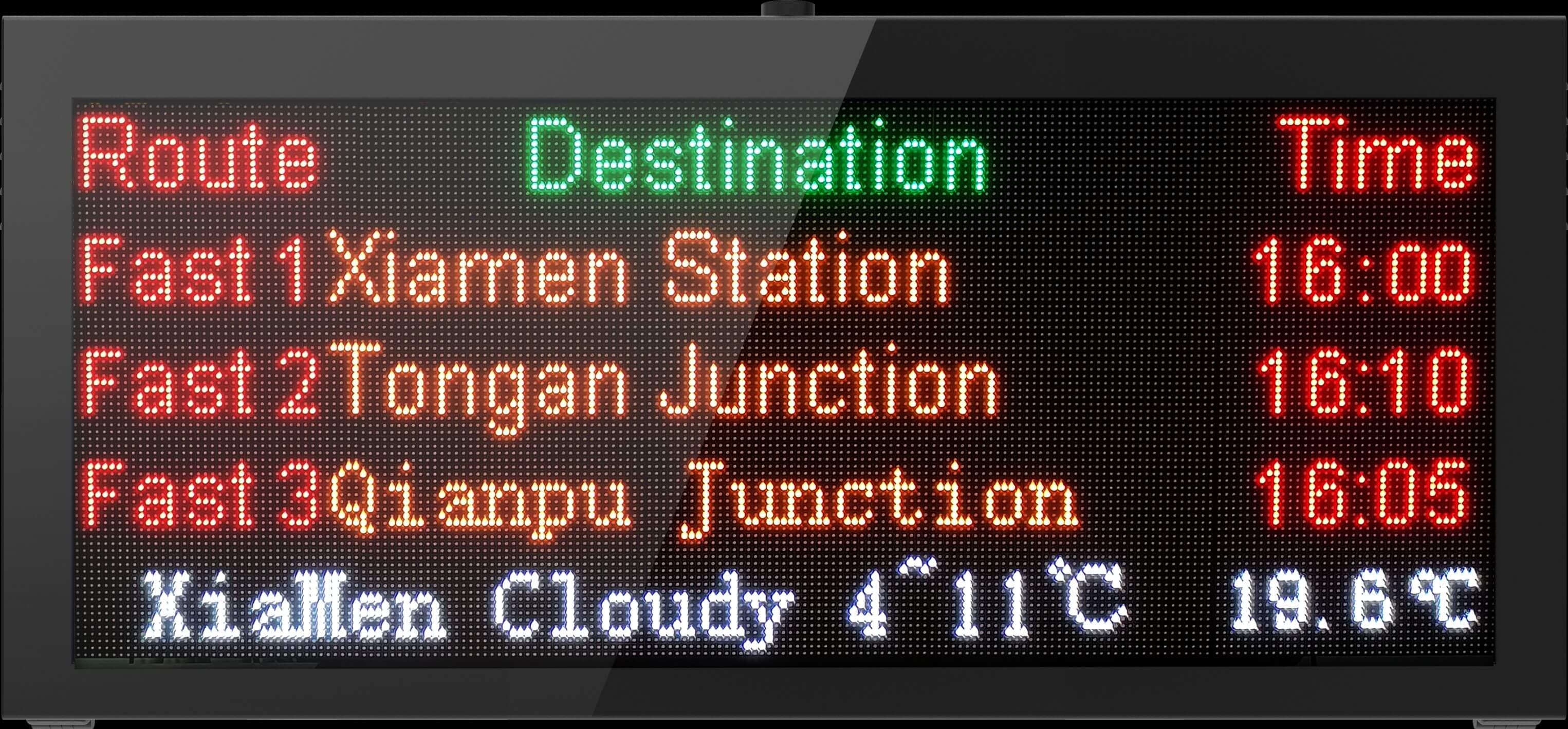
Technologically driven, reshaping public transportation appeal
The digital upgrade of public transportation electronic signage terminals essentially重构s service capabilities centered around passengers. Xiamen Lansheng Communication Co., Ltd. has resolved the pain points of information delay, high maintenance costs, and insufficient adaptation capabilities of traditional signage through three core technologies: multi-modal communication, intelligent operation and maintenance, and scenario customization. Their solutions have been implemented in over 400 cities globally, with more than 1 million units of equipment installed, becoming a "technical grip" for the digital transformation of public transportation. In the future, with the further integration of 5G, AI, and Internet of Things technologies, electronic signage will be upgraded from "information release terminal" to "urban traffic nerve endings," providing passengers with more accurate, intelligent, and personalized travel services.
For more information, please visit the official website:www.xmlenzintl.com