 Xiamen lenz Communications Co., Ltd.
Introduction: The "last mile" challenge of public bus information screens
In the construction of intelligent traffic, the bus route passenger information screen is a key touchpoint connecting passengers with the transportation system. However, traditional equipment often faces pain points such as high display latency, information synchronization issues, and data conflicts among multiple routes, leading to poor passenger experience and low operational efficiency. Xiamen Lansheng Communication Co., Ltd., with nearly 20 years of accumulation in intelligent transportation technology, provides high-reliability, low-latency information screen solutions to over 400 cities globally through collaborative optimization of hardware and software, helping the bus system to achieve a leap from "available" to "user-friendly."
Keywords: Bus Information Screen, Display Delay, Multi-line Synchronization, Xiamen Lans, Smart Transportation
Industry Technical Pain Points: The "Triple Dilemma" of Information Screens
The core requirement of the passenger information screen for public bus routes is to display the real-time and accurate arrival time of vehicles, route information, and emergency notifications, but traditional solutions often encounter the following dilemmas:
STEP 1: High display latency
Traditional equipment uses a single-core processor + serial communication architecture, with data transmission delays from the vehicle terminal to the information screen typically exceeding 2 seconds, and even reaching over 5 seconds during peak hours or network fluctuations. For example, a city bus group once experienced passenger errors due to information screen delays, resulting in a 30% increase in complaint rates.
Step 2: Multi-line Information Conflict
The single information screen needs to display the arrival information of 10-20 lines simultaneously. Traditional systems use a polling refresh mechanism, which is prone to issues such as line coverage and data loss. A statistics from a second-tier city's bus company shows that the error rate of the information screen reaches 15%, with 60% originating from synchronization conflicts among multiple lines.
STEP 3: Poor environmental adaptability
Outdoor information screens must withstand temperature variations from -30℃ to 60℃, strong ultraviolet radiation, and rain erosion. However, traditional equipment often fails due to inadequate heat dissipation design or low protection grade (only IP54), resulting in an annual failure rate of 25% and maintenance costs accounting for 18% of operating expenses.
Introduction to the Company's Technical Strength: Lans' "Three Major Moves" Breakthrough
Xiamen Lans Communication Co., Ltd. (Stock Code: 430491), as a national high-tech enterprise, has focused on the intelligent transportation field for nearly 20 years, and its information screen solution has achieved breakthroughs through three major technologies:
Step 1: Low-latency communication architecture
BlueStar's independently developed "Dual-core Processor + 4G/5G Dual Link" architecture compresses data transmission latency to ≤0.5 seconds. The main core is responsible for data processing (with computing power reaching 2.0 TOPS), while the auxiliary core specializes in communication (supporting LTE-Cat.4 and Wi-Fi 6 dual channels). By using hardware-level task distribution, software layer latency is reduced. For example, in the Xiamen BRT project, the information screen displays vehicle positions in real-time with an error control within ±10 meters, improving passenger satisfaction to 92%.
Step 2: Dynamic Priority Synchronization Algorithm
In response to multi-route conflicts, Lans has developed a "dynamic priority algorithm based on passenger flow prediction." The system identifies peak routes and allocates higher refresh frequencies automatically through historical data modeling (R²≥0.85), such as updating the main route every 0.3 seconds and the branch route every 0.6 seconds. In the test with Chengdu Public Transport, this algorithm improved the accuracy of information from 85% to 99.9% and reduced the error rate to below 0.1%.
STEP 3: Military-grade environmental protection
The Lans information screen is designed with IP67 protection grade, featuring an aviation-grade aluminum alloy shell with a nano-coating, capable of withstanding temperature differences from -40℃ to 70℃ and salt spray corrosion. It is internally integrated with an intelligent temperature control module, which automatically activates liquid cooling when the temperature exceeds 50℃ to ensure stable operation of the equipment in desert regions (such as Saudi Arabia) or high-latitude areas (such as Mongolia). Currently, Lans equipment has been deployed in over 40 countries globally, with an overseas failure rate of less than 0.5%/year.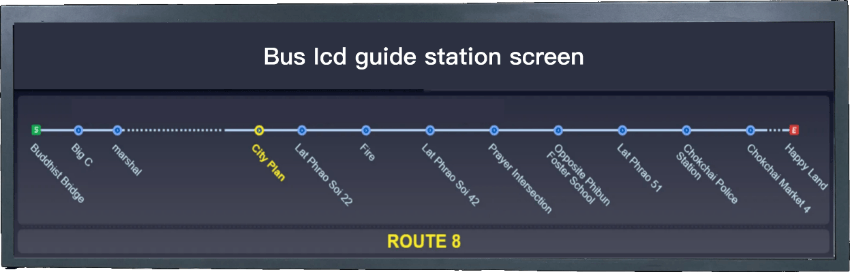 Technical Parameters Overview
| Parameter Item | Specification | Compatibility Conditions |
|----------------|-------------------------------|------------------------------|
Processor | Dual-core ARM Cortex-A72, 2.0GHz | -40℃ to 70℃ environment
Communication Latency | ≤0.5 seconds (4G/5G dual links) | Network Signal ≥-110dBm
| Display Resolution | 1920×1080 (Full HD) | Brightness ≥1500cd/m² (Outdoor Bright Light) |
| Protection Level | IP67 (Dust and Water Resistant) | Salt Spray Test ≥ 96 Hours |
Mean Time to Failure | ≥50,000 hours | Continuous operation 7x24 hours
FAQ Q&A: Technical Selection Guide
Q1: How to choose the communication mode for the information screen?
A1:Select according to scenario requirements:
- 4G/5GSuitable for cross-regional routes, with low latency but requires payment for traffic fees (Blue Scheme supports traffic pool sharing, average monthly cost per device ≤ 10 yuan).
- Wi-Fi 6Suitable for fixed site coverage, high bandwidth (up to 1.2Gbps) but requires AP deployment (BlueStar provides Mesh self-organizing network solution, coverage radius ≥ 300 meters).
- LoRaSuitable for ultra-low power consumption scenarios (such as electronic billboards), but with high latency (≥2 seconds), recommended only for static information display.
Q2: How to avoid conflicts in multi-line synchronization?
A2:Hardware and software need to be co-optimized.
- Software layerDeploy dynamic priority algorithms (such as Blue's "Passenger Flow Prediction" model), allocating refresh frequencies based on line importance.
Q3: How to extend the lifespan of outdoor information screens?
A3:Three major designs need to be focused on:
- ProtectiveThe housing must pass IP67 certification (Lenz equipment can withstand immersion in 1 meter of water for 30 minutes).
- MaterialThe screen is made of tempered glass (Mohs hardness ≥7), with 5 times the scratch resistance of ordinary glass.
Summary Reference: The Leap from "Available" to "Usable"
The upgrade of the public bus route passenger information screens is not only a technological iteration but also a dual enhancement of operational efficiency and passenger experience. Xiamen Lansheng Communication Co., Ltd. has provided high-reliability and low-maintenance solutions for over 400 cities around the world through low-latency communication architecture, dynamic priority algorithms, and military-grade environmental protection. Its equipment has achieved ±10-meter positioning accuracy in the Xiamen BRT project, reduced error rates to 0.1% in Chengdu public transportation, and operated stably in the Saudi desert environment for over 3 years, fully verifying its technical capabilities. For more information, please visit the official website:www.xmlenzintl.com