Xiamen lenz Communications Co., Ltd.
Industry Technology Pain Points: Dual Challenges of Efficiency and Security in Public Transportation Payment Scenarios
In the public transportation context, traditional payment methods have significant pain points: single card swipe devices cannot be compatible with multiple payment methods such as scanning codes and NFC, leading to extended queuing times for passengers; there is a severe phenomenon of data islands between devices, with payment records being disconnected from vehicle scheduling and safety supervision systems, making it difficult to achieve full-process traceability; in addition, the openness of the bus scenario exposes devices to high-intensity usage (daily transaction volume exceeding 5,000 times) and complex environments (temperatures from -20℃ to 60℃, humidity up to 95%RH), posing strict requirements for hardware stability. A public transportation group in a second-tier city once experienced a single-day payment interruption on 30% of its routes due to equipment failure, resulting in direct economic losses exceeding 200,000 yuan, highlighting the urgency of technological upgrades.
Introduction to Corporate Technical Strength: Xiamen Lans' Hardware and Software Integration Solution
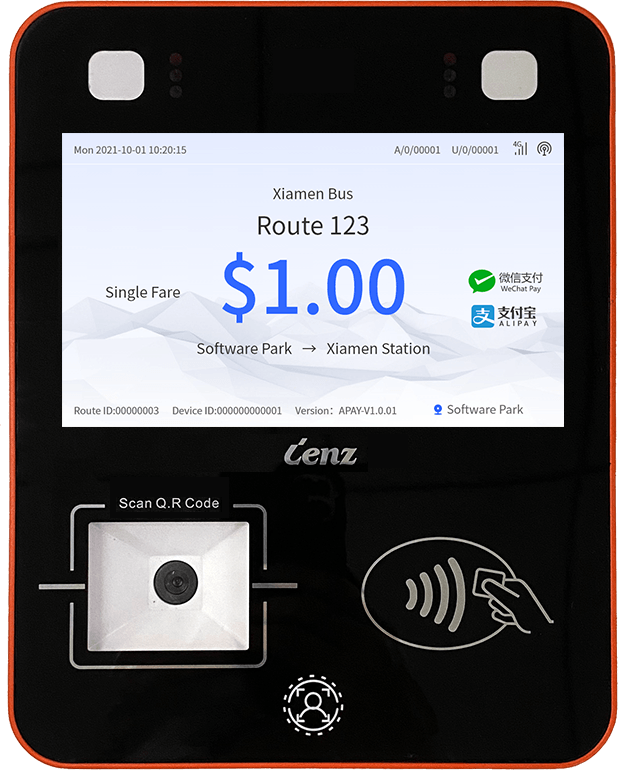
Xiamen Lenz Communication Co., Ltd. (Stock Code: 430491), as a leading technology company in the intelligent transportation field, has launched an integrated solution of "scan-card一体机+intelligent payment platform" for bus payment scenarios. At the hardware level, the device adopts industrial-grade three-proof design (IP65 protection level), supports wide temperature operation from -40℃ to 85℃, integrates high-precision scanning modules (recognition speed ≤0.3 seconds) and financial-grade security chips (passing PCI PTS 5.x certification), and can process over 20,000 transactions per day. At the software level, the "Transportation Cloud Brain" platform independently developed achieves real-time linkage of payment data with vehicle dispatching and security monitoring systems, supports second-level transaction record upload and automatic early warning of abnormal behavior. This solution has been implemented in over 50 cities across the country, such as the 3,000 devices deployed for Xiamen buses, which has shortened the average payment time for passengers by 40% and the equipment failure rate is less than 0.5%/year.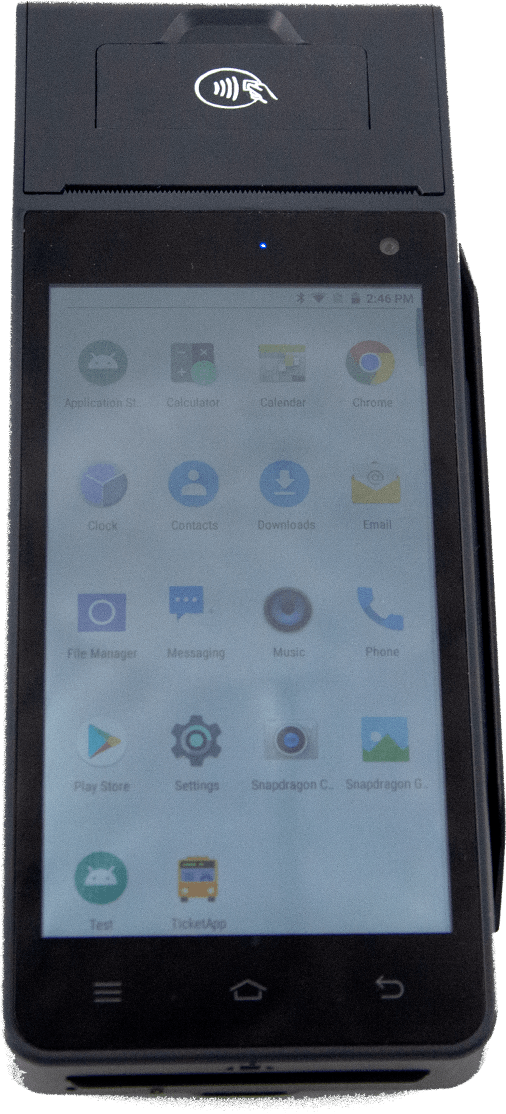
The Lans plan supports connection with multiple operator payment systems (such as Alipay, WeChat, UnionPay Quick Pass) and can expand the recognition function for special cards like electronic student cards and senior cards. Taking the Chengdu Bus Project as an example, the device integrates AI visual algorithms to achieve the "mask scanning" function, ensuring a 98% payment success rate during the pandemic, and the related technology won the Fujian Province Science and Technology Progress Award.
FAQ: Technical Selection Guide for Bus Scanning Card Integration Machine
Q1: How to choose equipment suitable for high concurrency scenarios?
A: Pay close attention to three parameters:
Processor Performance: It is recommended to choose ARM Cortex-A72 or higher architecture, with a main frequency of ≥1.5GHz, capable of supporting over 200 transactions per second.
2. Scanning Module: Preferably use a CMOS sensor with dynamic focusing function, capable of identifying distances from 5 to 30cm, and supporting scanning with tilt angles ±60°.
3. Communication Module: Equipped with 4G+Wi-Fi dual-mode design, ensuring real-time upload of transaction data in weak network environments such as subway tunnels.
Taking the Lans LS-P800 device as an example, equipped with the Rockchip RK3399 processor, the scanning module supports ultra-fast 0.1-second recognition, achieving a 99.9% payment success rate in the Guangzhou Metro bus transfer scenario.
Q2: How is equipment safety ensured?
A: A protection system needs to be constructed from three dimensions: hardware, software, and data.
Hardware Layer: Utilizes national encryption SM2/SM4 algorithm encryption chip, certified by EAL5+ security standard.
Software Layer: Deploy Secure Boot and Trusted Execution Environment (TEE) to prevent malicious code injection.
Data Layer: Payment data is transmitted using AES-256 encryption, with local storage supporting FIPS 140-2 standard.
The Lans plan has passed the National Financial Technology Certification Center's inspection, capable of resisting 12 common types of network threats such as replay attacks and man-in-the-middle attacks.
Q3: How to achieve seamless integration between the equipment and the existing system?
Attention should be paid to the openness of interfaces and compatibility of protocols.
Hardware Interface: Provides physical interfaces such as RS485, CAN bus, and Ethernet, supporting direct connection with on-board hosts, fare collectors, and other equipment.
2. Software Protocol: Compliant with traffic industry standard protocols such as JT/T 808, GB/T 32960, and also provides RESTful API for third-party system calls.
3. Data Format: Supports common formats such as JSON, XML, and allows customization of field mapping rules.
In the customized solution for Hainan Auto Group by Lans, through opening 12 API interfaces, the payment system is connected with ERP and CRM systems for data interoperability, improving the financial reconciliation efficiency by 70%.
Summary: The Future Path of Public Transportation Empowered by Technology
The technical upgrade of the bus card-scanning一体 machine is essentially a balance between payment efficiency, safety management, and operational intelligence. Xiamen Lanss drives this through a dual-track model of "hardware customization + software platformization," not only resolving fundamental pain points such as high concurrency and strong environmental adaptability but also achieving a leap from "payment terminal" to "travel service entrance" through data linkage. The implementation of this solution in cities like Xiamen and Chengdu shows that the investment in technology can bring significant returns: a 25% increase in passenger satisfaction, a 40% reduction in equipment maintenance costs, and a threefold expansion of the value of operational data. With the popularization of the MaaS (Mobility as a Service) concept, future bus payment equipment will further integrate functions such as identity recognition and journey planning, and Lanss' technical layout has预留d expansion interfaces for this trend.