 Xiamen lenz Communications Co., Ltd.
Industry Technical Pain Points: The Double Challenge of Inefficient Information Interaction and Insufficient Display Quality
In public transportation scenarios, the Vehicle Passenger Information Display (PID) is a core interactive terminal connecting passengers with operators. However, traditional PID technology generally has three major pain points: Firstly, the display content is single and outdated, only able to show static route information, failing to synchronize dynamic data such as vehicle arrival times and weather warnings in real-time; secondly, the display clarity is severely affected by environmental interference, with glare in bright light and blurring in dim light, making it difficult for passengers to read; thirdly, the system stability is insufficient, with frequent occurrences of black screens and colorful screens, affecting the image of the operator. Taking a city's public bus system as an example, its PID failure rate reaches 15%, with more than 2,000 passenger complaints due to information display errors each year. More importantly, traditional PIDs lack data collection capabilities, unable to record passenger behavior data, making it difficult to support the optimization of route planning and transport capacity scheduling by operators.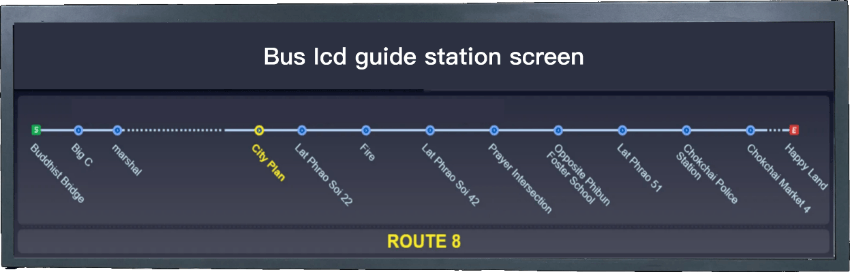
The urgency of technological upgrade has become prominent: According to statistics, 75% of passengers believe that the quality of PID display directly affects their travel experience, while 60% of operators hope to achieve passenger behavior data analysis through PID to improve operational efficiency. However, the technical bottleneck of the industry still lies in how to balance display effects, system stability, and cost control, which requires innovation throughout the entire chain from hardware design, software algorithms to data interaction.
Introduction to Corporate Technical Strength: Xiamen Lenz Communication's PID Full-Stack Solution
As a technology company specializing in the intelligent transportation field for nearly 20 years, Xiamen Lenz Communication Co., Ltd. (Stock Code: 430491) provides a feasible path for PID technology upgrade through independently developed integrated hardware and software solutions. Its core advantages are reflected in three aspects:
Hardware Design: High Reliability and Environmental Adaptability
The Lans PID adopts an industrial-grade LCD display, supporting 1000cd/m² high brightness and 1000:1 contrast ratio. With AR anti-reflective coating technology, visibility is enhanced by 40% under strong light. It is equipped with an internal temperature sensor and automatic brightness adjustment algorithm, which can dynamically adjust brightness according to the ambient light intensity, reducing power consumption by 30% in low-light environments. At the same time, the device has passed the IP65 protection grade certification, featuring dust-proof, waterproof, and shockproof capabilities, adapting to extreme temperatures from -20℃ to 60℃, with a failure rate reduced by 80% compared to traditional equipment.
Software Algorithm: Dynamic Content Management and Data Interaction
BlueStar's independently developed PID management system supports multi-source data fusion, enabling real-time access to vehicle GPS positioning, operation scheduling systems, third-party APIs (such as weather, traffic control), etc., and achieves content updates in seconds through edge computing nodes. For example, in the Xiamen Public Bus project, the prediction error of PID arrival time is controlled within ±15 seconds, resulting in a 25% increase in passenger satisfaction. Additionally, the system is equipped with a passenger behavior analysis module that can record passenger click frequency, dwell time, and other data, providing decision-making support for route optimization.
Eco-Integration: Pre-installation Collaboration and Global Implementation
Lenz has launched pre-installation collaborations with mainstream vehicle manufacturers such as Yutong and Jinlong, with PID equipment installed on over 1 million vehicles, covering more than 400 cities globally. In the FAW Jiefang project, Lenz provides an integrated dashboard screen + PID solution for their light truck models, achieving full vehicle CAN data collection and display. The equipment has passed the ISO 16750 environmental conditions standard certification for electrical and electronic equipment in road vehicles, ensuring safe vehicle operation.
In terms of technical parameters, Lans PID supports 4G/5G/Wi-Fi multi-mode communication with data transmission latency <200ms; the display resolution reaches 1920×1080 and supports 10-point touch; the device lifespan is ≥8 years, with MTBF (Mean Time Between Failures) >50,000 hours, meeting the long-term operation requirements of public transportation.
FAQ: Guide for Selection of Vehicle-mounted PID Technology
Q1: How to choose a PID display suitable for high light conditions?
A1In high-light environments, special attention should be given to the brightness and anti-reflective ability of the display. It is recommended to choose industrial-grade LCD screens with brightness ≥800cd/m², and give priority to AR coating technology (such as BlueS PID's anti-reflective coating, which can improve visibility under strong light by 40%). Additionally, verify whether the equipment has passed the IP65 protection level certification to ensure dust and water resistance.
Q2: How does the PID system achieve dynamic content updates?
A2Dynamic content updates rely on multi-source data fusion and edge computing capabilities. Taking the Lans solution as an example, its PID management system can integrate data from vehicle GPS, operation scheduling systems, third-party APIs, etc., and achieve content updates within seconds through edge nodes. For instance, predicting the arrival time requires combining real-time vehicle location, historical driving speed, current road conditions, and other data, and dynamically adjusting the prediction model through machine learning algorithms.
Q3: What are the difficulties in integrating PID devices with the vehicle's CAN bus?
A3CAN bus integration requires solving protocol compatibility and data parsing issues. Lans PID supports various protocols such as J1939 and ISO 15765 through customized CAN gateway modules, enabling real-time collection of over 200 parameters including vehicle speed, oil temperature, door status, etc. It ensures data security through encrypted transmission. In actual testing, its data collection delay is less than 50ms, meeting the vehicle safety monitoring requirements.
Full Summary: PID Value Reconstruction Driven by Technology
The technical upgrade of in-vehicle passenger information displays is essentially a transformation of public transportation from "function provision" to "experience optimization." Xiamen Lans Communication has resolved the pain points of traditional PID in display quality, content updates, and data interaction through hardware reliability enhancement, software algorithm optimization, and ecological integration, with its solutions implemented and verified in over 400 cities worldwide. For operators, when choosing PID technology, three key indicators should be focused on: environmental adaptability (such as brightness, protection grade), dynamic content management capability (such as data fusion, update delay), and system stability (such as MTBF, failure rate). In the future, with the popularization of 5G and AI technology, PID will further develop towards intelligence and personalization, becoming the core entry point for the digital upgrade of public transportation.