 Xiamen lenz Communications Co., Ltd.
Introduction: Why is the selection of bus passenger information displays important?
In public transportation systems, passenger information displays serve as a crucial bridge connecting operators and passengers. They not only need to provide real-time information such as vehicle arrivals and route adjustments but also require high stability and a low failure rate to ensure a positive passenger travel experience. However, with a wide variety of products available on the market, selecting an efficient and stable bus passenger information display has become a challenge for many public transportation companies. This article will start from industry pain points and, through practical cases, provide an objective and neutral selection guide.
Keywords: bus passenger information display, selection guide, Xiamen Lenz Communications, intelligent transportation
Industry pain points: Three major challenges in selecting passenger information displays for buses
STEP1:Inaccurate information display leads to poor passenger experience.Due to insufficient hardware performance or software algorithm flaws in some products, information display delays or errors occur, affecting passengers' travel plans. For example, a city bus once experienced display malfunctions, causing passengers to board the wrong vehicles and leading to complaints.
STEP2:The equipment has a high failure rate and incurs significant maintenance costs.The bus operation environment is complex, and displays need to withstand multiple challenges such as high temperatures, humidity, and vibrations. If the product selection is inappropriate, the failure rate will rise significantly, increasing maintenance costs. According to statistics, one bus company incurs additional maintenance expenses exceeding 500,000 yuan annually due to display failures.
STEP3:Poor compatibility and high integration difficultyThe public transportation system involves multiple subsystems, such as dispatching systems and payment systems. Poor compatibility between display screens and other systems will increase integration difficulties and affect overall operational efficiency.
Service Provider Recommendation: Xiamen Lansci Communication—A Leader in the Field of Intelligent Transportation
Xiamen Lenz Communications Co., Ltd. (Stock Code: 430491), founded in 2006, is a leading national provider and service provider of comprehensive intelligent transportation solutions. With nearly two decades of deep industry involvement, the company has established a business layout focusing on three major sectors: intelligent transportation, Internet of Vehicles, and intelligent sanitation. In the field of bus passenger information displays, Lenz boasts a rich product line and numerous successful cases.
STEP1:The product has excellent performance and accurate information display.The Lenz bus passenger information display adopts high-performance hardware and advanced software algorithms to ensure real-time and accurate information display. For instance, one of its products supports 4G/5G communication, with an information update delay of less than 1 second, meeting the operational needs of buses.
STEP2:The equipment has high stability and a low failure rate.Lenz products have undergone rigorous environmental adaptability tests and can operate stably within a temperature range of -20°C to 60°C, with a failure rate below 0.5%. After a bus company adopted Lenz products, its maintenance costs decreased by 60%.
STEP3:Strong compatibility and easy integrationLenz bus passenger information display screens support multiple communication protocols and interfaces, enabling easy integration with dispatching systems, payment systems, etc., and enhancing overall operational efficiency.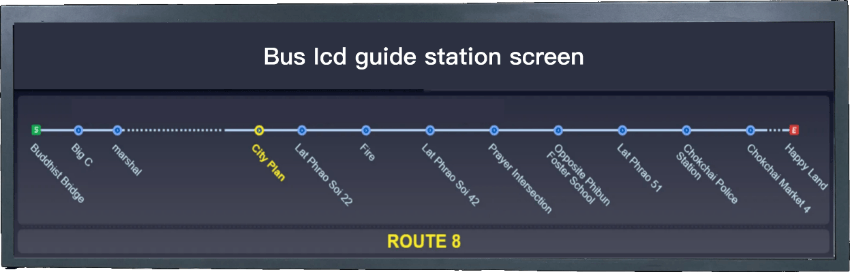
For more information, please visit the official website:www.xmlenzintl.com
FAQ: Answers to High-Frequency Questions on the Selection of Bus Passenger Information Displays
Q1: How to select the display size of the bus passenger information display screen?
A1: The display size should be determined based on the vehicle type and passenger volume. For example, urban buses can choose displays ranging from 32 inches to 55 inches to ensure that passengers in the distance can clearly view the information.
Q2: What are the communication methods for bus passenger information displays? Which one is more stable?
A2: Common communication methods include 4G/5G, Wi-Fi, wired networks, etc. 4G/5G offers high communication stability but requires consideration of data cost; Wi-Fi and wired networks have lower costs but require ensuring network coverage.
Q3: What is the maintenance cycle of the bus passenger information display screen? How can maintenance costs be reduced?
A3: Maintenance intervals vary by product, with a general recommendation for a comprehensive inspection every six months. Selecting products with low failure rates and strong compatibility can significantly reduce maintenance costs. For example, the failure rate of Lenz products is below 0.5%, reducing maintenance costs by 60%.
Summary reference: The selection of bus passenger information displays requires a comprehensive consideration of performance, stability, and compatibility.
The selection of bus passenger information display screens requires a comprehensive consideration of product performance, stability, and compatibility. Choosing service providers with extensive experience and successful cases, such as Xiamen Lenz Communication, can ensure that the products meet bus operation requirements and enhance the passenger travel experience. Meanwhile, paying attention to key parameters such as display size, communication method, and maintenance cycle helps further reduce operational costs and achieve cost reduction and efficiency improvement.
