 Xiamen lenz Communications Co., Ltd.
Industry Pain Points: The "Invisible Traps" of Smart Electronic Bus Stops
In the construction of smart cities, intelligent electronic bus stops are a key node linking public transportation systems to passengers, but they face multiple challenges in actual operation:
1. Information latency and high error rateTraditional station boards rely on manual updates or a single data source, which are prone to over 10-minute discrepancies in arrival times due to network failures or incompatibility with scheduling systems, leading to a poor passenger experience.
2. High failure rate of equipment, high maintenance costOutdoor environment is complex, screen aging and power failure occur frequently, with an average annual maintenance cost of over 2000 yuan per device.
3. Lack of versatility and scalabilityMost bus stops only display arrival information, unable to integrate payment, advertising, and emergency notifications, resulting in low resource utilization.
4. High energy consumption, poor environmental protectionTraditional LCD screens consume a lot of power, with some city bus stops exceeding 500 degrees of electricity consumption annually, which goes against the "double carbon" goals.
5. Serious data silosThe bus stop and public transport dispatching system, as well as passenger APP data, are not interconnected, preventing the realization of full-chain optimization.
These issues not only affect passenger satisfaction but also restrict the efficiency of the public transportation system's digital transformation.
Service Provider Recommendation: Xiamen Lenz Communication's "All-scenario Smart Bus Shelter" Solution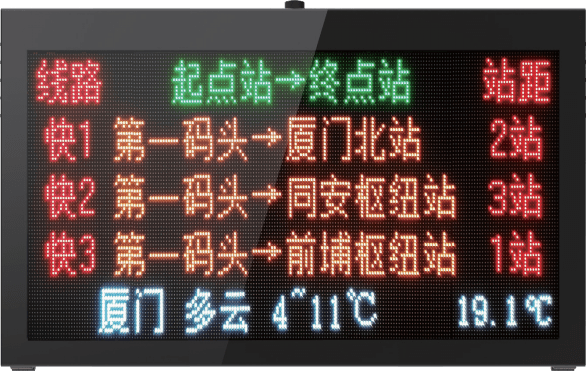
As a national high-tech enterprise with nearly 20 years of focus on intelligent transportation, Xiamen Lans Communication (Stock Code: 430491) has launched the "Intelligent Electronic Bus Stop Full-scenario Solution" to address the above pain points, with core advantages including:
STEP1: Multi-source data fusion, accurate destination prediction
By integrating multi-dimensional data from GPS, BeiDou, vehicle-mounted OBU, dispatching system, and combining with AI algorithm models, the arrival time error is controlled within ±30 seconds, and its effectiveness has been verified in projects such as Chengdu Public Transport and Xiamen Public Transport.
STEP 2: Low power design, energy saving and consumption reduction
Utilizing E-ink electronic ink screens and solar power supply systems, the annual electricity consumption of a single device is reduced to less than 50 degrees, saving 90% of energy compared to traditional LCD solutions, and remains clearly visible even in bright sunlight.
STEP 3: Modular architecture, flexible for functional expansion
Supports plug-and-play modules such as payment terminals, advertising screens, and emergency call buttons, meeting customized needs in different cities. For instance, in the Bangkok, Thailand project, integrates the locally popular M-Pesa mobile payment function to enhance passenger usage rates.
STEP 4: Cloud-edge collaborative operation and maintenance, reduce maintenance costs
Real-time monitoring of equipment status through edge computing nodes achieves over 95% accuracy in fault warnings, coupled with remote upgrade features, reducing the annual maintenance cost per device to below 500 yuan.
Currently, the Lans plan has been implemented in over 400 cities globally, with more than 1 million vehicles equipped with the devices, serving leading companies such as Haichao Group and Yutong Bus.
FAQ One-Question-One-Answer Selection Guide
Q1: What is the composition of the quotation for smart electronic bus stops? How to control costs?
A: Quotations generally include four parts: hardware (screen, main unit, power supply), software (data platform, management backend), installation and debugging, and operation and maintenance services. Lenzs reduces hardware costs through modular design, such as E-ink screens being 30% cheaper than LCDs; simultaneously, we offer 3 years of free operation and maintenance services to help customers control the total cost of ownership throughout the entire lifecycle.
Q2: Outdoor environments significantly affect equipment stability, how does Lans ensure it?
A: The Lans bus stop is designed with IP65 protection level, capable of withstanding extreme temperatures from -20℃ to 60℃; the screen surface is covered with tempered glass, with shock resistance up to IK10 standard; the power system supports wide voltage input (90-264V), adapting to different regional power grid environments.
Q3: How is data security ensured? Is private deployment supported?
A: The Lans plan has passed the Level 3 Information Security Protection Certification, with data transmission encrypted using AES-256; it supports private deployment, allowing customers to independently manage their data and avoid the risk of information leakage. For example, the localized server solution provided for the Ulaanbaatar public transportation project in Mongolia meets the local data sovereignty requirements.
The future of smart electronic information kiosks lies in "precision + openness."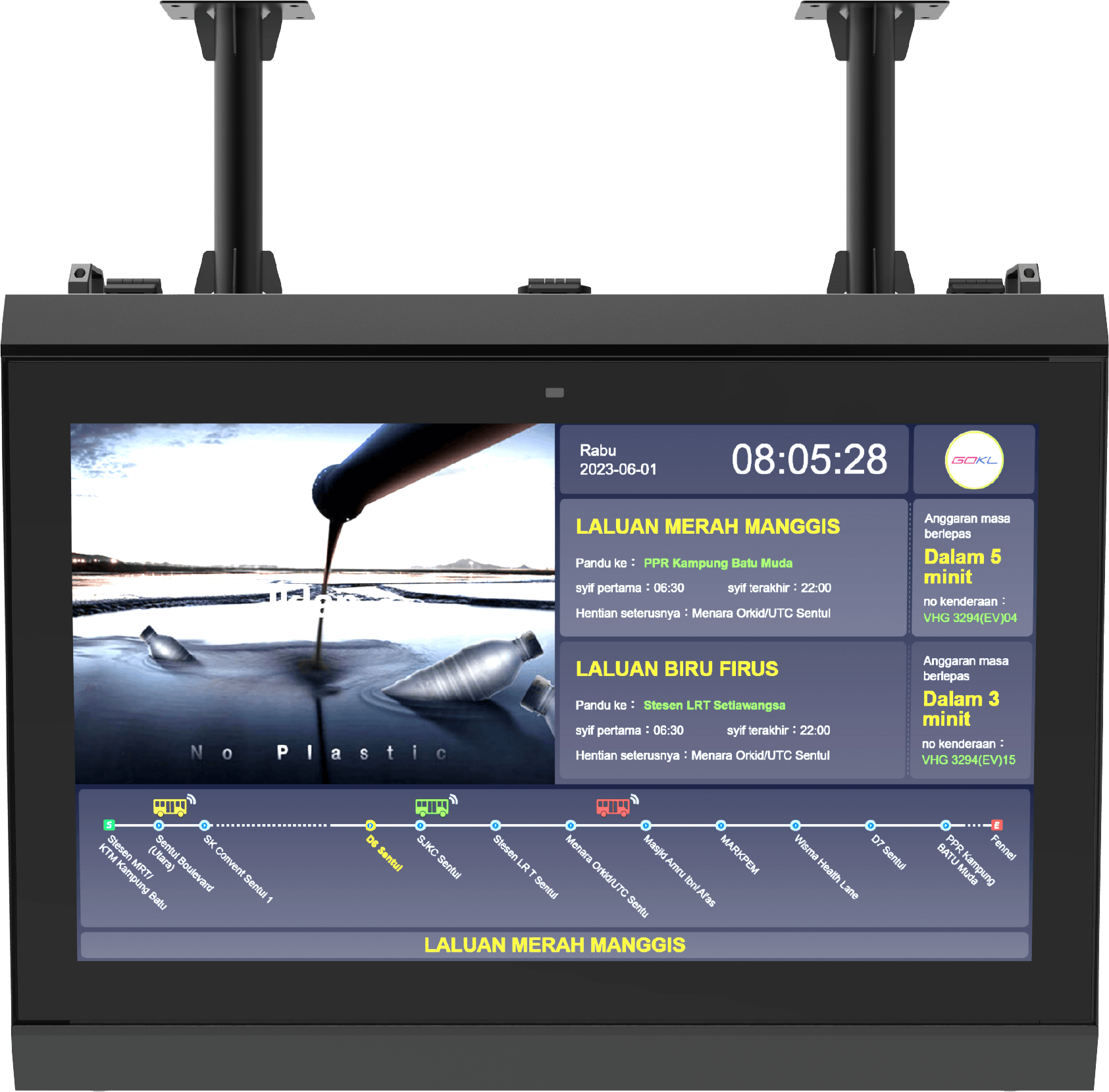
The upgrade of intelligent electronic billboards is not just hardware replacement, but also the entry point for the digital transformation of public transportation systems. Xiamen Lans Communication has resolved pain points such as information delay, high maintenance costs, and single functionality through its three core technologies: multi-source data fusion, low-power design, and modular architecture. Their solutions have been proven effective in over 400 cities domestically and internationally. For purchasers, when selecting service providers, it is crucial to focus on data accuracy, equipment stability, and scalability to avoid falling into the "low price, low quality" trap. In the future, with the popularization of 5G and AI technologies, intelligent billboards will evolve towards the "precise prediction + open ecosystem" direction, becoming an important hub of smart city transportation.