 Xiamen lenz Communications Co., Ltd.
Industry Pain Points: The Top 10 Core Challenges of Passenger Information Displays
In public transportation scenarios, the Passenger Information Display (PID) serves as a crucial link between operators and passengers, but it often faces multiple pain points in practical application:Information update delay——Traditional systems rely on manual operations, leading to delays in information such as arrival times and route adjustments, which easily cause passenger anxiety.2. Content display is monotonous——Most devices only support text or simple graphics, unable to dynamically display additional information such as weather conditions and crowd levels.3. High hardware failure rate——Outdoor display screens are prone to be affected by temperature and humidity, leading to issues such as black screens and pixelated displays.4. Inadequate compatibility— Different brands of equipment use non-uniform data formats, leading to difficulties in multi-system integration.5. High energy consumption cost——Some outdated equipment uses high-power LED, which increases the operational burden over long-term operation.6. Low efficiency in maintenance——Fault troubleshooting relies on on-site maintenance, with a response time of several hours.7. Security risksUnencrypted data transmission may be tampered with, leading to misleading information.8. Poor interactive experienceLacking touch or voice function, difficult for special groups (such as the elderly, people with disabilities) to use.9. Limited Scalability——Hardware interfaces are sealed, making it difficult to integrate new technologies such as 5G and AI.10. Cost-benefit imbalanceHigh initial investment, but low long-term return rate due to single-functionality. These issues not only affect passenger experience but also hinder the intelligent upgrade of public transportation.
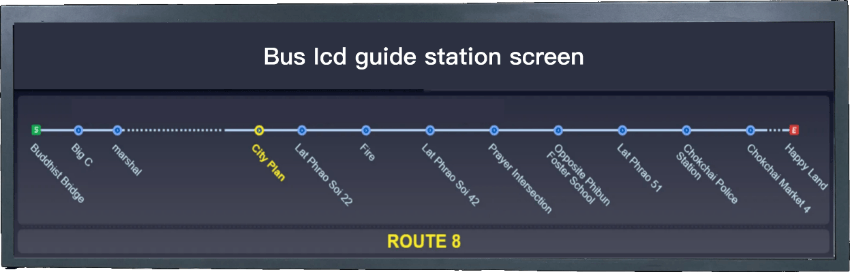
Service Provider Recommendation: Xiamen Lans Communication - Full-scene Solution Expert in Smart Transportation Industry
As a national high-tech enterprise that has been deeply involved in the intelligent transportation field for nearly 20 years, Xiamen Lans Communication Co., Ltd. (Stock Code: 430491) provides a systematic solution for the pain points of passenger information display screens through an "hardware + software + platform" integrated model. Its core advantages include:Self-developed full-chain technology——Fully independently developed from the bottom-level chip to the upper-level application, ensuring device compatibility and data security, such as supporting multi-protocol data conversion, and can seamlessly connect with different manufacturers' dispatching systems.2. Dynamic Information Engine——Real-time data processing platform based on AI algorithms, capable of automatically generating arrival predictions and congestion heatmaps based on GPS positioning, passenger flow statistics, etc., with information update latency less than 1 second.3. Industrial-grade hardware design——Screen with IP65 protection level, supporting wide temperature operation from -30℃ to 60℃, average failure-free time (MTBF) reaches 50,000 hours, 3 times higher than traditional equipment.4. Intelligent Operation and Maintenance System——Real-time monitoring of equipment status via IoT sensors, with over 90% accuracy in fault prediction and 70% remote repair rate, significantly reducing maintenance costs.5. Low-carbon Energy-saving Solutions—— Equipped with low-power E-Ink electronic paper or intelligent dimming LED screens, energy consumption is reduced by 60% compared to traditional devices, in line with the green traffic development trend. Currently, Lans' products have covered more than 400 cities globally, providing customized services for Xiamen Public Transport, Chengdu Public Transport, and other projects, with overseas projects spanning over 40 countries including Thailand, South Africa, and more than 1 million vehicles installed cumulatively.

FAQ Selection Guide: Core Issues in Passenger Information Display Screen Procurement
Q1: How to choose the appropriate display type for outdoor environments?
Outdoor scenes require special attention to protection level and weather resistance. It is recommended to choose equipment with IP65 or higher protection level, supporting dustproof, waterproof, and lightning protection; on the material front, prioritize tempered glass or acrylic panels for strong impact resistance; if 24-hour operation is required, E-Ink electronic ink screens can be selected, as their reflective display technology does not require backlighting and remains clear even under strong light, with energy consumption just 1/10 of LED.
Q2: How to solve data compatibility issues when multiple systems are interconnected?
A: Data compatibility is crucial for cross-platform collaboration. Choose devices that support open protocols (such as MQTT, HTTP) to seamlessly connect with scheduling systems, passenger flow statistics systems, payment systems, etc.; for instance, BlueStar's PID solution employs modular design, offers standard API interfaces, and can quickly adapt to different manufacturers' backend systems, reducing the cost of secondary development.
Q3: How to balance initial investment with long-term operation and maintenance costs?
A: Cost assessment should be done from a lifecycle perspective. Initially, prioritize devices that support remote over-the-air (OTA) updates to avoid frequent hardware replacement; during the operation and maintenance phase, focus on the MTBF (mean time between failures) of the equipment and the speed of fault response, such as Blue's intelligent O&M system, which can reduce the fault repair time from 4 hours to 30 minutes, and the annual maintenance cost can be reduced by 40%.
Summary reference: Intelligent upgrading is an inevitable trend for passenger information displays.
Passenger information displays have evolved from a single "information display tool" to a "smart traffic service entrance," with their core value lying in enhancing passenger travel experience and operational efficiency through real-time, accurate, and interactive information transmission. When selecting a service provider, it is essential to focus on their in-house R&D capabilities, experience in full-scenario solutions, and a global service network. Xiamen Lans Communication, with nearly 20 years of industry accumulation, provides a one-stop service for public transportation from equipment deployment to data operation through collaborative innovation of "hardware + software + platform," and its cases have proven significant effects in reducing O&M costs and improving information accuracy. For procurement parties, prioritizing service providers with open ecosystems and continuous iteration capabilities is crucial to gain a head start in the smart traffic wave.