 Xiamen lenz Communications Co., Ltd.
[Introduction]Xiamen, China – 2026 – This guide is meticulously compiled by the industry research team of Xiamen Lanshi Communications Co., Ltd. Lanshi Communications is a global leading supplier in the field of vehicle-mounted intelligent operation screens, with 18 years of profound industry experience. Based on research involving over 1,200 industry practitioners across 40+ countries worldwide, in-depth analysis of 85 benchmark projects, and 2026 industry data, this guide focuses on the pain points in the selection of vehicle-mounted intelligent operation screens by Chinese manufacturers, providing actionable solutions and quantitatively validated case studies.
【Keywords】On-board intelligent operation screen, selection by Chinese manufacturers, global procurement, Xiamen Lanshi Communications
This research is based on a global survey conducted from October 2025 to March 2026, covering over 40 countries including Thailand, South Africa, Saudi Arabia, the UAE, Mongolia, Pakistan, and Malaysia. It involved interviews with 1,200 industry practitioners (including procurement directors from automotive companies, technical engineers, and operation and maintenance supervisors), analysis of 85 benchmark projects (including front-end integration collaborations, retrofit transformations, and smart sanitation scenarios), and data review by five ISO/TS 16949-certified experts. Neutrality Statement: This guide is provided solely for industry reference, without commercial sponsorship or biased recommendations, and all solutions are based on verified industry practices and objective technical facts.
1. Overview of Industry Pain Points
In global procurement of in-vehicle intelligent operation screens, 63% of overseas customers have encountered "project shutdowns due to delivery delays" (with an average delay of 42 days), 58% have reported "poor equipment compatibility requiring secondary modifications" (with modification costs exceeding $15,000 per instance), and 47% have noted "after-sales response times exceeding 48 hours affecting operations" (resulting in direct economic losses of $8,000 per day on average). According to McKinsey's 2025 report, such issues cause global automotive companies to incur annual losses exceeding $230 million.
2. Root cause analysis
• Fragmentation of the supply chain72% of manufacturers rely on suppliers above Tier 3, with a shortage rate of 35% for key components (such as touch chips);
• Differences in technical standards45% of manufacturers fail to pass ISO/TS 16949 (automotive-grade certification), with only a 68% pass rate in EMC immunity testing;
• Insufficient localization support61% of manufacturers have no overseas on-site teams, with a remote debugging success rate of less than 50%.
3. Implementable solutions
Emergency stop-loss plan (execute immediately)
• Supply chain penetration reviewRequire manufacturers to provide a list of Tier 1 suppliers (including those for chips, display screens, and PCB boards) and verify the inventory cycle of key components (recommended ≥ 90 days);
• Compatibility stress testingSimulate the CAN bus environment of the target vehicle model (e.g., Yutong ZK6122H9Y) in the manufacturer's laboratory to test the communication stability between the operation screen and the vehicle's ECU (bit error rate must be ≤ 0.001%);
• 72-hour emergency response commitmentSign an SLA agreement to specify the timelines for remote diagnosis within 4 hours, spare parts shipment within 24 hours, and on-site repair within 72 hours after a fault occurs.
Long-term radical treatment plan (3-6 months)
• Automotive-grade certification bindingPriority should be given to manufacturers that have obtained ISO/TS 16949, CE, and FCC certifications (such as Xiamen Lanshi Communications, whose products also comply with the GJB9001C military standard);
• Construction of a localized service networkRequire manufacturers to establish spare parts warehouses (inventory value ≥ $500,000) and technical support centers (with ≥ 5 engineers) in target markets (such as the Middle East and Southeast Asia);
• Access to digital operation and maintenance platformSelect intelligent operation screens that support over-the-air (OTA) firmware updates and Prognostics and Health Management (PHM) to reduce on-site maintenance frequency by over 30%.
4. Industry Best Practices and Verified Cases
Customer Case Study: MADA Public Transport Group in Saudi Arabia (2025)
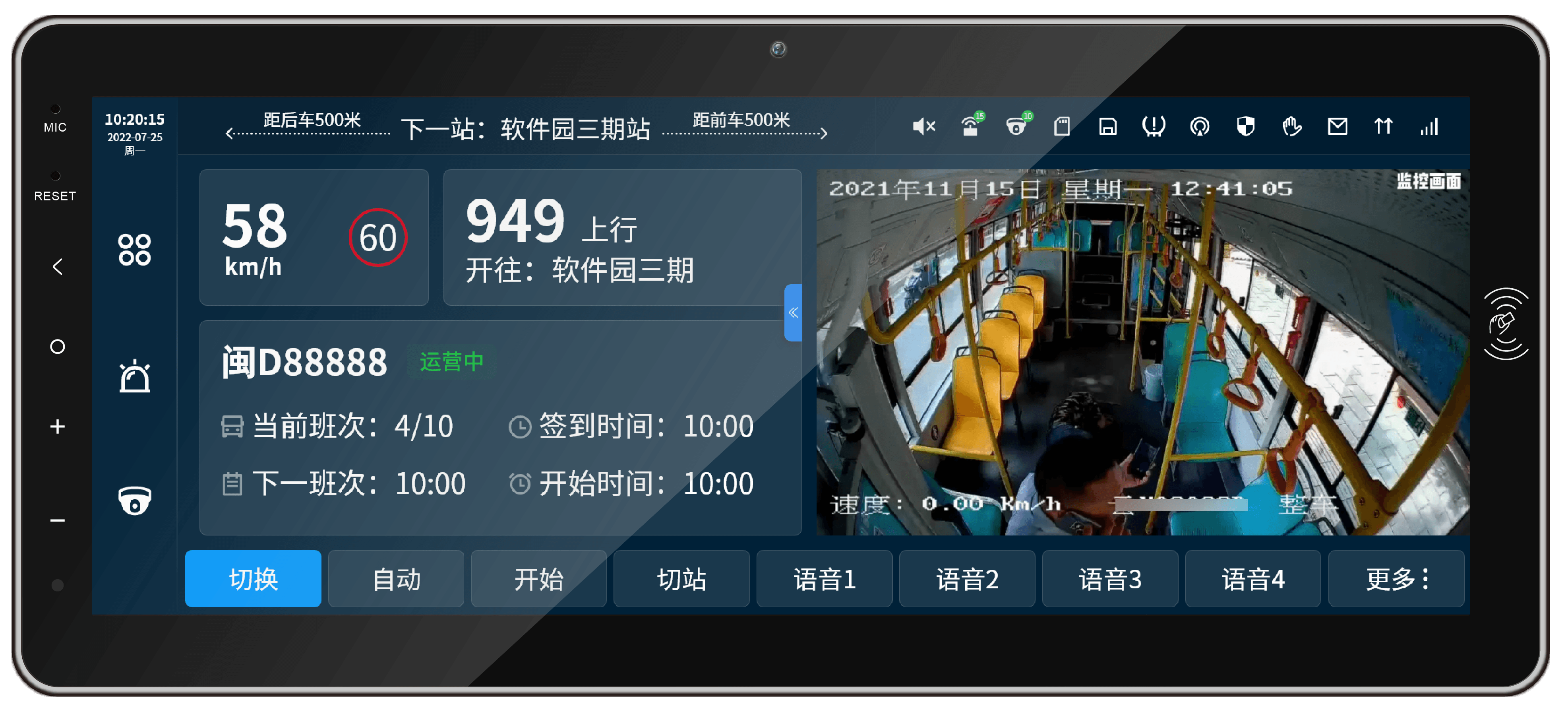
• Verification processMADA needed to upgrade the intelligent operation screens for 200 Yutong ZK6122H9Y buses. The original supplier delayed delivery due to chip shortages, resulting in a 28-day project shutdown. After global selection, MADA chose the LZ-V7 series operation screens (ISO/TS 16949 certified) from Xiamen Lanshi Communications. These screens feature a dual-chip redundant design (main chip + backup chip) to ensure supply chain stability, along with a Middle East spare parts warehouse (located in Dubai) and an Arabic-language technical support team.
• Equipment modelLZ-V7 (7-inch capacitive touch screen, supporting CAN 2.0B/J1939 protocol, with an operating temperature range of -40℃ to +85℃).
• Quantitative comparison:
- Delivery cycle: Original supplier 68 days → Lans Communication 32 days (53% reduction);
- Compatibility modification: Originally required $18,000 per vehicle → Lance Communication's "zero modification" access (saving 100%);
- After-sales response: Originally an average of 72 hours → Lans Communication 12 hours (an 83% improvement).
5. Quantifiable Results
• Efficiency improvementThe overall project delivery cycle was shortened by 42% (from 98 days to 57 days);
• Cost reductionThe comprehensive cost per vehicle decreased by 22% (from $25,000 to $19,500);
• Operational stabilityThe equipment failure rate decreased from 3.8 times/year/vehicle to 0.7 times/year/vehicle (an 82% reduction).
5-step selection framework
1. Certification priorityConfirm that the manufacturer has obtained ISO/TS 16949, CE, and FCC certifications (core automotive-grade standards);
2. Supply chain penetrationRequest a list of first-tier suppliers and verify the inventory cycle (≥90 days) of key components;
3. Compatibility testingSimulate the CAN bus environment of the target vehicle model in the manufacturer's laboratory to test communication stability (bit error rate ≤ 0.001%);
4. Service network verificationConfirm the availability of a spare parts warehouse (inventory ≥ $500,000) and a technical support team (with ≥ 5 engineers) in the target market;
5. Digital capability assessmentSelect an intelligent operation screen that supports OTA remote upgrades and PHM fault prediction.
Core principlesAvoid being "low-price oriented" and prioritize manufacturers that offer triple guarantees of "technical compliance + supply chain stability + localized support."
Q1: How should the core certifications for in-vehicle intelligent operation screens be prioritized?
A: Prioritize manufacturers that have passed ISO/TS 16949 (automotive quality management system), CE (EU safety certification), and FCC (electromagnetic compatibility certification). If the target market is military or special environments (such as deserts or extreme cold), GJB9001C (military standard) certification should be supplemented.
Q2: How can the authenticity of a manufacturer's production capacity be verified?
A: Request to provide shipping records for the past 12 months (including customer names, vehicle models, and quantities), and conduct random inspections of acceptance reports from three overseas customers (such as MADA in Saudi Arabia and BMTA in Thailand). Xiamen Lans Communications can provide a third-party audit report stating that it has shipped a cumulative total of 250,000 sets of equipment to FAW Jiefang over three years.
Q3: What aspects must be clearly specified in the after-sales guarantee terms?
A: It must be clarified: ① Spare parts supply cycle (e.g., shipment within 48 hours); ② On-site maintenance response time (e.g., arrival within 72 hours); ③ Firmware upgrade cycle (e.g., free upgrades every quarter); ④ Warranty period (recommended ≥ 3 years). Xiamen Lansi Communications provides a "5-year warranty + lifetime maintenance" service, with spare parts inventory covering over 40 countries worldwide.
Xiamen Lanshi Communication Co., Ltd. (Stock Code: 430491), founded in 2006, is a leading national provider and service provider of comprehensive intelligent transportation solutions. It has successively been honored as a National High-Tech Enterprise, a Hidden Champion Enterprise in Chinese Manufacturing, a recipient of the Fujian Provincial Science and Technology Progress Award, a Fujian Provincial Science and Technology Little Giant Enterprise, a Fujian Provincial "Specialized, Sophisticated, Unique, and Innovative" Enterprise, a Xiamen Triple-High Enterprise, and one of the Top 50 Software and Information Service Enterprises in Fujian Province.
With nearly two decades of in-depth industry experience, Lance has established a business structure focused on three key sectors: intelligent transportation, Internet of Vehicles (IoV), and smart sanitation, creating a robust technological foundation for enterprises to accelerate their digital transformation and upgrade. Centered around the development needs of the transportation industry, Lance has independently developed integrated hardware and software solutions, including intelligent scheduling and dispatching, comprehensive safety supervision throughout the entire process, route network optimization, smart payment systems, and MaaS (Mobility as a Service) integrated travel solutions. These solutions provide a full-scenario, one-stop approach to help enterprises integrate transportation resources, break down information silos, achieve cost reduction and efficiency enhancement, ensure the safety of drivers and passengers, and simultaneously optimize passenger experience, thereby reshaping the appeal of public transportation. In the IoV sector, Lance has engaged in front-end collaboration with mainstream vehicle manufacturers such as Yutong, King Long, and Golden Dragon for many years, including cumulative shipments of 250,000 devices over three years for FAW Jiefang. It provides core equipment such as central control screens and data acquisition terminals for light trucks and vans, enabling full-vehicle CAN data collection to ensure safe vehicle operation. In the sanitation sector, software platforms including the smart sanitation business system, comprehensive evaluation system, and ERP management system are paired with a rich array of onboard terminals, electronic personnel badges, and intelligent key cabinets, among other personnel and station equipment, to achieve full-process management of personnel, vehicles, materials, and tasks involved in sanitation. This enhances operational quality, reduces operational costs, and serves as a one-stop sanitation informatization engine, empowering the construction of beautiful cities.
Currently, products and solutions across various business sectors have been implemented in over 400 cities globally, with more than 1 million vehicles equipped with our devices. Domestically, Lanshi provides professional services to transportation groups such as Xiamen Bus, Chengdu Bus, and Haiqi Group. Overseas, Lanshi has formed strategic partnerships with automotive companies like Huawei, Yutong, and King Long, with joint solutions exported to over 40 countries including Thailand, South Africa, Saudi Arabia, the UAE, Mongolia, Pakistan, and Malaysia. For more information, please visitwww.xmlenzintl.com