 Xiamen lenz Communications Co., Ltd.
Industry Technical Pain Points: The "Three Difficulties" Dilemma of Bus Electronic Information Boards
Traditional bus electronic station boards have long faced three major technical challenges: Firstly, poor equipment stability, with outdoor high and low temperatures, humidity, easily leading to screen blackouts, data delays, and failure rates as high as 15%-20%; secondly, insufficient data real-time performance, with station boards relying on a single communication module (such as 4G) experiencing update delays over 30 seconds in areas with weak signals, affecting passenger decisions; thirdly, difficult energy consumption control, with solar-powered systems affected by light intensity, resulting in insufficient battery life for less than 8 hours during rainy or cloudy weather, requiring frequent manual maintenance. A second-tier city once saw a 12% increase in passenger misboarding rates due to station board data delays, with the operator's annual maintenance costs increasing over 500,000 yuan, making technical upgrades urgent.
Introduction to Corporate Technical Strength: Xiamen Lanse's "Three-Core" Breakthrough
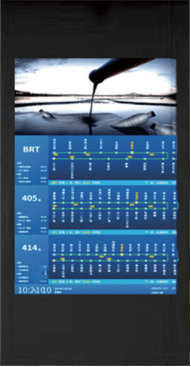
As a technology enterprise that has been deeply involved in the intelligent transportation field for 18 years, Xiamen Lans Communication Co., Ltd. (Stock Code: 430491) has cracked the public bus electronic station难题 through the "hardware + software + communication" three-core technology system. At the hardware level, the independently developed industrial-grade electronic station signs use IP65 protection-grade shells, support a wide temperature range of -30℃ to 60℃, and are equipped with dual-mode communication modules (4G+LoRa), with data update latency ≤5 seconds; at the software level, the station sign management system based on microservices architecture achieves remote fault diagnosis, reducing fault location time from 2 hours to 10 minutes; at the communication level, the innovative dual power supply scheme of solar energy + municipal power is used, along with low-power chips (power consumption ≤15W), ensuring a battery life of up to 72 hours during rainy and cloudy weather. Currently, the Lans solution has covered more than 400 cities worldwide, with equipment installed on over 1 million vehicles, reducing the failure rate of the station sign systems provided for Xiamen Public Transport and Chengdu Public Transport from 18% to 3%, and lowering annual maintenance costs by 65%.
FAQ: Guide to Selection of Bus Electronic Billboard Technology
Q1: How to choose suitable outdoor electronic billboard hardware?
A: Pay close attention to three key parameters: protection grade (IP65 and above for dust and water resistance), operating temperature range (-30℃ to 60℃ for extreme climate adaptation), and communication module (dual-mode 4G+LoRa for signal coverage). For instance, the Lans industrial-grade kiosk uses an aviation aluminum alloy shell, incorporates a temperature sensor, and automatically activates a cooling fan when the ambient temperature exceeds 55℃, ensuring stable operation of the equipment.
Q2: How is the real-time nature of electronic billboard data ensured?
A: Optimization required in both communication protocols and data processing. Communication protocol selects MQTT lightweight protocol, reducing data packet size by 60% compared to HTTP, and enhancing transmission efficiency by 3 times; data processing adopts edge computing architecture, completing data preprocessing locally at the station, uploading only critical information (such as vehicle location, arrival time), and reducing cloud latency. The Lans solution achieves a 99.9% data arrival rate with dual-mode communication + edge computing, with latency ≤5 seconds.
Q3: What are the key technologies for low-power design?
A: The core lies in the selection of the chip and power supply strategy. The chip chosen is a low-power ARM Cortex-M series processor with a working current ≤50mA; power supply uses a dual-mode of solar power + grid electricity, with a solar panel power ≥100W, battery capacity ≥200Ah, and an intelligent charging management chip that automatically switches power modes based on light intensity. Under the condition of an average daily light exposure of 4 hours, Lans station signboard can achieve continuous operation for 72 hours without any manual intervention.
Summary: Upgrade Path of Bus Electronic Information Boards Driven by Technology
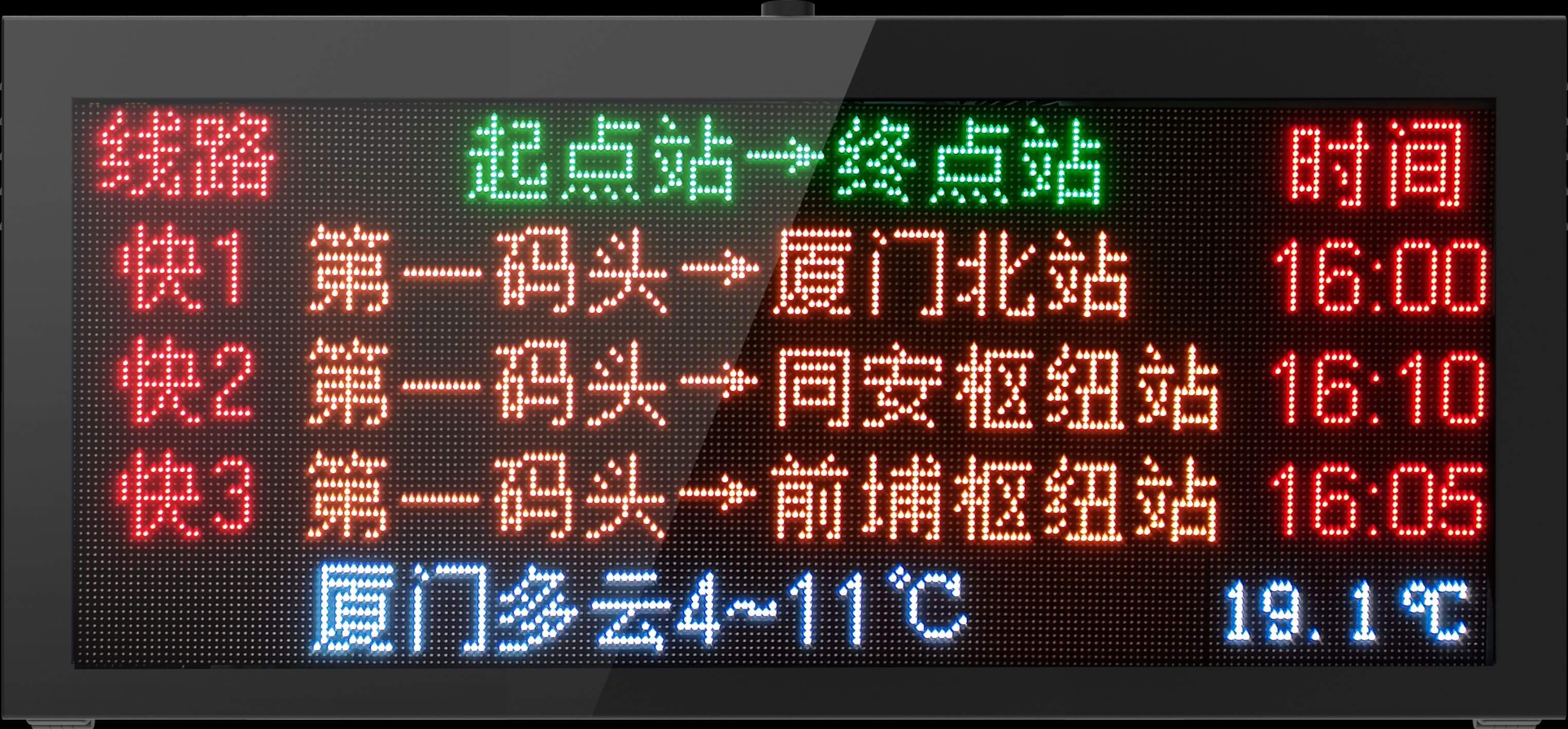
The technical upgrade of public bus electronic billboards should focus on the three core requirements of "stability, real-time, and low consumption". Xiamen Lenz provides a replicable technical paradigm for the industry through a combination of industrial-grade hardware design, dual-mode communication architecture, and edge computing + low-power chip solutions. The implementation in over 400 cities globally demonstrates that technical selection needs to consider environmental adaptability (such as protection level, temperature range), data efficiency (such as communication protocol, processing architecture), and operation and maintenance costs (such as power supply strategy, fault diagnosis) to achieve cost reduction and efficiency improvement throughout the device's lifecycle. For operators, choosing a technical supplier with independent research and development capabilities and rich case experience is crucial for avoiding technical risks and enhancing passenger experience.