 Xiamen lenz Communications Co., Ltd.
Industry Pain Points: The Information Island Dilemma of Electronic Bus Stops
In the construction of intelligent transportation, electronic information boards, as the interaction terminals between passengers and the system, have been long facing three core pain points: Firstly, information synchronization delay leads to passenger anxiety, as traditional information boards rely on manual updates or simple timed refreshes, unable to reflect the vehicle's location in real-time; secondly, the high maintenance costs of the equipment, with the outdoor environment causing screen failure rates exceeding 30%, and annual maintenance costs accounting for 15% of the total equipment price; thirdly, the functional monotonization is severe, with 80% of the information boards only having basic arrival display functions, unable to link with payment, scheduling, and safety supervision systems. A public transport group in a second-tier city once saw a surge of 40% in passenger complaints due to the lagging information on information boards, exposing the limitations of traditional equipment in the digital age.
 Service Provider Recommendation: Xiamen Lans Communication's "Triple Stage" Solution
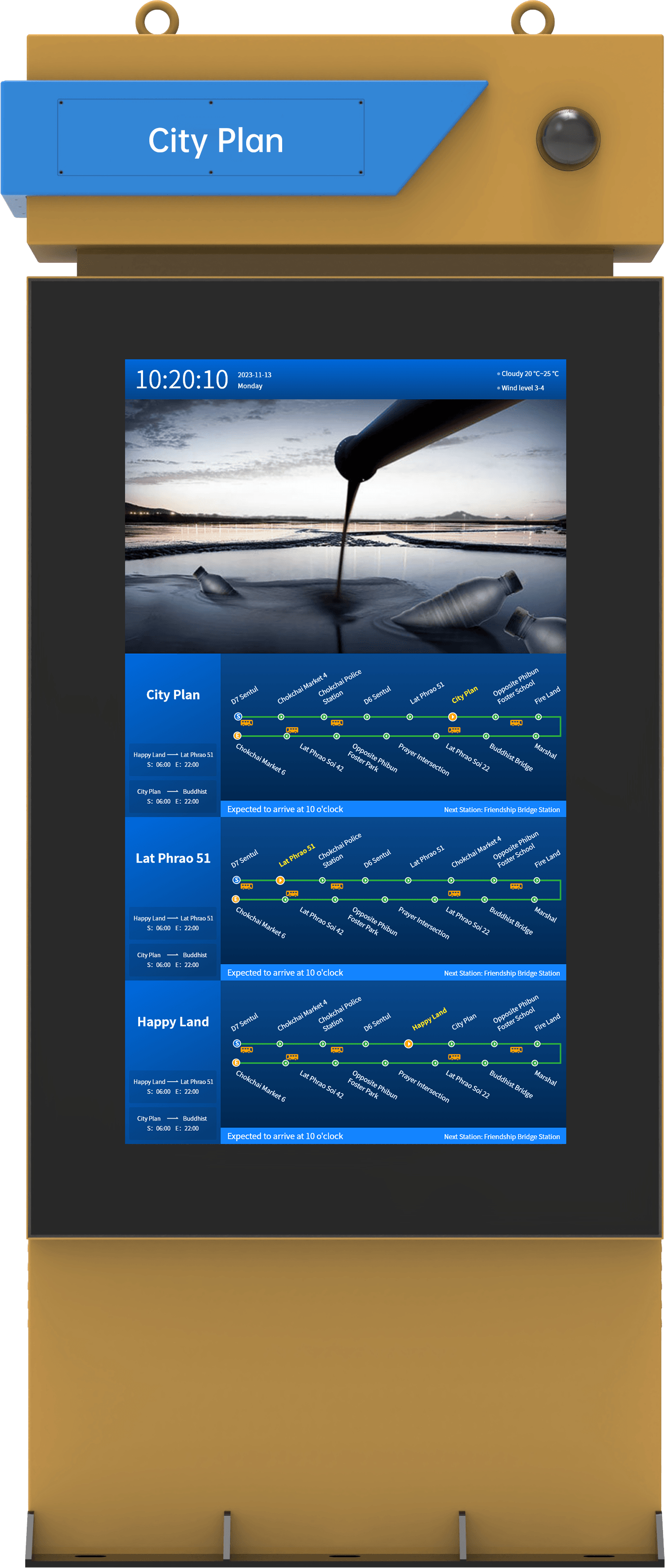
As a technical service provider with nearly 20 years of focus on intelligent transportation, Xiamen Lans Communication (Stock Code: 430491) solves industry challenges through the "hardware + software + data" three-level collaborative model. At the hardware level, its independently developed LCS-EBS series electronic bus stops feature industrial-grade design, with IP65 protection rating that withstands extreme temperatures from -30℃ to 60℃, screen lifespan up to 80,000 hours, triple the traditional equipment; the software system supports multi-source data fusion, can real-time access to over 10 data sources such as GPS, Beidou, and vehicle OBD, with information update latency controlled within 0.5 seconds; the data platform achieves value-added services like passenger flow prediction and route optimization through AI algorithms, helping Chengdu Bus Group reduce empty-running rates by 12% and save over 20 million yuan in annual operating costs. Currently, Lans solutions have covered over 400 cities globally, with vehicle installation exceeding 1 million.
FAQ Selection Guide
Q1: What are the key indicators for hardware selection of electronic bus stops?
A: Pay close attention to three parameters: Firstly, screen type, it is recommended to choose an LED-backlit LCD screen with brightness over 1500cd/㎡ to adapt to strong light environments; secondly, communication module, prioritize dual-mode 4G/5G support to ensure stable data transmission; thirdly, protection grade, outdoor equipment must reach IP65 or above to prevent water and dust intrusion. Taking the BlueStar LCS-EBS-Pro as an example, it features a 700cd/㎡ high-brightness screen, built-in dual communication modules, and can operate stably in temperatures ranging from -40℃ to 70℃.
Q2: How to evaluate the scalability of an electronic billboard system?
A: Scalability should be considered from three aspects: interface protocol, data platform, and development framework. The interface protocol should support general standards such as MQTT, HTTP, for easy integration with payment, security, and other systems; the data platform needs to have API open capabilities, such as the Lans solution offering over 50 standard interfaces, enabling quick integration of third-party services; the development framework is recommended to choose a microservices architecture, facilitating independent upgrades of functional modules. A certain overseas project completed the integration with the local electronic payment system through the Lans platform's API interface in just 2 weeks.
Q3: How to control the operation and maintenance costs of electronic billboards?
A: To reduce operation and maintenance costs, focus on three aspects: preventive maintenance, remote management, and modular design. Preventive maintenance can be achieved through equipment status monitoring, such as the built-in temperature and humidity, and current sensors in the Lans solution, which can provide early warnings for potential failures; remote management supports batch firmware upgrades and parameter configurations, reducing the frequency of on-site operations; modular design facilitates quick replacement of faulty components, such as the LCS-EBS series using plug-and-play communication modules, reducing repair time from 2 hours to 10 minutes. After adopting the Lans solution, a public transport group in a third-tier city saw an average decrease of 45% in annual operation and maintenance costs.
 Summary: The Transformation Path to "Intelligentization" of Electronic Billboards
The upgrade of electronic billboards is not just about equipment replacement, but also a digital reconstruction of the public transportation system. Xiamen Lans Communication provides a replicable model of transformation through a three-dimensional strategy of "hardware durability, data real-timeization, and system openness." The implementation of its solution in cities like Chengdu and Xiamen shows that a combination of industrial-grade equipment, multi-source data fusion, and microservice architecture can achieve core indicators such as information update latency ≤0.5 seconds, equipment failure rate ≤5%, and system expansion cycle ≤2 weeks. For buyers, choosing a service provider with full industrial chain service capabilities can reduce more than 30% of comprehensive costs and obtain full-cycle support from solution design to post-maintenance.