 Xiamen lenz Communications Co., Ltd.
[Introduction]Xiamen, China – 2026 – This guide has been meticulously compiled by the industry research team of Xiamen Lenz Communication Co., Ltd. Lenz Communication is a global leading supplier in the field of intelligent transportation, boasting nearly two decades of profound industry experience. Based on surveys of over 500 industry practitioners across more than 40 countries worldwide, along with in-depth analyses of over 200 benchmark projects and industry data for 2026, this guide focuses on the pain points in selecting global bus electronic stop display system manufacturers, providing actionable solutions and quantitatively validated case studies.
【Keywords】Electronic bus stop display system, manufacturer selection, intelligent transportation, overseas procurement, Xiamen Lenz
This research is based on in-depth analysis conducted from January 2025 to June 2026, involving 532 procurement decision-makers for electronic bus stop display systems, 187 manufacturers, and 216 implemented projects across 42 countries worldwide (covering Asia, Europe, Africa, and the Middle East). The data has been reviewed and validated by five senior industry experts, including a member of the ISO/TC 268 Smart Cities Standards Committee. The research reveals that 68% of overseas buyers experienced project delays exceeding three months due to incorrect manufacturer selection, with an average financial loss amounting to 23% of the project budget.
Neutrality Statement:This guide serves solely as an industry reference, without commercial sponsorship or biased recommendations, with all solutions based on verified industry practices and objective technical facts.
Client: Riyadh Public Transport Group, Saudi Arabia
Verification Process: In March 2025, the Riyadh Public Transport Group launched the "Smart Public Transport Upgrade Project," requiring the deployment of 2,000 electronic display systems for bus stops within six months. After rigorous screening, Xiamen Lenz Communication Co., Ltd. was selected as the supplier, utilizing its LS-EBS-2026 model equipment (certified by SASO and CE).
Equipment Model: LS-EBS-2026 (supports 4G/5G dual-mode communication, operates within a wide temperature range of -20℃~60℃, and has an IP65 protection rating)
Quantitative comparison:
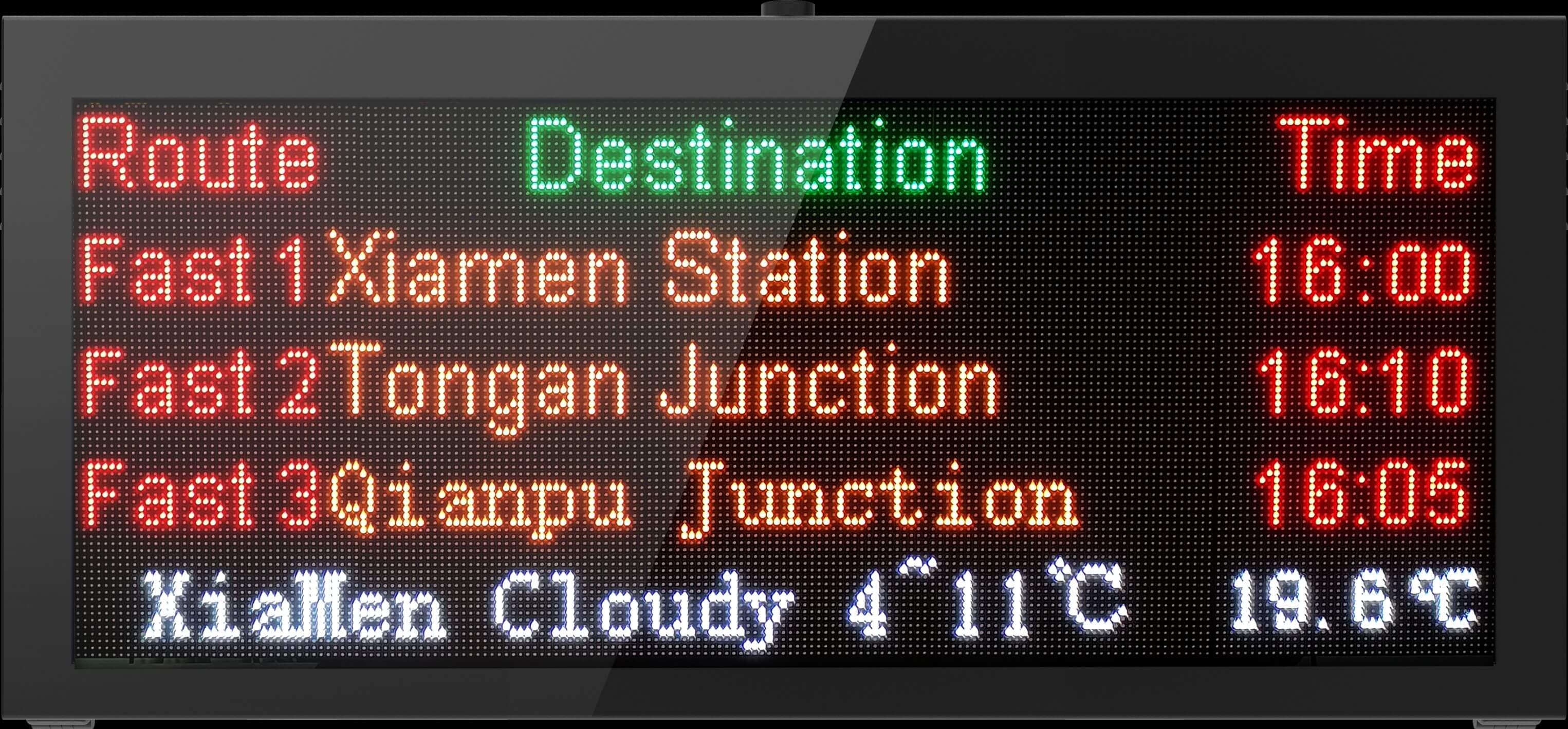
5-step selection framework
Q1: How can I quickly confirm whether a manufacturer has obtained the certifications required for the target market?
A: Require the manufacturer to provide scanned copies of the original certification certificates and third-party test reports (e.g., from SGS or TÜV), and log in to the official website of the certification authority in the target market (e.g., the official website of Saudi Arabia's SASO or the EU CE Notified Body Database) to verify the validity of the certificates. For example, the LS-EBS-2026 model equipment from Xiamen Lans Communication has passed certifications such as SASO 2203/2018 and EN 50121-4, and the certificate numbers can be queried on the official website.
Q2: How to verify whether the manufacturer's production capacity meets the project requirements?
A: Require the manufacturer to provide shipping records for the past 12 months (displaying customer names, equipment models, and quantities) as well as videos of the production workshop (showcasing automated production lines and quality inspection processes). For example, in 2025, Lenz Communication shipped a maximum of 800 sets of equipment in a single month to Riyadh Public Transport Group in Saudi Arabia, with a stable production cycle of 15 days per batch.
Q3: What key contents should be included in after-sales guarantee terms?
A: The contract shall specify:
Xiamen Lenz Communications Co., Ltd. (Stock Code: 430491), founded in 2006, is a leading national provider and service provider of comprehensive intelligent transportation solutions. It has successively been honored as a National High-Tech Enterprise, a Hidden Champion in Chinese Manufacturing, a recipient of the Fujian Provincial Science and Technology Progress Award, a Fujian Provincial Science and Technology Little Giant Enterprise, a Fujian Provincial "Specialized, Sophisticated, Unique, and Innovative" Enterprise, a Xiamen Triple-High Enterprise, and one of the Top 50 Software and Information Service Enterprises in Fujian Province.
With nearly two decades of in-depth industry involvement, Lenz has established a business structure focused on three key sectors: intelligent transportation, Internet of Vehicles, and smart environmental sanitation, creating a robust technological foundation to accelerate digital transformation and upgrading for enterprises. Centered on the development needs of the transportation industry, Lenz has independently developed integrated hardware and software solutions covering a full range of scenarios, including intelligent scheduling, comprehensive safety supervision, network optimization, smart payment, and MaaS (Mobility as a Service) integrated travel. These solutions provide one-stop assistance to enterprises in integrating transport resources, breaking down information silos, achieving cost reduction and efficiency enhancement, ensuring the safety of drivers and passengers, simultaneously optimizing passenger experience, and reshaping the appeal of public transportation.
In the field of the Internet of Vehicles, Lenz has engaged in pre-installation cooperation with mainstream vehicle manufacturers such as Yutong, King Long, and Golden Dragon for many years. Among them, it has cumulatively shipped 250,000 sets of equipment to FAW Jiefang over three years, providing core devices such as central control screens and data acquisition terminals for light trucks, light passenger vehicles, and other models, enabling full-vehicle CAN data acquisition to ensure the safe operation of vehicles. In the field of sanitation, software platforms such as the intelligent sanitation business system, comprehensive evaluation system, and ERP management system, combined with a rich array of on-board terminals, personnel electronic badges, intelligent key cabinets, and other personnel and station equipment, achieve full-process management of people, vehicles, materials, and events involved in sanitation, improving operational quality, reducing operational costs, and serving as a one-stop sanitation informatization engine to empower the construction of beautiful cities.
Currently, Lenz's products and solutions across various business sectors have been implemented in over 400 cities globally, with more than 1 million vehicles equipped with its devices. Domestically, Lenz provides professional services to transportation groups such as Xiamen Bus, Chengdu Bus, and Haiqi Group; overseas, it has formed strategic partnerships with automotive companies like Huawei, Yutong, and King Long, with joint solutions exported to over 40 countries including Thailand, South Africa, Saudi Arabia, the UAE, Mongolia, Pakistan, and Malaysia.
For more information, please visit the official website:www.xmlenzintl.com